Researched and drafted with AI assistance, fact-checked by our editorial team before publishing. This guide synthesizes manufacturer specifications, independent lab results, and verified buyer reviews from multiple sources. We have not conducted hands-on testing of these products ourselves. How we review → · Affiliate disclosure →
Reviewed by the Trusted Buyer Report Editorial Team · Updated July 1, 2026
TL;DR — Best Portable Chargers 2026
- Best overall for daily carry: Anker Nano Power Bank (30W) — built-in USB-C cable, 10,000mAh, compact
- Best budget pick: Iniu Pawsible P41L-E2 — matched the Anker in real-world iPhone charging tests, costs less
- Best multi-device: Wirecutter's top-ranked 10,000mAh pick — 45W USB-C + USB-A + built-in holster cable
- Best for backpacking: Nitecore NB10000 Gen 4 — ultralight champion with over a decade of field-test validation
- Best rugged/outdoor: Nimble CHAMP Pro — survived a full summer of outdoor abuse across two kids
- Best high-capacity: UGreen 25,000mAh — percent-display LCD, dual USB-C, frequent discounts for Prime members
Your phone is at 12% and your flight boards in 40 minutes. The nearest outlet has a line. You have a power bank in your bag — but is it the right one?
This guide gives you the answer before that moment arrives. The top-tested models of 2026 are ranked side by side below, followed by the technical context that explains why each pick lands where it does. No filler, no vague superlatives — just a decision framework built around how you actually use your devices.
How this guide was researched: We synthesized independent lab tests, buyer feedback, and specialist field research from sources including CNN Underscored, Wirecutter, GearJunkie, Adventure Alan, Libratel, and community threads on r/batteries. We have not personally tested these products. Every claim links to its source.
Head-to-Head Comparison: Top Portable Chargers of 2026
| Model | Capacity | Max Output | Ports | Built-in Cable | Best For |
|---|---|---|---|---|---|
| Anker Nano Power Bank (30W) | 10,000mAh | 30W | USB-C + USB-A | Yes (USB-C) | Daily commuters |
| Iniu Pawsible P41L-E2 | 10,000mAh | 30W | USB-C + USB-A | Yes (USB-C) | Budget buyers |
| Wirecutter Top Pick (unnamed) | 10,000mAh | 45W USB-C | 2× USB-C + USB-A | Yes (holster USB-C) | Up to 3 devices |
| Anker MagGo A1657 | 10,000mAh | Varies | USB-C + wireless pad | Yes (USB-C) | Wireless charging users |
| UGreen 25,000mAh | 25,000mAh | High (multi-port) | 2× USB-C + USB-A | No | Multi-device & laptop top-ups |
| Nimble CHAMP Pro | 20,000mAh | 65W per output | Dual output | No | Outdoor/rugged use |
| Nitecore NB10000 Gen 4 | 10,000mAh | Moderate | USB-C | No | Ultralight backpacking |
| Anker Prime 20,100mAh | 20,100mAh | High | Multi-port | No | Value at mid-range price |
One important note on "best overall": it genuinely depends on your context. A city commuter charging one phone needs something very different from a thru-hiker six days from the nearest outlet. The sections below match each use case to the right pick.
The Most Common Buying Mistake: Chasing mAh Without Thinking About Weight
Here's the trap most buyers fall into: they maximize the mAh number on the label without asking whether they'll actually carry the thing.
A 26,800mAh power bank sitting on your desk because it's too heavy to bring along delivers exactly zero value. The useful metric is the capacity you'll reliably have with you — not the capacity listed on the box.
There's also a math problem with mAh labels. As Libratel's power bank guide explains, a bank's rated capacity is measured at its internal voltage (around 3.7V), but your phone charges at 5V or higher. That voltage conversion loses energy — meaning a 10,000mAh bank realistically delivers around 7,000–8,000mAh of usable charge to your phone, not 10,000mAh. Plan for roughly two full charges of a modern smartphone, not three or four.
Adventure Alan, whose portable charger analysis draws on over a decade of field research, frames the selection principle clearly: power-to-weight ratio is the north star. The goal is the lightest bank with enough practical mAh for your actual usage pattern — not the most mAh available at any weight.
Three buyer tiers help clarify the right capacity range:
- Light user — One phone charge per day, predictable outlet access. A 5,000–10,000mAh compact bank covers you.
- Moderate user — Two devices, heavier phone use (streaming, navigation), occasional day trips. A 10,000–20,000mAh bank handles most scenarios.
- Heavy user — Aging phone battery, constant video recording, GPS apps running all day, or cold-weather trips where all battery devices passively lose charge faster. Adventure Alan specifically recommends moving up at least one capacity tier beyond what the math alone suggests.
That last point about cold weather is worth underscoring. Lithium-ion batteries lose output capacity in sub-freezing temperatures — both the power bank itself and the devices it's charging. If you're heading into winter conditions, the capacity you calculated at room temperature is not what you'll have on the trail.
Fast Charging Explained: Why Wattage Is Only Half the Story
Fast charging is not a single universal standard. Here's the core rule, as GearJunkie puts it plainly: a system only charges as fast as its weakest link. Your phone, your power bank, and your cable each have their own wattage ceiling. If any one of them is rated below the others, it caps the entire chain.
Libratel breaks down the practical tiers:
- 10W (5V/2A): Standard speed — functional but noticeably slow by current benchmarks.
- 18W: Fast charging for most Android phones.
- 20W+: Fast charging for iPhones and newer Android devices.
- 30W+: Capable of partially charging tablets and some laptops, though full laptop compatibility depends on the model's power requirements.
The Wirecutter top pick offers concrete benchmarks worth using as a reference point: its USB-C ports deliver 27W input / 45W output, while its USB-A port delivers 22.5W output. That USB-A figure is notably high — most power banks cap out at 18W on USB-A — which matters if you're still using older devices or cables that connect via USB-A.
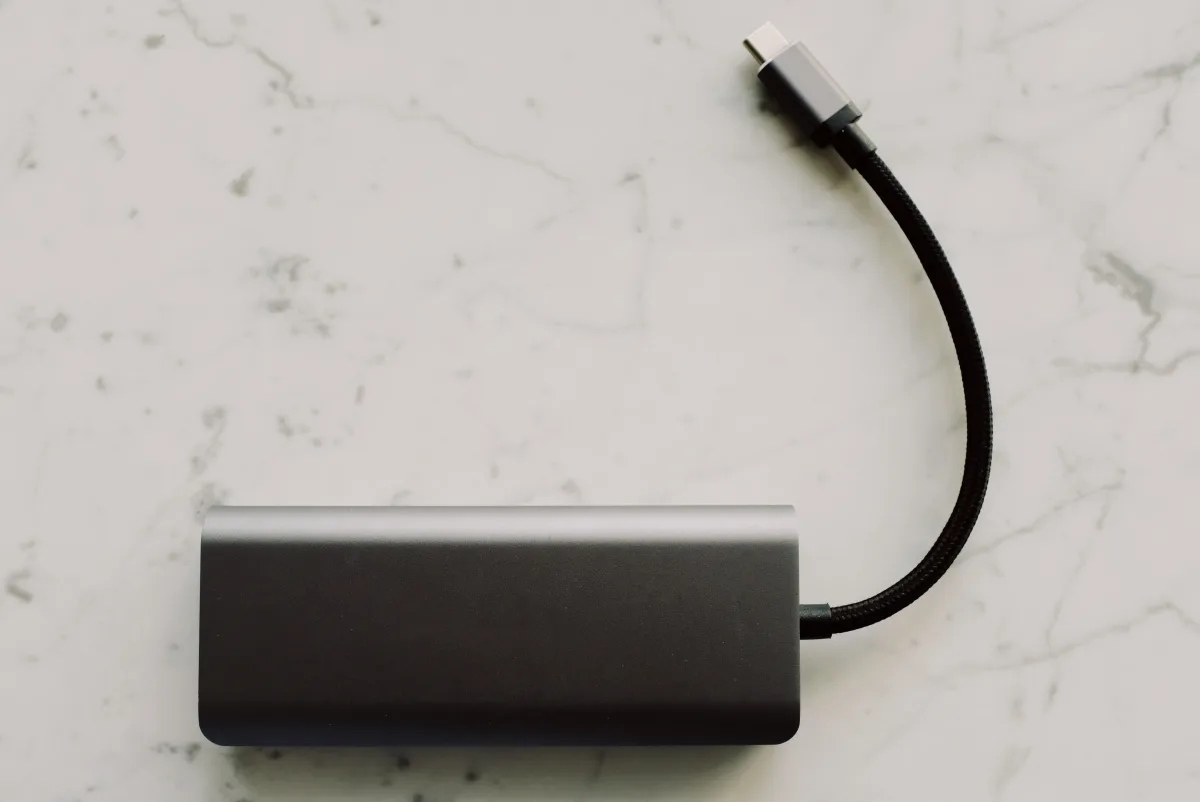
Built-in cables: the real trade-off. They eliminate the need to carry a separate cable — a genuine convenience win for everyday carry. But the cable itself has its own wattage rating, which may differ from the port it's attached to. The Anker Nano's retractable flat cable is two feet long: useful for keeping a phone in your pocket while charging, but shorter than a standard cable if you need more reach.
One often-overlooked detail: input wattage determines how quickly your power bank refills from a wall adapter. A bank that outputs 45W but only accepts 18W input will take a long time to recharge overnight — relevant if you're on a tight schedule between trips.
Best Portable Charger for Everyday Carry: Which Compact Option Is Right for You?
For most people — commuters, students, office workers who want a phone safety net — the real decision comes down to three models.
Wirecutter's top pick can charge up to three small devices simultaneously. It includes one built-in USB-C cable (27W in / 45W out), one additional USB-C port (27W in / 45W out), and one USB-A port (22.5W out). The built-in cable slides into a small holster that doubles as a wrist strap or hanging loop — a small design detail that genuinely helps when you're juggling a bag and a coffee. It comes in black or white and carries a three-year warranty, longer than most competitors at this price tier.
The Anker Nano Power Bank (30W) posted strong results in CNN Underscored's real-world iPhone charging tests, and its built-in USB-C cord is slightly easier to handle than competing options. Wirecutter notes that the Anker Nano adds a USB-A port and a backlit screen — genuinely useful features — but its chunkier form factor and retractable cable design make it slightly less elegant for pocket carry.
The Iniu Pawsible P41L-E2 tied the Anker Nano in CNN Underscored's iPhone charging test. If you're primarily charging one phone and want to spend less, the Iniu delivers comparable real-world performance. The cable design is less refined, but for a user who needs reliable output above all else, that's a reasonable trade.
What about wireless charging? If you want to top off wireless earbuds or a smartwatch without a cable, Wirecutter highlights the Anker MagGo A1657. It includes a built-in wireless charging pad alongside a USB-C cable, making it the most versatile option for users embedded in the wireless ecosystem. The trade-off: it has only one built-in cable rather than two, limiting simultaneous wired connections.
If you're comparing multiple electronics purchases at once — like picking a charger to go alongside a new phone, laptop, or tablet — our 2026 Consumer Electronics Buying Guide covers the full ecosystem. You may also want to read our best wireless earbuds comparison to understand how charging compatibility factors into that decision.
Best Power Bank for Backpacking and Outdoor Use: When Weight Is Non-Negotiable
Backpacking changes the calculus entirely. Every gram you carry is a gram you feel over ten miles. A power bank that's too heavy to pack provides exactly zero value.
Adventure Alan identifies the Nitecore NB10000 Gen 4 as the top ultralight battery pack after more than a decade of comparative field research. Its power-to-weight ratio is the benchmark for weight-conscious hikers who still need enough capacity to keep a phone and GPS device running across multiple days.
Durability is the second axis. The GearJunkie team handed the Nimble CHAMP Pro to their daughters for an entire summer of outdoor use. It survived being tossed indoors and outdoors, left in sleeping bags, and forgotten on picnic tables. Its rubberized exterior provides grip and absorbs the shock of drops onto hard surfaces — the kind of real-world abuse that a smooth-sided urban power bank wouldn't survive intact. At 20,000mAh with 65W per output, it also handles two devices charging simultaneously at serious speed, which matters when you're sharing a tent and both phones need power before a long day.
Before you buy for outdoor use, ask yourself these three questions honestly:
- Is your phone battery aging or degraded?
- Do you run navigation apps, shoot video, or use GPS continuously?
- Are you heading into cold weather?
If two or more of those are true, plan for at least one capacity tier above what a simple calculation suggests. Cold weather causes passive battery drain in all lithium-ion devices, including the power bank itself.
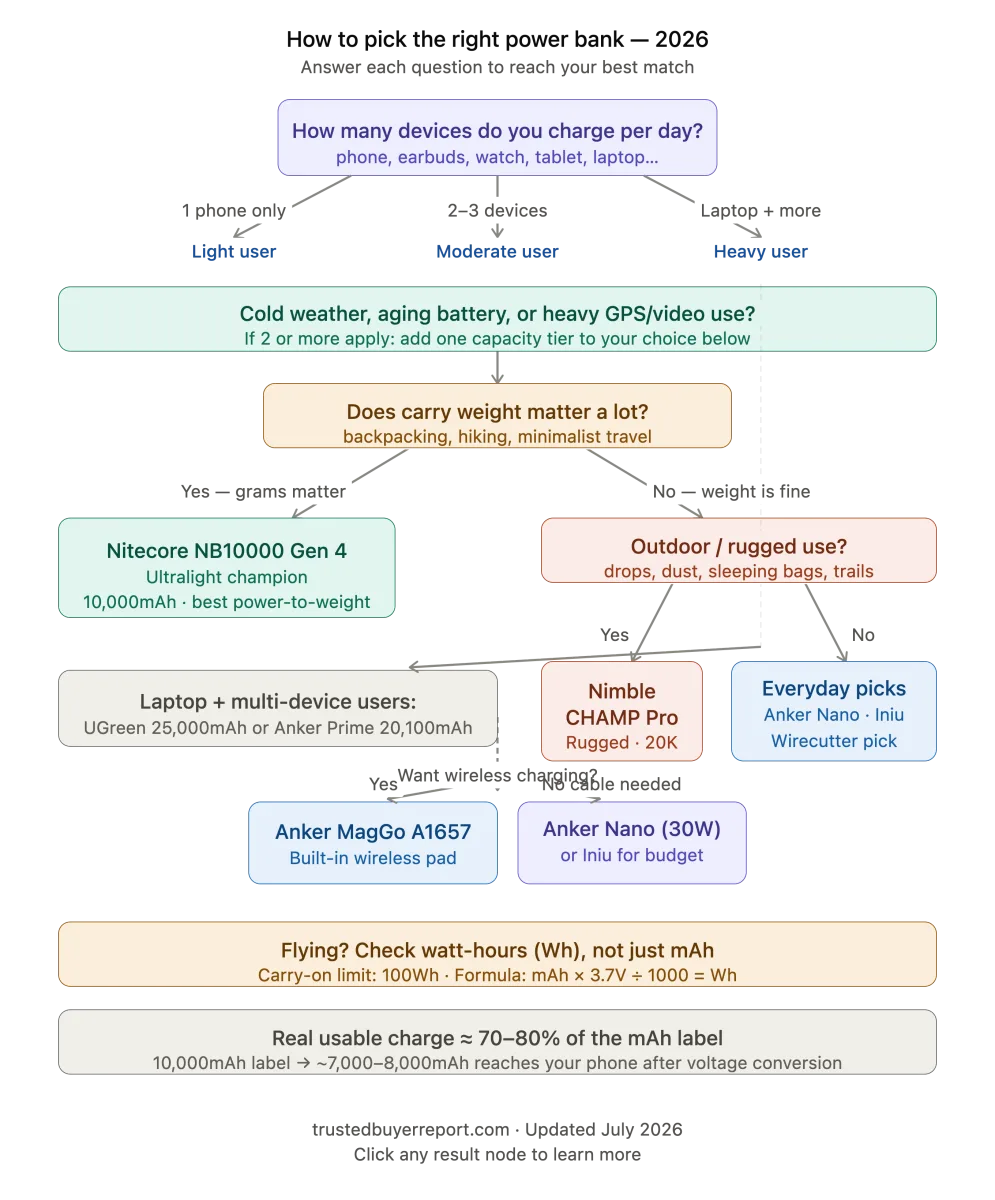
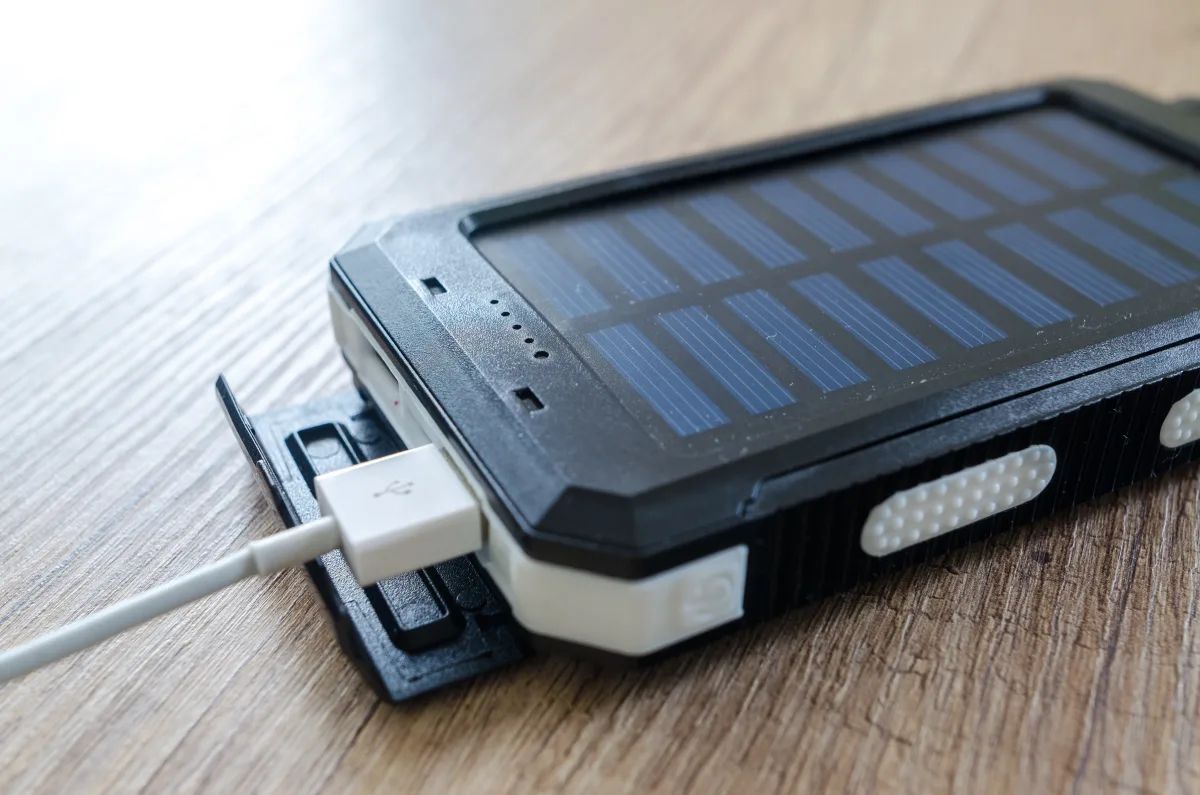
What about solar power banks? They exist for extended expeditions, but carry real limitations: photovoltaic panels add weight, and charge rates from sunlight alone are slow enough that solar input is best treated as a supplement to a primary lithium bank, not a replacement. For most trips under two weeks, a high-capacity lithium bank remains the more practical choice.
Best High-Capacity Power Bank for Multi-Device and Laptop Charging
If you regularly charge a laptop, tablet, and phone from the same power bank, the specs that matter shift significantly. You need USB-C Power Delivery at 30W or above, and ideally multiple high-wattage ports so you don't have to choose which device gets priority.
The UGreen 25,000mAh, highlighted by CNN Underscored, delivers dual USB-C ports and one USB-A port. A single tap of its side button activates an LCD screen showing remaining charge as a percentage — a practical feature that eliminates the guesswork of LED indicator dots. CNN Underscored notes it comfortably covers typical multi-device use, and it frequently sells below its standard retail price for Amazon Prime members.
In the mid-range budget tier, the Anker Prime 20,100mAh earned a real-world endorsement on r/batteries, where buyers researching that price bracket concluded it offered the best value after community input. Unsolicited peer validation from buyers with no commercial interest is worth weighing alongside professional reviews.
Pass-through charging — the ability to charge the power bank itself while simultaneously charging your connected devices — is a feature worth verifying before purchase. As Libratel explains, quality banks support this for overnight setups where you plug everything into a single wall adapter. Not all banks handle it gracefully; some generate excess heat or throttle output when charging both ways at once.
The airline carry-on constraint: Regulations cap lithium battery capacity at 100 watt-hours (Wh) for carry-on luggage. To convert: multiply mAh by the battery voltage (typically 3.7V) and divide by 1,000. A 27,000mAh bank at 3.7V comes in just under 100Wh — but always verify the specific product's listed Wh rating before you travel. Some high-capacity banks exceed the limit and cannot be brought aboard. TSA guidelines and airline-specific rules apply.
How to Read a Power Bank Spec Sheet Without Being Misled
Three numbers mislead more buyers than any others: mAh capacity, output wattage, and the number of ports.
mAh: Rated vs. usable capacity
mAh ratings are measured at the battery's internal voltage (~3.7V). Your phone charges at 5V. The voltage step-up loses energy — a 10,000mAh bank delivers closer to 7,000–8,000mAh to your device under real-world conditions. Factor in 20–30% loss as a baseline estimate.
Output wattage: the weakest link rule
A 45W output port is only useful if your cable and device both support 45W. If your cable is rated for 18W, charge speed caps at 18W regardless of the power bank's maximum capability. Always check the cable you plan to use — not just the bank and the phone.
Number of ports: shared vs. dedicated power
Some banks split their total output across ports — meaning two devices charging simultaneously each receive less wattage than one device would alone. Others maintain full wattage per port. Look for per-port output specs; if the listing only states total output, that's a yellow flag. Seek independent test data before buying.
Warranty length as a quality signal
The Wirecutter top pick carries a three-year warranty. Most budget banks offer one year. A manufacturer willing to back a product for three years is signaling confidence in its build — and gives you meaningful recourse if the battery degrades earlier than expected.
What the 2026 Power Bank Market Tells Us About Where Technology Is Heading
The global power bank market has grown consistently — rising from $7.8 billion in 2022 to $9.2 billion in 2024, according to GM Insights. That growth is driven by increased dependency on smartphones, wearables, and multi-device ecosystems — the same forces that make a reliable portable charger less of a luxury and more of a daily necessity.
Two technology trends are shaping the next generation:
- Wireless charging integration — like the Anker MagGo A1657's built-in pad — is moving from novelty to mainstream feature across price tiers.
- Battery architecture improvements are allowing manufacturers to pack higher capacity into smaller, lighter form factors, which directly benefits the backpacking and everyday carry segments.
Regulatory scrutiny around battery safety is also increasing, which should push manufacturers toward more transparent capacity labeling over time — a net win for buyers who currently have to account for the mAh-to-usable-charge gap themselves.
If you're looking to pair your power bank with the right devices, explore our deep-dive guides on the best headphones of 2026, best tablets, and best Bluetooth trackers — all of which have charging implications worth factoring into your power bank choice.
Who Should Buy Which Power Bank: A Use-Case Summary
Buy the Anker Nano (30W) if: You're a daily commuter who wants a reliable, compact bank with a built-in cable you don't have to think about. The backlit screen and USB-A port add flexibility. If pocket-friendly form factor is critical, note the slightly chunkier profile.
Buy the Iniu Pawsible P41L-E2 if: Your priority is one phone, one cable, and spending less. Real-world charging performance matches the Anker Nano — the trade-off is a less refined cable mechanism.
Buy the Wirecutter top pick if: You regularly charge two or three devices and want the most versatile compact option. The 45W USB-C output and three-year warranty are the key differentiators.
Buy the Anker MagGo A1657 if: You have wireless earbuds or a smartwatch you want to charge without a cable. It's the only option on this list with a built-in wireless charging pad.
Buy the Nitecore NB10000 Gen 4 if: Gram-counting matters. It's the validated ultralight benchmark for backpackers who need capacity without weight.
Buy the Nimble CHAMP Pro if: Your power bank will take drops, get wet, and spend time in a pack with rocks and tent stakes. Ruggedness and 65W dual output are the key reasons to choose it.
Buy the UGreen 25,000mAh if: You're a heavy multi-device user or occasionally need to top off a laptop. The percent-display LCD and dual USB-C ports are worth the extra bulk.
Skip portable chargers entirely if: You have reliable outlet access throughout your day and primarily need occasional overnight charging. A good wall adapter will serve you better at lower cost and weight.
Frequently Asked Questions
How many times can a 10,000mAh power bank charge a phone?
Realistically, one to two full charges for a modern smartphone with a 4,000–5,000mAh battery. Energy lost during voltage conversion means usable output is roughly 70–80% of the rated capacity. A bank labeled 10,000mAh delivers approximately 7,000–8,000mAh to your device under typical conditions.
Is a built-in cable worth it?
For everyday carry, yes — it eliminates the need to carry a separate cable and removes the chance of being caught without one. The trade-off: built-in cables can wear out over time and are not replaceable on most models. The Anker Nano and Wirecutter top pick both handle this well, with holster designs that protect the cable when not in use.
Can I bring any power bank on a plane?
Most power banks under 100Wh are permitted in carry-on luggage on commercial flights. Always check the product's listed Wh rating — not just mAh — before traveling. Banks above 100Wh require airline approval and cannot be placed in checked luggage. Banks above 160Wh are generally prohibited on passenger aircraft entirely. Verify with your airline before travel, as policies can vary.
Does cold weather affect a power bank?
Yes, significantly. Lithium-ion batteries lose output capacity in sub-freezing temperatures. If you're camping or hiking in cold conditions, expect both the power bank and your devices to drain faster than the specs suggest at room temperature. Plan for at least one capacity tier higher than your warm-weather calculation.
What does "pass-through charging" mean?
Pass-through charging means the power bank can charge itself from a wall outlet while simultaneously charging your connected devices. Useful for overnight hotel setups where you plug everything into a single adapter. Not all banks support this cleanly — some throttle output or generate excess heat when doing both at once.
What's the difference between USB-A and USB-C output?
USB-A is the older rectangular port. USB-C is the newer oval port capable of higher wattage, faster data transfer, and bidirectional power (the bank can charge from USB-C too). For maximum fast-charging speed, use USB-C on both ends with a cable rated for the wattage your device supports.
More Buying Guides for the Devices You're Charging
Power banks only make sense in context of the devices they support. Here are the guides most relevant to what you're likely charging:
- Best Wireless Earbuds 2026: AirPods vs Sony vs Samsung — most wireless earbuds charge via USB-C; match your bank to the cable included
- Best Headphones 2026: Over-Ear, On-Ear & Noise-Canceling — premium over-ear headphones charge slowly via USB-C; a compact bank is all you need
- Best Tablets 2026: iPad vs Samsung vs Amazon Fire — tablets need 30W+ USB-C PD to charge at full speed; verify before buying
- Best E-Readers 2026: Kindle vs Kobo vs Nook — e-readers have small batteries; a 5,000–10,000mAh bank is more than enough
- Best Bluetooth Trackers 2026: AirTag vs Tile vs Samsung SmartTag — trackers use replaceable batteries, not power banks — but worth reading alongside this guide
- Best Webcams for Remote Work & Streaming 2026 — USB-C webcams draw power from your laptop; relevant for portable setups
- Best External Hard Drives & SSDs 2026 — bus-powered SSDs can draw from a power bank for field use
- Best PC Monitors 2026 — USB-C monitors can charge your laptop via power delivery
- Best Mechanical Keyboards 2026 — wireless mechanical keyboards charge via USB-C; a compact bank keeps them running
- Best Photography Equipment for Hobbyists 2026 — camera batteries and field charging are a distinct topic; check this guide
- Best Home Printers 2026 — not typically charged via power bank, but part of the broader electronics setup
We may earn a commission when you use our links to make a purchase. This does not affect our recommendations. Read our full affiliate disclosure →
This article was drafted with AI assistance and fact-checked by our editorial team before publishing. Our editorial standards →