How this guide was researched: This guide is based on manufacturer specifications, hands-on reviews from TechRadar, DPReview, and Amateur Photographer (April–June 2026), and aggregated buyer feedback. It does not reflect hands-on testing by Trusted Buyer Report. We cite our sources throughout.
This article was drafted with AI assistance and fact-checked by our editorial team before publishing.
We may earn a commission when you use our links to make a purchase. Affiliate commissions are added only after our assessment is complete and never influence our rankings.
The Camera That Ends Up in the Closet — and How to Avoid It
Most hobbyists buy the wrong photography gear for one simple reason: they shop for the photographer they imagine becoming, not the one they currently are.
The pattern is predictable. Someone spends $700–$1,000 on a well-reviewed DSLR kit after two weeks of YouTube research. They use it enthusiastically for a month, take it on one trip, find it too heavy to carry alongside everything else, and quietly move it to a shelf. Three months later, it's in a closet. Contrast that with someone who bought a $350 compact vlog camera because they genuinely wanted to document their weekends — and used it every week for two years because it fit in a jacket pocket.
The photography equipment market is larger and more crowded in 2026 than it's ever been. That's good news for value and variety — but it also means more opportunities to buy exactly the wrong thing. This guide cuts through the noise by starting where most gear guides don't: helping you identify how you actually shoot, before recommending a single product.
What you'll find below:
- A self-assessment framework to identify your shooting identity
- Camera recommendations at beginner and intermediate tiers
- An honest guide to lenses (the purchase that matters more than the body)
- Accessories worth buying — and ones to skip initially
- Complete kit suggestions mapped to four shooting identities
- A gear budget table and FAQ
If you're researching across consumer electronics categories, our 2026 Consumer Electronics Buyer's Guide provides broader context for making smart purchasing decisions this year.
Step One: Identify Your Shooting Identity (Don't Skip This)
Before you look at a single spec sheet, answer this question honestly: how do you actually plan to use a camera? Not aspirationally — in practice.
Four hobbyist shooting identities cover the overwhelming majority of people entering photography in 2026. Each maps to genuinely different gear requirements.
🎯 The Casual Documenter
Family events, travel snapshots, everyday life. Priorities: ease of use and portability. A camera that requires a dedicated bag and 15 minutes of setup will never leave the house.
📱 The Content Creator
Social media content, vlogs, short-form video. Priorities: video quality, reliable autofocus for self-filming, compact form factor. Size and speed of access matter as much as image quality.
📚 The Dedicated Learner
Wants to genuinely understand manual controls, composition, and light. Priorities: a camera system with real room to grow — interchangeable lenses, manual exposure modes, a lens ecosystem worth investing in over time.
🦅 The Adventure/Outdoor Shooter
Hiking, wildlife, action sports. Priorities: weather sealing, telephoto reach, and a body durable enough to take real-world punishment in the field.
Be honest about which identity fits your life right now. That single choice changes every recommendation that follows — and it's the difference between a camera you use and a camera you own.
Why Mirrorless Has Become the Default for Hobbyists in 2026
If you haven't followed camera technology closely, here's the summary that matters: DSLRs are no longer the practical default for new buyers. Mirrorless interchangeable lens cameras (MILCs) have taken that position, and the reasons are concrete.
TechRadar's camera editors, who have reviewed cameras for over 15 years, confirm that mirrorless cameras now represent where every major manufacturer is pouring its development resources. DSLR lens catalogs have largely stopped growing. Mirrorless lens catalogs are expanding rapidly across Sony, Canon, Nikon, and Fujifilm.
The other critical decision: sensor size. You'll encounter two formats most often:
- APS-C (crop sensor): Smaller sensors, smaller and lighter lenses, lower cost. The practical sweet spot for most hobbyists.
- Full-frame: More light-gathering ability, shallower depth of field at equivalent apertures — but lenses are significantly larger, heavier, and more expensive.
DPReview notes that the Nikon Z5 II is "almost unimaginably good for a camera priced under $2,000" and describes it as "an impressive all-rounder that delivers excellent image quality and good video" — hard to see what more an enthusiast photographer could want. But that's full-frame. For most beginners, APS-C delivers results they won't outgrow.
The honest rule of thumb: don't move to full frame because you feel like you should. Move when low-light performance or shallow depth of field is a consistent creative priority in your actual shooting — and when you're ready to invest in the lenses that match.
Best Cameras for Beginner Hobbyists in 2026
Four cameras stand out at the entry level in 2026, each suited to a different beginner shooting identity.
Canon EOS R10 — Best Overall Beginner Mirrorless
TechRadar names the Canon EOS R10 the best beginner mirrorless in 2026, calling it "compact and lightweight." It sits within Canon's RF mount ecosystem, which is important: the RF-S lens selection for APS-C bodies continues to grow, and the body adapts Canon's existing EF DSLR lenses via adapter — giving beginners both affordability and genuine upgrade paths.
Best for: Dedicated Learners and Casual Documenters
Key limitation: No in-body image stabilization (IBIS), which matters in low light without a tripod
Sony ZV-E10 II — Best for Content Creators
Sony's ZV line is purpose-built for self-filming and video. The ZV-E10 II improves on the original with better autofocus and video specs, while keeping the interchangeable-lens flexibility the ZV-1F fixed-lens line lacks. For content creators who might eventually want to swap lenses for portrait work, this is the smarter starting point.
Best for: Content Creators who want some room to grow
Key limitation: Body ergonomics are minimal — prioritizes compactness over handling
Nikon Z50 II — Best for Learners on a Budget
Amateur Photographer added the Nikon Z5 II as the best value full-frame option in January 2026 — and for the APS-C tier, the Z50 II fills an equivalent role. It uses Nikon's Z mount, which has a growing high-quality lens catalog and a clear path to Nikon's full-frame bodies if you eventually want to upgrade.
Best for: Dedicated Learners who plan to invest in a system over time
Key limitation: Native APS-C lens selection is smaller than Sony's E-mount ecosystem
Sony ZV-1F or a Used Sony a6400 — Best Budget Options
For Casual Documenters who just want simplicity, the fixed-lens Sony ZV-1F removes all complexity — no lens decisions, no system investment. At the other end of the value spectrum, KEH Camera notes that buying a high-end 2022 model for around $1,200 often outperforms a brand-new entry-level camera at the same price point — and a used Sony a6400 typically lands under $500 with strong autofocus and a mature lens ecosystem.
Best for: Casual Documenters (ZV-1F) or budget-conscious buyers who want max capability per dollar (used a6400)
Best Cameras for Intermediate and Serious Hobbyists ($1,000–$3,000)
Once you've shot consistently for six to twelve months and identified specific limitations in your current setup, these bodies open up meaningfully better options.
Sony a6700 — Best APS-C for Serious Hobbyists
DPReview calls the Sony a6700 "the most capable APS-C camera on the market, with extremely strong autofocus performance, image quality and video capabilities" and notes that Sony's E-mount has the most complete array of APS-C lenses after Fujifilm's, largely thanks to third-party support.
The a6700 shoots 4K video oversampled from 6K, offers Sony's Real-time AI tracking autofocus, and packs five-axis in-body stabilization into a compact body. For hobbyists who want maximum technical capability without full-frame size and cost, it's the standout pick of 2026.
Best for: Dedicated Learners, Content Creators who want the best APS-C
Canon EOS R7 — Best for Outdoor and Wildlife Hobbyists
The Canon EOS R7 adds weather sealing the a6700 lacks — which matters the moment you're shooting in rain, dust, or near water. TechRadar's editors anticipate a Canon EOS R7 II as one of the most exciting upcoming releases, noting it would "upgrade Canon's current flagship APS-C model, perfect especially for enthusiast wildlife and sports photographers."
If you're an Adventure/Outdoor Shooter, Canon's 800mm f/11 and 100-500mm lenses make the RF ecosystem the most wildlife-friendly APS-C system available.
Best for: Adventure/Outdoor Shooters, Wildlife Hobbyists
Nikon Z6 III — Best Full-Frame All-Rounder Under $2,500
DPReview describes the Nikon Z6 III as "a significant step-up from its predecessor and to-date the most all-round capable camera in its class," with excellent stills and video — including outstanding rolling shutter performance and multiple raw video formats.
The Z6 III is where many serious hobbyists land: capable enough that most will never outgrow it, without the flagship price tag of the Z8 or Canon R5 Mark II.
Best for: Serious hobbyists ready for full-frame, hybrid stills/video shooters
Canon EOS R5 Mark II — The Upper Boundary of the Hobbyist Tier
For serious hobbyists who want professional-grade capability, the R5 Mark II offers 45MP stills, cutting-edge subject-tracking autofocus, and serious video specs. It's a significant investment — but it's also a body you won't outgrow. Amateur Photographer notes that recording raw video internally and outputting ProRes RAW to external recorders is "certainly nothing to sniff at" in this camera class.
Best for: Serious hobbyists with the budget to match and a clear creative direction
Lenses: The Purchase That Matters More Than the Camera Body
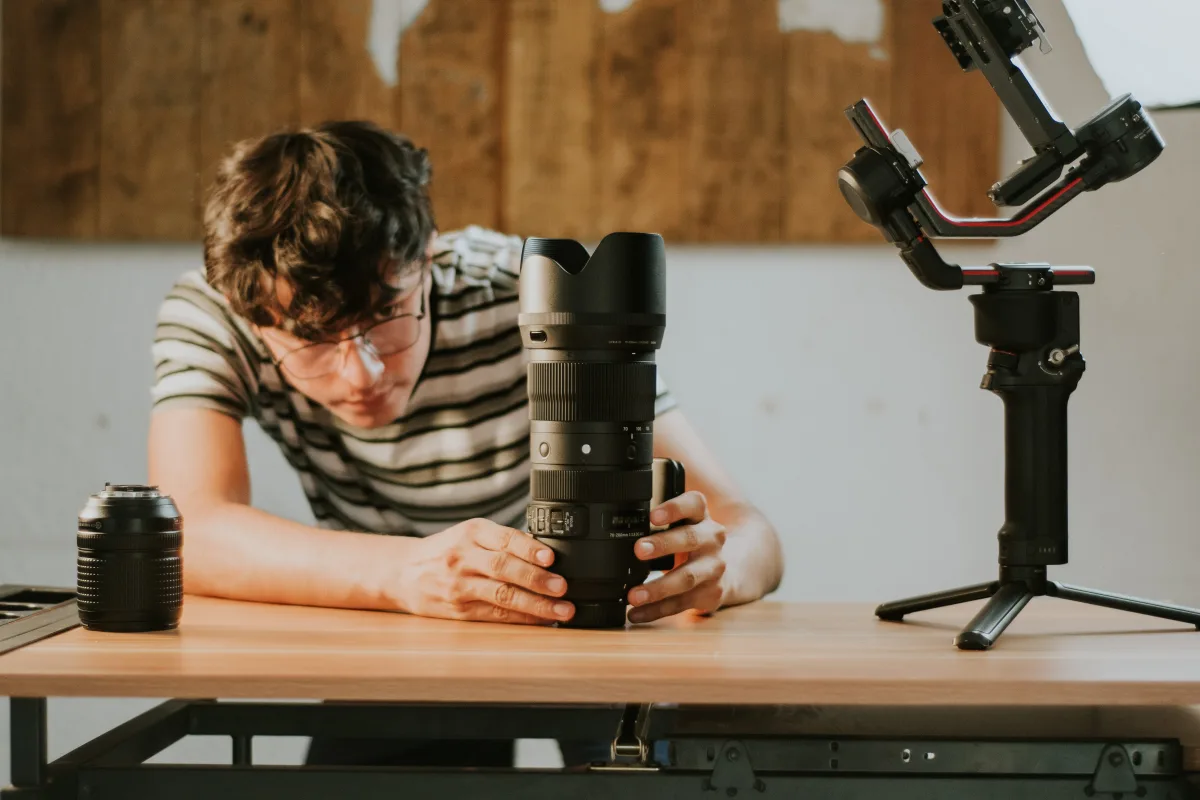
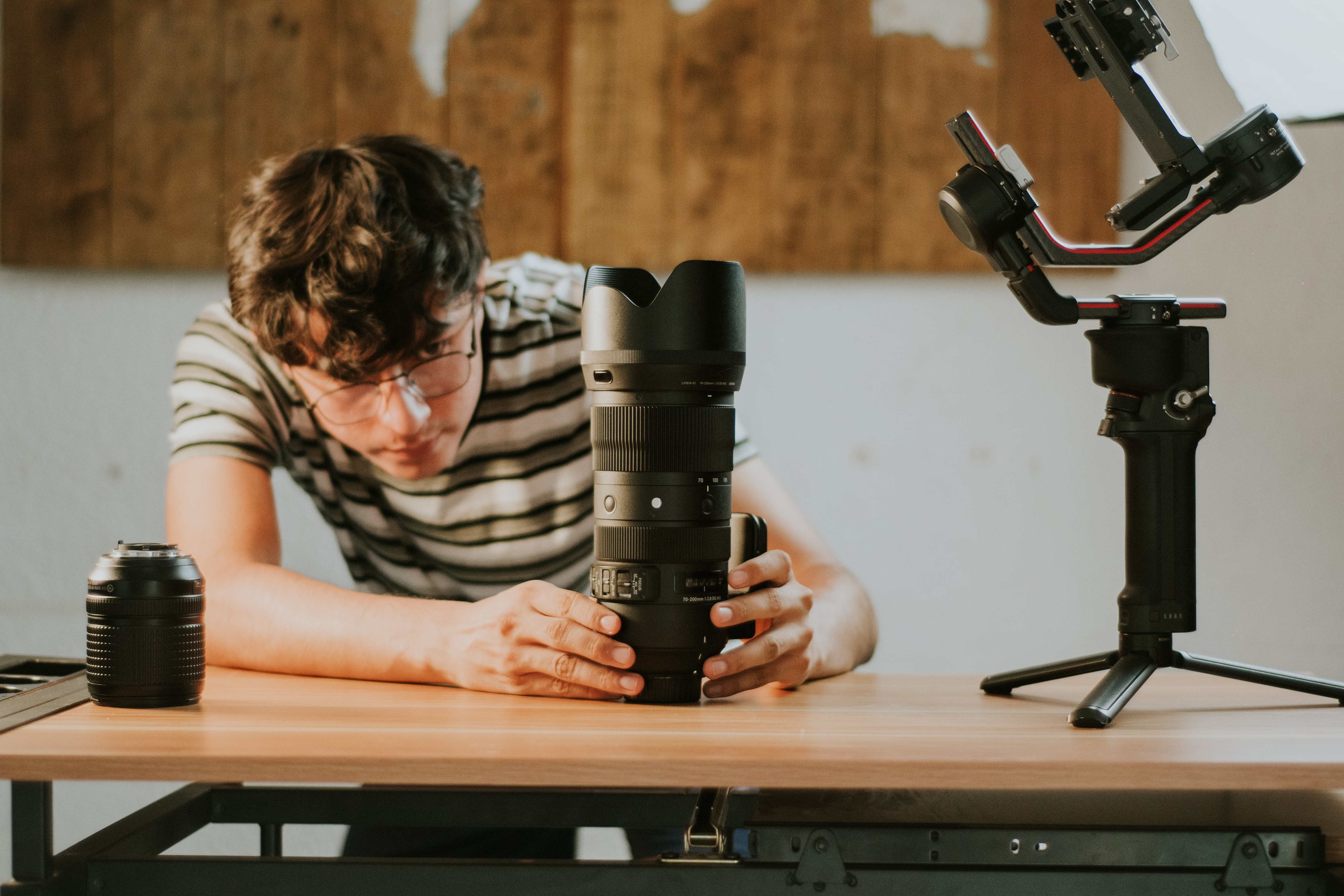
Here's the insight most beginners miss: a great lens on a mid-range body will consistently outperform a mediocre lens on an expensive body. Glass shapes the image in ways sensor upgrades can't compensate for — sharpness, color rendering, background separation, and low-light performance are primarily lens characteristics.
The Two-Lens Starter Strategy
A practical two-lens starting kit covers the vast majority of hobbyist scenarios:
- An all-purpose zoom (24–70mm or 18–55mm kit range): Everyday versatility for travel, events, street photography. The kit lens that came with your camera is often underrated — it covers this role well.
- A fast prime (35mm or 50mm at f/1.8): Portraits, low light, and the shallow depth of field effect that a kit zoom can't produce. At f/1.8, these lenses gather dramatically more light than the typical f/5.6 kit zoom at its longest focal length.
KEH Camera highlights third-party lenses from Sigma, Tamron, and Samyang as offering "high-quality lenses at 40–60% less than first-party equivalents, often with little to no compromise in performance" — particularly on Sony E-mount bodies.
Lenses for Dedicated Learners
Consider starting with just a single 35mm or 50mm prime. It forces you to physically move to frame shots rather than rotating a zoom ring — a constraint that builds compositional instinct faster than zooms do. It's a counterintuitive recommendation, but experienced instructors consistently endorse it for the learning phase.
Lenses for Wildlife and Outdoor Shooters
Telephoto reach is non-negotiable for wildlife photography — and it comes at significant cost:
| Setup | Approximate Cost |
|---|---|
| Canon 800mm f/11 (budget entry telephoto) | ~$800 |
| Canon R7 + RF 100-500mm kit | ~$4,000 |
| Canon R5 Mark II + RF 600mm f/4 | $10,000+ |
The APS-C crop factor is actually an advantage here: a 500mm lens on an APS-C body delivers the equivalent field of view of a ~750mm lens on full frame, giving you more reach for less money. Plan your wildlife budget around the lens first, then choose a body that pairs well with it.
Essential Accessories: What to Buy, What to Skip
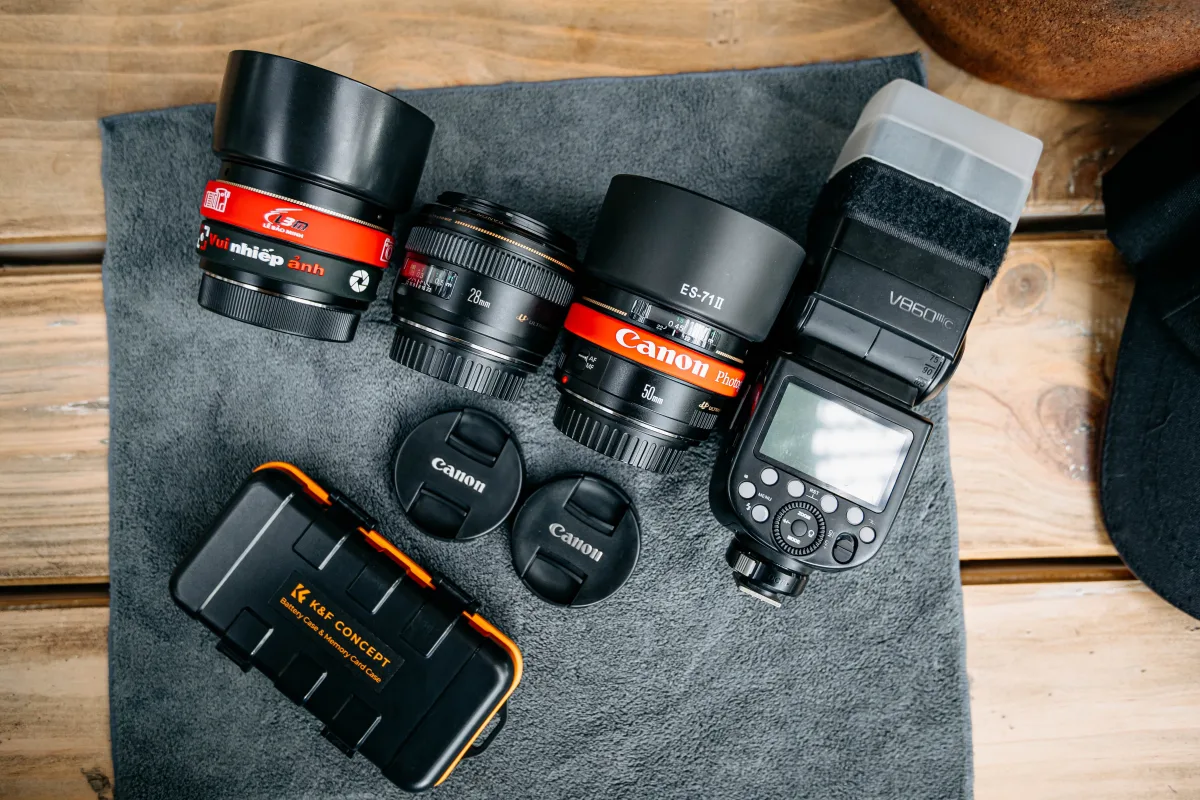
Accessories are where hobbyist budgets quietly disappear. Some purchases are genuinely necessary. Others are marketed aggressively but used rarely, if ever.
✅ Buy These
Memory Cards — Class 10 / UHS-I, 64GB minimum, buy two
The Imaging Resource recommends reliable brands like ProGrade Digital or Delkin for peace of mind, noting that "memory cards are where you shouldn't compromise." Two cards give you a backup if one fails mid-shoot. Budget $20–$40 per card depending on speed class. For cameras that shoot 4K video or high-burst stills, invest in faster UHS-II cards.
Camera Bag matched to your shooting lifestyle
GearJunkie's testing found the WANDRD Rogue Sling 9L to be "an extremely comfortable bag" well-suited for photographers who don't carry extensive accessories — and Peak Design and Lowepro remain the benchmarks for quality. The choice between sling bag and backpack should match your shooting context: slings for urban/street work (quick one-handed access), backpacks for hiking and travel (weight distribution over distance). Budget $80–$200.
Lens Cleaning Kit
A rocket blower, microfiber cloth, and cleaning solution cost $15–$30 and extend the usable life of your lenses meaningfully. Dust and smudges affect image clarity in ways that are easy to prevent and annoying to fix in post-processing.
Tripod — situational
A lightweight travel tripod ($50–$120) is worth buying if your shooting includes landscape photography, long exposures, or video work. Skip it initially if your shooting is primarily handheld documentary or street work — it will sit unused.
❌ Skip Initially
- External flash/speedlight: Genuinely useful for portraits and events, but a steep learning curve. Buy when natural light consistently becomes your limitation.
- ND filter sets: Essential for video work and long-exposure landscape photography — but premature without clear creative intent.
- Gimbal stabilizer: Valuable for content creators producing smooth video, but unnecessary for still photographers and casual documenters.
- Multiple camera bodies: Tempting to buy "just in case," but beginners consistently learn faster by thoroughly knowing one body.
The rule: buy accessories when a specific limitation in your actual work makes the need obvious — not preemptively.
Complete Kit Recommendations by Shooting Identity
Rather than a single ranked list, here's how the gear maps to the four shooting identities:
| Shooting Identity | Recommended Camera | Recommended First Lens | Key Accessories | Approximate All-In Budget |
|---|---|---|---|---|
| Casual Documenter | Sony ZV-1F or used Sony a6400 | Kit lens (fixed on ZV-1F) | 2× memory cards, sling bag, cleaning kit | $400–$700 |
| Content Creator | Sony ZV-E10 II | 16mm f/1.4 or kit zoom | Tripod/mini-stand, memory cards | $700–$1,200 |
| Dedicated Learner | Canon EOS R10 or Nikon Z50 II | 35mm or 50mm f/1.8 prime | Backpack, extra memory cards, tripod | $700–$1,300 |
| Adventure/Outdoor | Canon EOS R7 | RF 100-500mm or RF 100-400mm | Weather-resistant backpack, extra batteries | $2,500–$5,000 |
These ranges reflect realistic all-in costs — camera body plus lens plus essential accessories. The adventure/outdoor range is wide because telephoto lens choice drives the total more than any other variable.
How Photography Gear Connects to Other Hobbyist Tech
Good cameras don't exist in isolation. If you're investing in a photography setup, a few related categories from our buying guide series are worth knowing:
- Sharing and storage: Once you're shooting seriously, external hard drives and SSDs become essential for backing up your photo library. A fast SSD matters if you edit large RAW files.
- Portable charging on location: Location shoots drain batteries fast. Our guide to portable chargers and power banks covers what to carry for all-day field shoots.
- Video creators: If photography and video content creation overlap, our reviews of the best webcams for remote work and streaming may also be relevant — particularly for studio-style setups.
- Monitors for editing: Color-accurate photo editing benefits from a quality display. Our best PC monitors guide for 2026 covers what to look for when evaluating screens for creative work.
- Printing your photos: Many hobbyists eventually want to print. Our best home printers comparison (inkjet vs. laser) covers the options most relevant to photo printing quality.
Frequently Asked Questions
Is a mirrorless camera better than a DSLR for a beginner hobbyist in 2026?
For most new buyers in 2026, yes. Amateur Photographer confirms that mirrorless is where every major manufacturer is "pouring the most time and energy," with the best autofocus, fastest burst speeds, and the most active lens development all happening in mirrorless systems. DSLRs are optically excellent but represent a mature, largely static platform. The main exception: if you're buying used gear on a very tight budget, second-hand DSLRs can offer strong value below $300.
Do I need a full-frame camera as a hobbyist?
Almost certainly not at the start — and possibly never. DPReview notes that today's APS-C cameras like the Sony a6700 "consistently delivered sharp, balanced images" with "class-leading autofocus accuracy" in real-world testing — results most hobbyists won't outgrow. Full-frame makes sense when low-light performance or very shallow depth of field is a consistent creative priority, and when you're prepared to invest in lenses that match the sensor.
How much should a beginner spend on their first camera kit?
A complete beginner kit — body, kit lens, two memory cards, and a bag — can be assembled for $400–$900 depending on which body you choose. Spending more before you've shot consistently for at least six months is a common mistake. The camera you use regularly will teach you more than the camera that sits in a closet because it was too expensive to risk taking out.
Should I buy lenses or a better camera body first?
Lenses first, almost always. Beyond a basic competency threshold, lens quality affects image output more than body upgrades do. A sharp, fast 50mm prime at f/1.8 on a mid-range body will outperform a kit zoom on a premium body for portrait and low-light work. Invest in glass, then upgrade the body when a specific capability gap — not general dissatisfaction — makes the case.
What's the most common mistake hobbyists make buying photography gear?
Buying for the photographer they imagine becoming rather than the one they currently are. A camera that's too heavy to carry consistently, too complex to use quickly, or too expensive to risk in the field will not get used. Gear that gets used — even gear that's technically inferior — produces more learning and more photographs. Start with what you'll actually pick up and carry.
Is the Sony a6700 or Canon EOS R7 better for a hobbyist?
It depends on your shooting identity. DPReview gives the technical edge to the Sony a6700 for autofocus performance and lens ecosystem variety, while the Canon EOS R7 adds weather sealing and better telephoto lens pairing — making it the stronger choice specifically for outdoor and wildlife hobbyists. For all other shooting identities, the a6700 wins on technical specs.