
Quick Answer
Spec sheets are marketing documents first and buying tools second. The single biggest mistake buyers make in 2026 is matching a purchase to a benchmark score instead of their actual use case — and the second-biggest is ignoring software support years, which predict total cost of ownership far better than raw horsepower does. Below, we break down exactly how to evaluate smartphones, wearables, smart home devices, and laptops without falling for the upgrade cycle.
The Myth That's Costing You Money Before You Even Open the Box
The most common misconception in consumer electronics shopping is that better specs automatically mean a better purchase. They don't. A $1,200 flagship phone with a 200-megapixel camera is a worse purchase than a $400 mid-range phone if your daily use is calls, navigation, and social media — you're paying for capability you'll never touch.
Here's a pattern that plays out in millions of US households every year: a family upgrades the living room TV, adds a streaming stick "for better performance," and buys a soundbar to round things out — then discovers three months later that the TV's built-in apps already covered every streaming service they use, and the soundbar's Bluetooth conflicts with the TV's HDMI-ARC port in ways nobody mentioned at checkout. Two of those three purchases were redundant. That's not a technology problem — it's a buying-framework problem, and it's the one this guide fixes.
Why Buying Electronics in 2026 Feels Harder Than Ever
The sheer scale of the market creates noise on its own. The global consumer electronics market is projected to reach $2.66 billion in 2026, up from $1.73 billion in 2025, according to Fortune Business Insights. A market that size generates an enormous volume of advertising and sponsored content, which makes objective comparison genuinely harder for the average shopper.
Volume tells a similar story: the average person is projected to contribute roughly 1.025 devices to global market volume in 2026, per Statista's Market Forecast — meaning most US households will buy at least one new device this year, inside a product landscape that now spans phones, wearables, smart home gear, laptops, tablets, and audio.
Budget pressure is reshaping the decision itself. YouGov's 2026 US consumer electronics rankings report finds that perceived value, not innovation alone, now drives purchase decisions across crowded categories, via YouGov. That cuts both ways: buyers are more skeptical of premium pricing, but also more vulnerable to "value" framing that quietly hides real trade-offs.
Supply chains add a layer most retail marketing never mentions. TechInsights names geopolitical dynamics as one of the forces reshaping availability and pricing in 2026 — a device that's cheap and plentiful in one region can carry a real premium elsewhere because of tariffs or distribution deals. Worth a quick price-check across regions before assuming the listed price is the market price.
Do You Actually Need a New Device? Ask These 3 Questions First
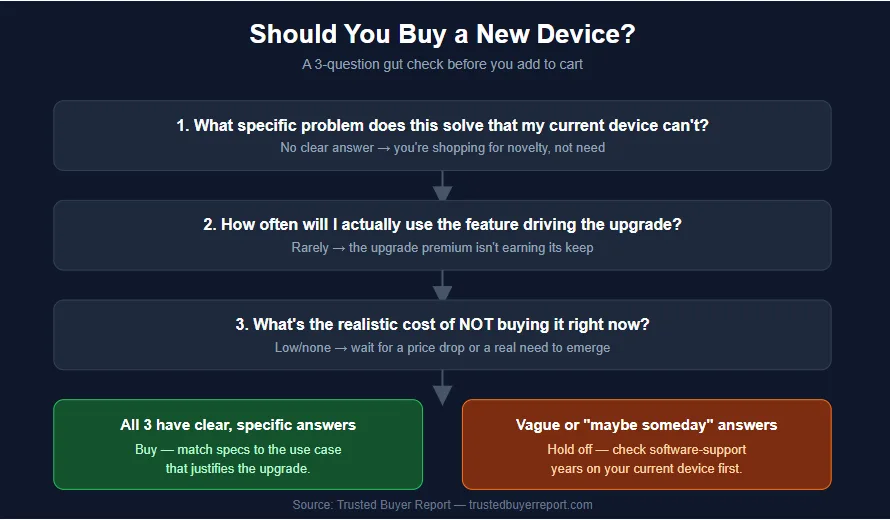
Before evaluating any specific product, answer honestly:
- What specific problem does this solve that my current device can't?
- How often will I actually use the feature driving the upgrade?
- What's the realistic cost of not buying it right now?
The upgrade cycle is as much a marketing construct as a technological reality. A laptop that runs your required apps without lag is a functional laptop — full stop — regardless of whether a newer model exists. A phone that makes calls, runs navigation, and holds a charge through the day is doing its job. The real question isn't whether a newer device wins on benchmarks (it almost always does) — it's whether that improvement changes your actual day-to-day experience.
Infographic: Trusted Buyer Report's 3-question upgrade gut-check
Software support years predict longevity better than specs do
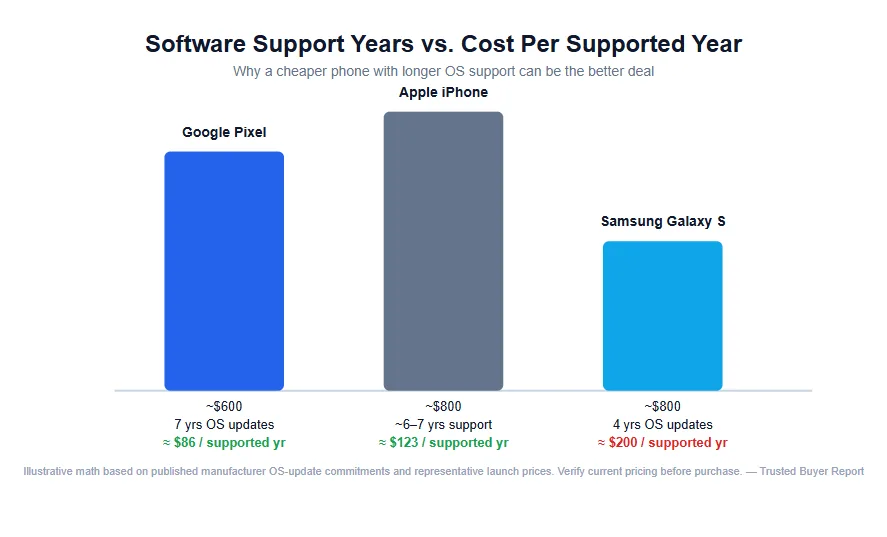
This is the single highest-leverage piece of advice in this guide: a device with five-plus years of guaranteed OS updates is typically a better long-term investment than a faster device with two. Google's Pixel line now commits to seven years of Android updates; Apple's iPhone support window has historically run six to seven years from launch; Samsung's Galaxy S series currently offers four years of OS updates. Run the math and a $600 phone supported for seven years can cost less per supported year than an $800 phone supported for three.
Infographic: illustrative cost-per-supported-year, based on published OS-update commitments
Deloitte's 2026 Global Hardware and Consumer Tech Industry Outlook identifies a "trusted trailblazers" consumer segment — roughly 24% of consumers strong on both innovation adoption and data stewardship — that reports the highest satisfaction with their technology purchases. In plain terms: people who evaluate both performance and privacy before buying consistently end up happier than impulse upgraders.
One more hidden cost worth budgeting for: ecosystem lock-in. Switching from Android to iOS, or between smart home platforms, means app repurchases, accessory incompatibility, and a real learning curve. Price that in before the sticker price of the new device becomes the only variable you're weighing.
Smartphones: What Actually Matters in 2026
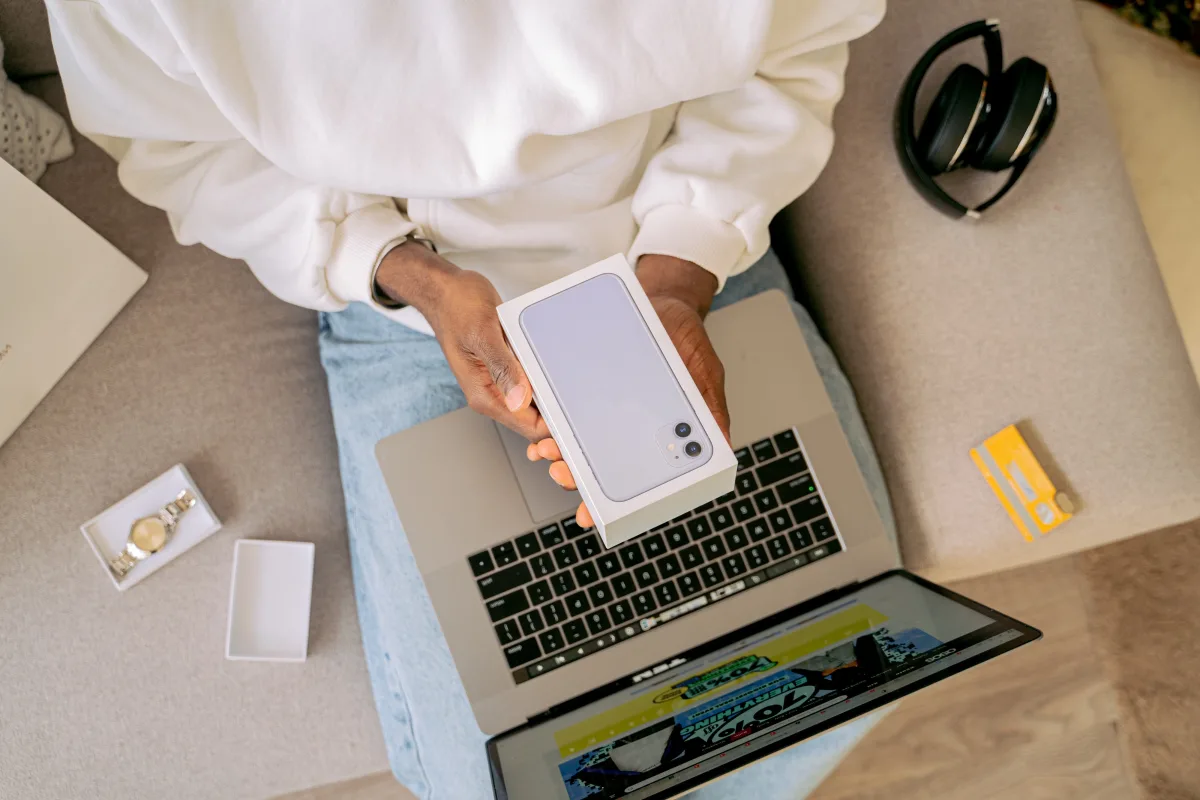
Telephony remains the single biggest electronics category by manufacturer spend, which means smartphone marketing is the most sophisticated — and the most worth scrutinizing — of any category here.
Megapixels are the most overstated spec in phone marketing. Sensor size and aperture drive image quality far more than raw pixel count. A 50MP sensor crammed onto a tiny 1/2.8" chip will lose to a 12MP sensor on a larger 1/1.5" chip in low light, almost every time. Computational photography — Google's processing pipeline, Apple's Photonic Engine, Samsung's ProVisual Engine — does more heavy lifting than the spec sheet number. Judge a camera by real sample shots taken in the conditions you actually shoot in, not by comparing megapixel counts.
For everyday use, the flagship-vs-mid-range gap is mostly invisible. If your primary uses are social media, navigation, and calls, the difference between a $400 mid-ranger (Google Pixel 8a, Samsung Galaxy A55) and a $1,200 flagship is barely noticeable day to day. The flagship's real edge shows up in sustained performance under heavy load, premium display quality, and low-light camera performance — pay for that only if you'll actually use it.
Verify 5G instead of assuming it. Coverage varies a lot by carrier and region. Confirm your carrier's 5G network actually covers where you live and work, and that the phone's specific 5G bands match your carrier's deployed spectrum — a "5G capable" phone with sub-6GHz-only support behaves very differently from one with mmWave in a city that has mmWave infrastructure.
Repairability deserves more weight than buyers give it. Right-to-repair rules are expanding across the EU and several US states. Higher iFixit repairability scores translate into real savings: the Fairphone 5 scores 10/10, the iPhone 15 scores 7/10, and many Android flagships land at 3–5/10. A $150 battery swap at year three can buy a phone two more years of useful life — that materially changes the total-cost math.
→ Browsing retailers for your next phone? See our Best Buy electronics review for return-window and price-match details before you commit.
Wearables and Smartwatches: Utility Over Aspiration
Wearables are among the most-purchased — and most-abandoned-in-a-drawer — electronics categories. Forbes Vetted's 2026 research on mass-affluent shoppers finds that 66% have adopted wearables like smartwatches and fitness trackers, with 17% more expressing interest in adopting them — and that this group is drawn to the tech for utility, not as a status symbol. That framing holds at every income level, not just affluent buyers.
Fitness tracker vs. smartwatch comes down to battery life vs. functionality. Dedicated trackers (Garmin Vivosmart 5, Fitbit Charge 6) typically run 5–14 days on a charge with more accurate activity-specific metrics. Smartwatches (Apple Watch Series 10, Samsung Galaxy Watch 7, Google Pixel Watch 3) trade that battery life for app ecosystems, contactless payments, and richer notifications. Neither wins universally — it depends whether you want a health monitor or a wrist-based phone extension.
Serious runners should skip the smartwatch. A dedicated GPS running watch (Garmin Forerunner 265, Polar Pacer Pro) beats a general-purpose smartwatch on GPS accuracy, running dynamics, training-load analysis, and battery life on long runs — even though it looks less versatile on paper.
AI pendants need to clear a high bar. Ask one question before buying any AI wearable: what does this do that my phone can't, and does it need its own subscription to do it? Several AI pendant launches in 2024–2025 showed that ambient AI hardware without a strong standalone use case struggles to beat a smartphone running an AI assistant app.
Check the health-data policy before you buy. Heart rate variability, sleep, SpO2, and cycle-tracking data are sensitive. Some brands keep this on-device by default; others default to cloud storage with third-party sharing enabled unless you manually opt out. Read the privacy policy, not just the box copy.
Smart Home Devices: Ecosystem First, Features Second

This is the category where buyers most often make expensive, hard-to-reverse mistakes — and ecosystem compatibility should be evaluated before you compare features or price.
Matter compatibility reduces lock-in risk. Matter is the cross-platform smart home standard backed by Apple, Google, Amazon, and Samsung. A Matter-certified smart plug works across Apple HomeKit, Google Home, and Amazon Alexa without extra hubs or workarounds. A device tied to a proprietary ecosystem only works for as long as that manufacturer keeps the lights on.
Ask three questions before any smart home purchase:
| Question | Why it matters |
|---|---|
| Does it work without an active internet connection? | Determines whether an outage bricks your device |
| What happens if the manufacturer shuts down its cloud service? | Real precedent exists — Insteon (2022) and Wink's subscription pivot both stranded working hardware |
| Is local processing available as a fallback? | Local processing is a durability feature, not a luxury one |
Robot vacuums: LiDAR-based navigation (Roborock S8 Pro Ultra, Dreame L20 Ultra) consistently beats camera-based navigation in low light and produces more accurate floor maps. Dustbin capacity and auto-empty base compatibility matter more for daily convenience than the suction-power number on the box, which is measured under lab conditions that don't reflect carpeted rooms with pet hair. Check whether mapping data stays local or uploads to the manufacturer's servers if privacy is a concern.
Smart thermostats: Real savings depend heavily on your schedule. Homes with irregular occupancy — where heating or cooling can drop during predictable away-periods — benefit most. The Google Nest Learning Thermostat and Ecobee Smart Thermostat Premium both report manufacturer-tested average savings of 10–15% on heating and cooling; independent analysis from the American Council for an Energy-Efficient Economy puts real-world savings closer to 8–12%. A consistently-occupied home with an already-efficient HVAC system will see less.
→ Smart home and electronics deals across 200+ verified retailers live in our Electronics & Technology store directory.
Laptops and Tablets: Match Specs to Your Actual Workflow
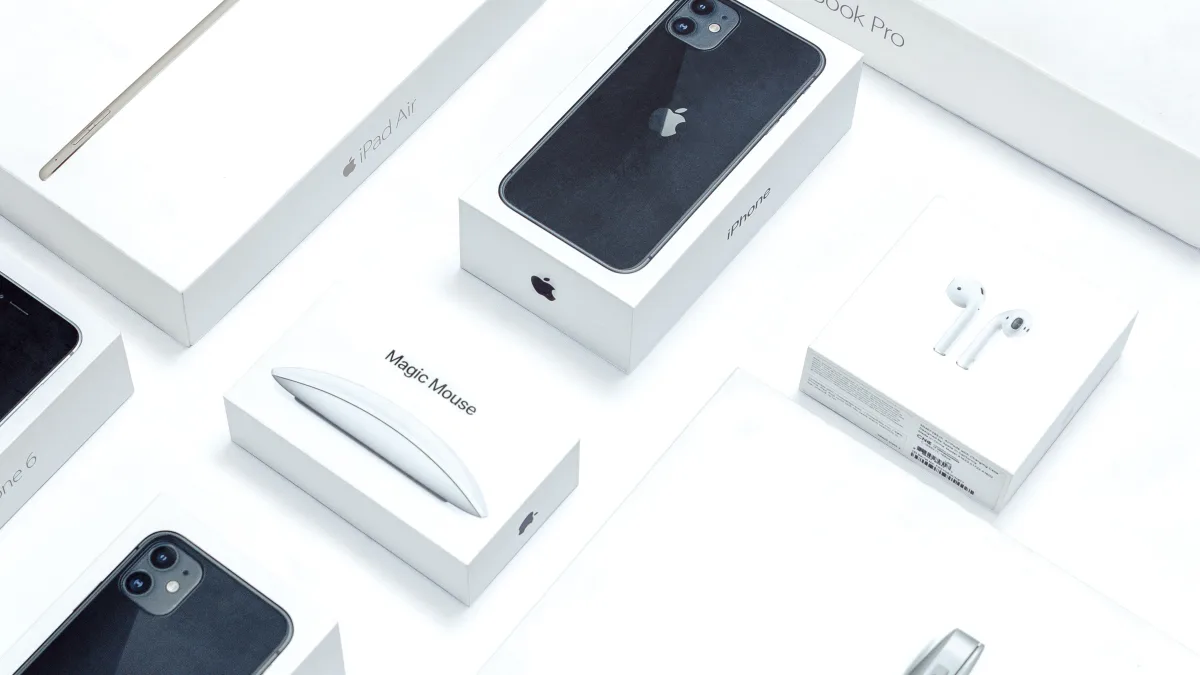
The same rule that opened this guide applies hardest here: a laptop is "good enough" the moment it runs your required software without lag, regardless of what's newer on the shelf.
Define your workload before comparing chips. Web browsing, email, and document editing run comfortably on entry-level Apple Silicon or mid-tier Intel/AMD chips with 8GB of RAM — paying for a higher-end processor here is paying for headroom you won't use. Video editing, 3D rendering, and local AI workloads are the cases where extra CPU/GPU power and 16–32GB of RAM actually translate into time saved.
RAM and storage age worse than CPU speed. 8GB of RAM is already tight for modern multitasking with dozens of browser tabs open; 16GB is the more future-proof baseline for most buyers in 2026. On storage, prioritize SSD speed and at least 512GB if you keep large media files locally — cloud storage doesn't help when you're offline.
Battery life claims are lab numbers, not your numbers. Manufacturer battery-life ratings are measured under standardized, often unrealistically light usage. Check independent reviews (RTINGS, Laptop Mag, PCMag) for real-world battery testing before trusting the spec sheet figure.
Tablet or laptop? If your work involves typing more than a paragraph at a time, spreadsheets, or multi-window workflows, a laptop (or a tablet with a keyboard case and a desktop-class OS, like iPadOS with Stage Manager) will save real friction over a tablet-only setup. Pure content consumption and note-taking lean the other way.
→ Comparing components or full pre-builts? Our Laptops & Computers store directory tracks current pricing, and Newegg's review covers component-buying specifics like GPU inventory and marketplace seller risk.
Frequently Asked Questions
Is it worth buying a flagship smartphone in 2026? Only if your use case touches the flagship's real advantages — sustained heavy performance, premium display, or low-light camera quality. For calls, navigation, and social media, a $400 mid-range phone delivers a nearly identical daily experience.
How many years of software updates should I look for before buying a phone? Treat anything under four years of guaranteed OS updates as a red flag for long-term value. Five-plus years (Google Pixel's seven-year commitment, Apple's typical six-to-seven-year window) usually produces a lower cost per supported year, even at a higher sticker price.
Do I need Matter compatibility for smart home devices? If you want the flexibility to switch platforms or mix devices from different brands later, yes — Matter-certified devices work across Apple HomeKit, Google Home, and Amazon Alexa without extra hubs, which meaningfully reduces the risk of a stranded device if a manufacturer changes course.
Are higher megapixel cameras always better? No. Sensor size and aperture, plus the phone's computational photography pipeline, matter more than the megapixel number for real-world image quality, especially in low light.
Where to Buy: Retailers Worth Comparing
Price and return policy vary meaningfully by retailer for the same device. Before checking out anywhere, compare at least two sources:
- Amazon electronics reviews — broadest selection, fastest shipping for Prime members
- Best Buy electronics review — strongest for in-store evaluation and price matching
- Newegg review — best for PC components and gaming hardware specifically
- Our Price Trend Analyzer tool can confirm whether now is actually a good time to buy a specific model before you do
This article was researched and drafted with AI assistance, then reviewed and fact-checked by a human editor before publishing. Our buying guides are research-based — we synthesize manufacturer specifications, independent industry research, and verified buyer feedback, and we cite our sources. We don't accept payment for rankings. Read our full methodology. Trusted Buyer Report may earn a commission when you click links or make purchases through our site, at no extra cost to you — affiliate placements are added only after our editorial assessment is complete. Full affiliate disclosure.