This guide is based on manufacturer specifications, publicly available market research, and verified buyer feedback aggregated from multiple independent sources. It does not reflect hands-on testing by Trusted Buyer Report. Sources are cited throughout. This article was drafted with AI assistance and fact-checked by our editorial team before publishing.
Trusted Buyer Report may earn a commission when you click links on this page, at no extra cost to you. Full disclosure →
The short answer: If you want zero-setup nostalgia with a fixed game library, the NES Classic Edition or Sega Genesis Mini gets the job done under $100 on the secondary market. If you own original cartridges and want the most accurate modern playback, the Analogue 3D is the standout FPGA choice for N64. And if you want the broadest classic library in a single device you're already buying for modern gaming, the Nintendo Switch 2 with a Nintendo Switch Online + Expansion Pass subscription beats everything else on pure breadth.
The catch? None of these wins every category. Keep reading to figure out exactly which one matches how you actually play.
The 2026 Retro Console Landscape at a Glance
The assumption that retro gaming is a shrinking hobby kept alive by aging collectors is flatly wrong. The global retro gaming console market reached an estimated $3.80 billion in 2025 — up 21.8% year-over-year — and is projected to hit $8.50 billion by 2033 at a 10% compound annual growth rate, according to Icon Era's NES Classic Edition Statistics 2026. That pace is roughly two to three times faster than the broader console market's 3–5% annual growth.
North America leads demand at 38% market share. The search term "retro gaming console" pulls over 74,000 monthly searches with year-over-year growth, per 8BitBlood's 2026 retro handheld review. These numbers reflect active purchase intent, not passive nostalgia.
Three forces are driving the surge. First, players who grew up with the NES and Genesis in the late 1980s and 1990s are now in their 30s, 40s, and 50s — with disposable income and a renewed appetite for the games that defined their childhoods. Second, younger players are discovering classic titles through YouTube retrospectives, streaming, and Nintendo's own subscription services. Third, a growing segment of buyers is actively choosing retro hardware to escape modern gaming's complexity — no day-one patches, no microtransactions, no online requirements.
PCMag's April 2026 update to its best retro consoles list added the Analogue 3D, Analogue Duo, and Nintendo Switch 2 while removing several discontinued models — a clear signal that the market has consolidated around premium FPGA hardware and modern platforms with curated classic libraries.
Head-to-Head Comparison Table
| System | Category | Game Library | Cartridge Support | Display Output | Approx. Price | Best For |
|---|---|---|---|---|---|---|
| NES Classic Edition | Mini console (discontinued) | 30 pre-loaded games | None | HDMI | ~$70–$150 (secondary market) | Casual nostalgia, zero setup |
| Sega Genesis Mini | Mini console | 42 pre-loaded games | None | HDMI | Varies by retailer | Sega fans, plug-and-play |
| Analogue 3D | FPGA cartridge system | Unlimited (N64 carts) | N64 cartridges | HDMI 4K upscaling | $250+ | Collectors, authenticity-focused |
| Nintendo Switch 2 | Modern console + classic catalog | NES, SNES, N64, GB, GBA, Genesis (subscription) | None (digital only) | HDMI / handheld | Current-gen pricing + subscription | Versatile players, breadth over authenticity |
No system sweeps the board. The right pick depends on three variables: what game library matters to you, whether you own original cartridges, and how much you're willing to spend. The rest of this guide works through each system on those terms.
If you're assembling a complete gaming station around your retro picks, the Gaming Buyer's Guide 2026: Consoles, PCs & Accessories covers the full hardware landscape — from current-gen consoles to peripherals and desk setup.
NES Classic Edition (2026): What It Still Gets Right — and Where It Stops
What is the NES Classic Edition and is it worth buying in 2026?
The NES Classic Edition is a plug-and-play mini console that Nintendo produced in two limited runs (2016–2017 and 2018), loading 30 NES games onto HDMI-output hardware the size of a paperback book. It is no longer manufactured. In 2026, buying one means buying on the secondary market.
For casual players, it still works extremely well for its intended purpose. The 30-game library is a genuine all-star lineup — Super Mario Bros., The Legend of Zelda, Mega Man 2, Castlevania, Metroid — and the replica controllers feel close to the originals. Setup is literally plug-in-and-play. There's no firmware to update, no account to create, no internet connection required.
The hard ceiling is the library itself. The NES Classic has no cartridge slot and no expansion path. If you want to play any NES title not on those 30, this is the wrong device. That's not a flaw for its intended audience — it's a design choice. Treat the 30-game list as a feature, not a limitation, and you'll be satisfied. Expect more, and you won't.
NES Classic Edition pricing in 2026: secondary market reality
Nintendo discontinued the NES Classic in 2017 after selling 2.3 million units, then rereleased it in 2018 (adding roughly 1.3 million more). According to Coop Board Games' NES Classic Edition Statistics, total lifetime sales were approximately 3.6 million units.
Secondary market prices in 2026, per Icon Era:
- Loose unit: approximately $70 (17% above original MSRP of $59.99)
- Complete-in-box: approximately $80 (33% above MSRP)
- New sealed: approximately $120 (104% above MSRP)
- VGA 90+ graded mint: $200 or higher
- VGA 95 Gold graded: $539.99 — roughly 900% above original retail
The premium at the collector end tells you something important: a meaningful portion of NES Classic demand is now investment-driven rather than player-driven. For someone who wants to actually play games, a loose unit at ~$70 is the practical buy. Paying $200+ for a sealed unit only makes sense if you're treating it as a collectible.
Bottom line: The NES Classic Edition is a good buy at the right price for the right player. It's not the right buy if you want to explore beyond its curated 30 games.
Sega Genesis Mini: The Best Mini Console for Sega's Library — With a Familiar Tradeoff
Is the Sega Genesis Mini still worth buying in 2026?
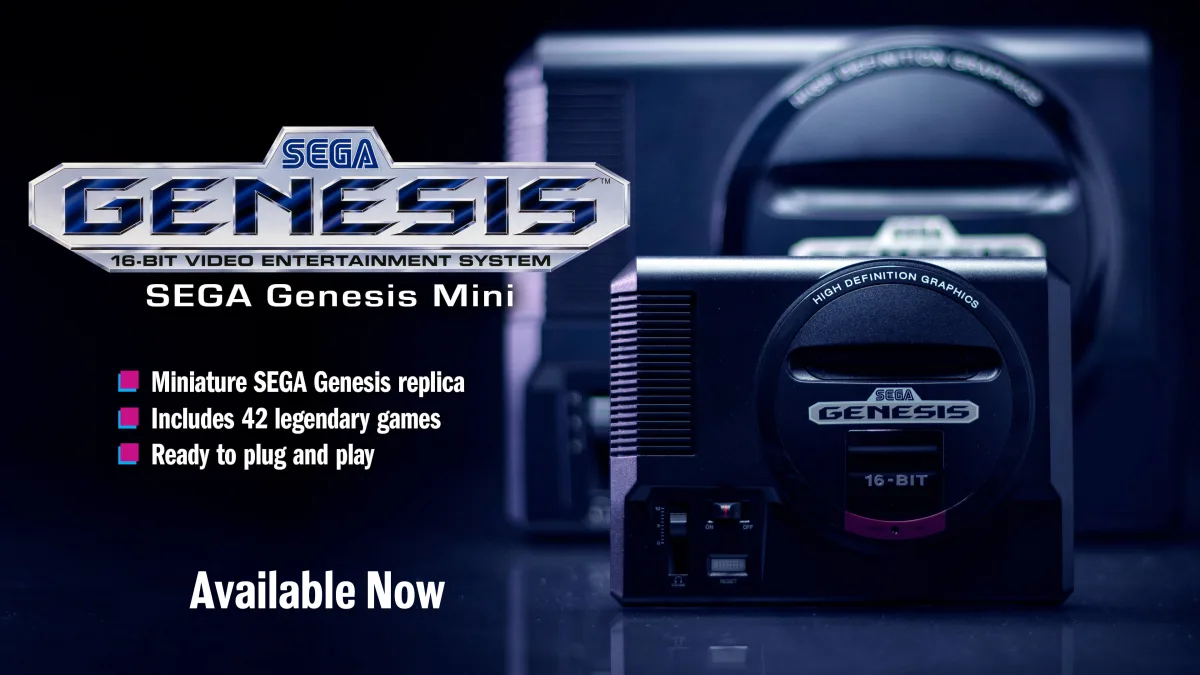
Yes — if you grew up with a Sega Genesis and want that specific library in plug-and-play form. The Genesis Mini is the best-executed mini console for Sega's catalog, and GamesRadar's 2026 retro console roundup specifically lists it as "Best for Sega" because of how faithfully it replicates the original experience.
The original Sega Genesis sold 34.06 million units in its lifetime, per Gaming Console Statistics and Facts (2026), creating a large installed base of players with genuine nostalgia for Sonic, Streets of Rage, Mortal Kombat, and Castlevania: Bloodlines. The Genesis Mini's 42 pre-loaded games cover most of the catalog's high points, and the replica USB controllers nail the feel of the original three-button and six-button pads.
The limitation mirrors the NES Classic: no cartridge slot, no expansion. If a Genesis title isn't on the pre-loaded list, you can't play it here. The Analogue Mega Sg — an FPGA-based Genesis system that accepts original cartridges — is the natural upgrade for players who want to go deeper into the Sega back catalog.
Who should buy the Genesis Mini: Someone who wants a self-contained Sega experience with no technical friction, doesn't have an existing cartridge collection, and is specifically nostalgic for the Genesis era (not Master System, not Sega CD).
Who should skip it: Anyone who owns Genesis cartridges and wants to play them, or anyone expecting to access the full Genesis library.
Analogue 3D and Analogue Duo: The Case for FPGA Retro Gaming
What is FPGA and why does it matter for retro gaming?
FPGA stands for Field-Programmable Gate Array — a chip that can be reconfigured to replicate the behavior of another chip at a hardware level. When Analogue builds an FPGA console, it isn't running software that imitates a Nintendo 64. It's reconfiguring hardware to behave like the original N64 silicon. The practical result: more accurate audio reproduction, more precise video timing, and fewer of the compatibility glitches that software emulation sometimes introduces with edge-case games.
This is the core reason Analogue hardware costs significantly more than mini consoles or RetroN systems. You're not paying for more pre-loaded games — you're paying for hardware-level accuracy with original cartridges.
Analogue 3D: the standout FPGA story of 2026
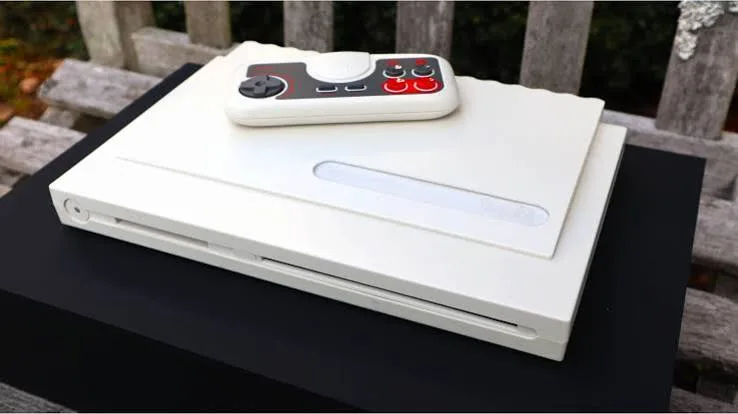
The Analogue 3D is designed to play original N64 cartridges on modern televisions with HDMI output and 4K upscaling. Retrolize describes it as "one of the year's most visible FPGA stories," and PCMag added it to its best retro consoles list in its April 13, 2026 update alongside the Analogue Duo.
A key recent firmware update added save states — a feature the original N64 never supported — which illustrates how FPGA systems can extend original hardware's usability while still requiring original cartridges. The Nintendo 64 sold 32.93 million units in its lifetime per Gaming Console Statistics and Facts (2026), so the potential audience for the Analogue 3D is real. But it's a subset of that audience: collectors and enthusiasts willing to invest in premium hardware and source cartridges separately.
Analogue Duo: the best option for PC Engine and TurboGrafx-16
The Analogue Duo targets a narrower audience — players with PC Engine or TurboGrafx-16 cartridge collections. The TurboGrafx-16 had a devoted following in Japan and among North American enthusiasts but never reached mainstream scale. If you have that collection, the Duo is one of the few modern options that handles it properly via FPGA. If you don't, the Duo is not an entry point into retro gaming — it's a specialist tool.
Who should buy Analogue systems: Serious collectors with existing cartridge libraries who prioritize hardware authenticity over convenience and are willing to pay premium pricing.
Who should skip them: Casual players, anyone without existing cartridges, or anyone primarily interested in breadth of available titles.
Nintendo Switch 2: The Best Single Device for Classic Nintendo Games in 2026
Is the Nintendo Switch 2 a good retro gaming console?
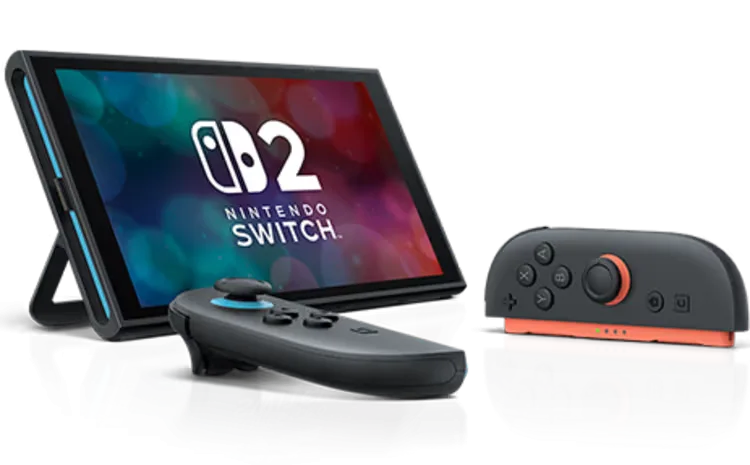
For breadth of classic titles accessible through a single device, nothing in 2026 comes close. With a Nintendo Switch Online + Expansion Pass subscription, the Switch 2 provides access to libraries spanning NES, SNES, Nintendo 64, Game Boy, Game Boy Advance, and Sega Genesis. PCMag explicitly calls the Switch 2 "easily the best platform for playing classic Nintendo games" in its April 2026 assessment.
Consider the scale: the NES sold 61.91 million units, the SNES 49.1 million, the Game Boy Advance 81.51 million — all per Gaming Console Statistics and Facts (2026). The Switch 2's subscription catalog draws from hardware that collectively reached hundreds of millions of players.
The structural tradeoff is real and worth understanding before you buy:
- Subscription dependency. Classic game access disappears if the subscription lapses. You're renting access, not owning it.
- Software emulation, not FPGA. The Switch 2 runs classic titles through software emulation, which is excellent for the vast majority of players but doesn't match the hardware-level accuracy of Analogue systems.
- No cartridge support. Everything is digital-only. Original retro cartridges don't work here.
- Modern gaming included. If you're buying the Switch 2 for current-gen games anyway, the classic library is essentially a free bonus.
If you're building a broader gaming setup and want to understand where a gaming subscription fits alongside hardware like this, the comparison in Best Game Subscription Services 2026: Xbox Game Pass vs PS Plus vs Nintendo Online breaks down the value calculation in detail.
Who should buy the Switch 2 for retro gaming: Players buying it primarily for modern games who want classic libraries as a secondary benefit, or anyone who wants the widest possible catalog without managing cartridges.
Who should skip it (for retro purposes): Collectors who want original cartridge playback, or anyone who only wants retro gaming and doesn't need a current-gen console.
Beyond the Big Four: Evercade, Hyperkin RetroN, and Handheld Alternatives
Not every retro buyer fits the four systems above. Several alternatives fill important gaps in the market.
Evercade VS-R uses its own licensed cartridge format — compilations from publishers including Atari, Namco, and Data East. You buy a physical cartridge, you own the games permanently, and you can play them without a subscription or internet connection. It's the best option for players who want physical media ownership without the price point of Analogue hardware or the cartridge-sourcing effort.
Hyperkin RetroN series takes a multi-system approach. The RetroN 5, for example, accepts NES, SNES, Famicom, Super Famicom, and Game Boy cartridges in a single device. As Mezha notes in its 2026 retro console overview, systems like the RetroN series let players use original cartridges without sourcing original hardware. The tradeoff is software emulation rather than FPGA accuracy, but the price point is considerably more accessible than Analogue.
Analogue Pocket is the standout for handheld retro gaming. It accepts original Game Boy, Game Boy Color, and Game Boy Advance cartridges and uses FPGA hardware for accurate playback. 8BitBlood's 2026 handheld roundup highlights it as a top pick for Game Boy-era players who want the definitive portable version of that specific library.
For more handheld options across the full gaming landscape, Best Gaming Laptops 2026: Balancing Performance, Price & Portability covers portable gaming hardware at a broader level if you're weighing handheld versus laptop form factors.
Controllers, Displays, and Accessories Worth Knowing About
Hardware choice doesn't stop at the console. A few accessories meaningfully affect the experience:
Controllers: The NES Classic and Genesis Mini include replica controllers, but their cord lengths are short — a common complaint. For the Analogue 3D, original N64 controllers work directly; aftermarket options like the Brawler64 are worth considering for ergonomic improvements. If you're comparing third-party versus official controller options for any of these systems, Best Gaming Controllers 2026: Third-Party vs Official has a detailed breakdown.
CRT vs modern displays: FPGA systems like the Analogue 3D output HDMI with 4K upscaling optimized for modern televisions. Mini consoles also output via HDMI. If you want the original CRT look on modern hardware, a RetroTINK upscaler or similar device is the standard solution.
Desk and setup: Running a multi-console retro setup generates a surprising amount of cable management complexity. If you're building a dedicated gaming space, Best Gaming Desks 2026: Space and Cable Management covers the desk options designed with cable routing in mind.
Where to Buy Retro Gaming Consoles — and How to Avoid Overpaying
The NES Classic and Sega Genesis Mini are no longer sold new by Nintendo or Sega. Your options in 2026:
- eBay and StockX for secondary market pricing with buyer protection. Secondary market prices for the NES Classic currently sit around $70 loose, per Icon Era data.
- GameStop carries some retro hardware, though availability varies by location and stock. For a full picture of what GameStop offers in 2026 versus online alternatives, the GameStop Review 2026: Is It Still Relevant? covers the retailer's current value proposition honestly.
- Amazon and Best Buy for the Sega Genesis Mini and Hyperkin RetroN systems, where availability is more consistent.
- Analogue's official site (analogue.co) for the Analogue 3D, Analogue Duo, and Analogue Pocket — though inventory often sells out quickly.
- Digital game marketplaces for the cheapest way to play classic titles. If you're primarily interested in classic game access rather than original hardware, Cheap Game Keys 2026: Steam, PS, Xbox covers where to find legitimately discounted digital games across platforms.
Frequently Asked Questions
Is the NES Classic Edition still worth buying in 2026?
For casual players who want a specific, curated NES experience with zero setup, yes — if you find a loose unit near the $70 secondary market price. Paying $120 or more for a sealed unit makes sense only as a collectible, not as a gaming device. The Nintendo Switch 2's Nintendo Switch Online subscription covers all 30 NES Classic titles plus hundreds more, so the Switch 2 beats it on pure value if you already own one.
What is FPGA and why does it matter for retro gaming?
FPGA hardware replicates the original console's chip behavior at the hardware level rather than through software emulation. For retro gaming, this means more accurate audio and video output and fewer compatibility issues with original cartridges. Analogue systems use FPGA technology — which is why they cost significantly more than mini consoles or Hyperkin RetroN devices, but produce results that software emulation cannot fully match.
Can I play original cartridges on any of these systems?
The Analogue 3D plays original N64 cartridges. The Analogue Duo plays PC Engine and TurboGrafx-16 cartridges. The Hyperkin RetroN 5 accepts NES, SNES, Famicom, Super Famicom, and Game Boy cartridges. The NES Classic, Sega Genesis Mini, and Nintendo Switch 2 do not accept any original cartridges — their libraries are fixed (mini consoles) or digital-only (Switch 2).
Which retro gaming console has the best value for beginners?
The Nintendo Switch 2 with Nintendo Switch Online + Expansion Pass offers the broadest classic access at the lowest per-game cost — assuming you're buying the Switch 2 for modern gaming anyway. If you only want retro gaming and nothing current-gen, a Sega Genesis Mini or NES Classic at secondary market prices is a lower upfront investment for a specific, contained experience.
Are retro gaming consoles a good financial investment in 2026?
Sealed and graded NES Classic units have appreciated significantly — VGA 95 Gold units have sold for approximately $540 against an original $59.99 MSRP, per Icon Era. But buying retro hardware as a financial investment is speculative. Individual product appreciation depends heavily on condition, grading, and collector demand at the time of sale. Don't buy for investment unless you're prepared to hold.
How does FPGA compare to software emulation for retro gaming?
FPGA replicates original hardware behavior at the chip level, producing more accurate audio, video timing, and cartridge compatibility. Software emulation (used by the Switch 2, RetroN systems, and most PC/mobile emulators) interprets the original hardware's behavior through code running on modern processors — excellent for the vast majority of games, but occasionally imperfect on edge cases. For 95% of players, software emulation is indistinguishable from the real thing. For collectors and enthusiasts who care about 100% accuracy, FPGA is worth the premium.
Final Decision Framework: Which Retro Console Is Right for You?
The right retro console isn't the most expensive one — it's the one that matches how you actually play.
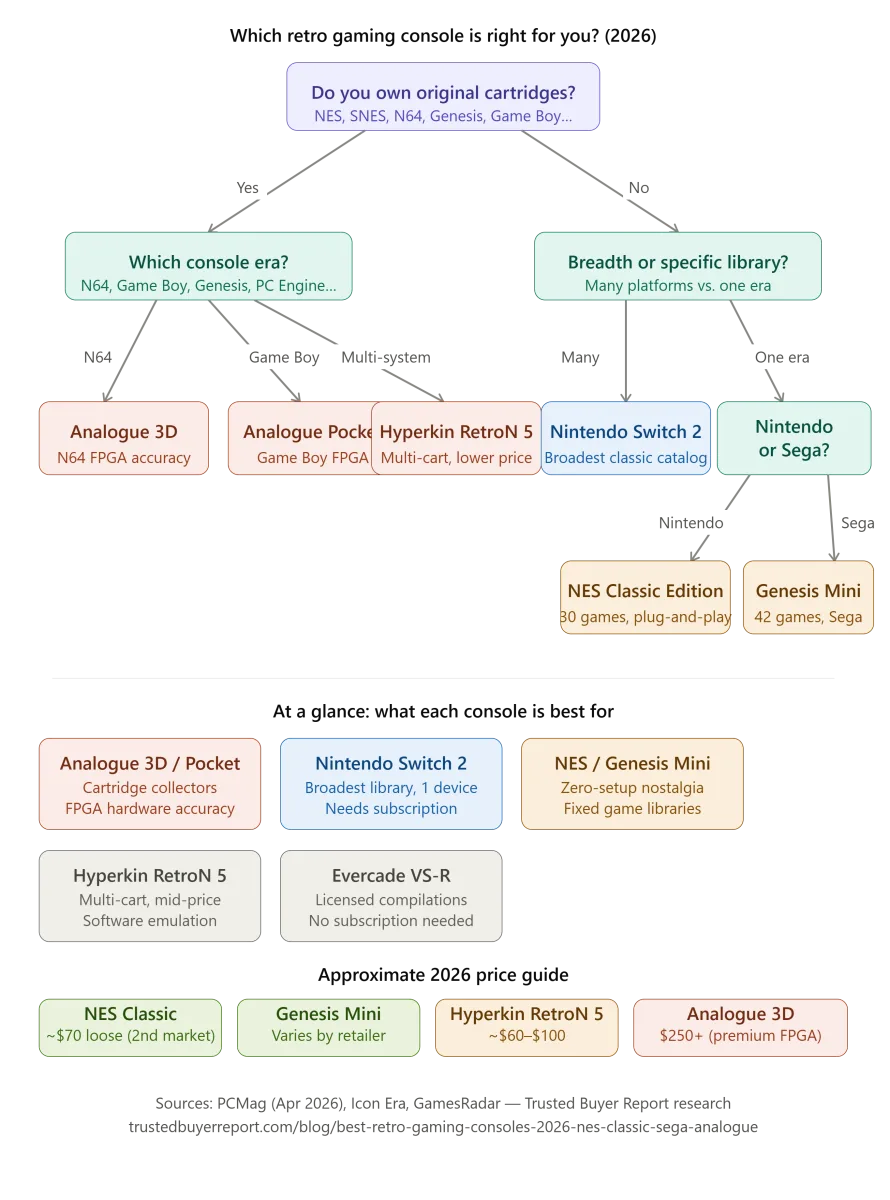
Choose the NES Classic Edition if: You want specific, curated Nintendo nostalgia with zero setup complexity. Buy loose at secondary market pricing (~$70). Treat the 30-game library as the feature, not the flaw.
Choose the Sega Genesis Mini if: You're specifically nostalgic for Sega's library and want a faithful, plug-and-play replica. You don't own Genesis cartridges and don't need to access the full catalog.
Choose the Analogue 3D if: You own or plan to build an N64 cartridge collection and want hardware-accurate playback on modern displays. You prioritize authenticity over convenience and are comfortable with the premium price.
Choose the Nintendo Switch 2 if: You want the widest possible classic library in a single device you're already buying for modern gaming. You accept subscription dependency and digital-only access.
Choose the Hyperkin RetroN 5 or Evercade VS-R if: You want original cartridge support at a lower price than Analogue, or you want physical media ownership without subscription costs. Accept software emulation rather than FPGA accuracy.
The retro gaming market in 2026 is legitimately well-served across price points and use cases. The most common mistake buyers make is choosing based on brand recognition rather than use-case fit. Match the hardware to how you actually play, and you'll get it right.
Researched and drafted with AI assistance; fact-checked by the Trusted Buyer Report editorial team. Sources cited throughout. For our full review methodology, see how we review.
Infographic: Which Retro Console Is Right for You? (Decision Tree)