

Most people Googling this aren't trying to learn what a robo-advisor is. They're trying to answer one question: given my situation, which one actually serves me better? That's the question this guide answers — not with a generic feature list, but with a decision framework built around your asset level, your financial complexity, and your life stage.
Quick answer: if you have a straightforward financial life and less than $100,000 in investable assets, a robo-advisor is almost always the better fit. If you're within 10 years of retirement, navigating an inheritance or business sale, or your money decisions are starting to touch each other (taxes, estate, insurance, multiple accounts), a human advisor's coordination is worth the higher fee. If you're somewhere in between, a hybrid model — automated management plus occasional human access — is increasingly the default choice, not a compromise.
TL;DR
- Robo-advisors charge a median of 0.25% annually; the average human advisor charges around 1.50% of assets managed.
- Only about 7% of financial advisors actively work with clients who have under $100,000 in investable assets — robo-advisors exist specifically to serve everyone else.
- Hybrid platforms (automated investing + access to a human CFP) are projected to make up 56.5% of the robo-advisory market in 2026 — it's now the dominant model, not a niche one.
- If you're choosing a specific platform rather than a model, see our best robo-advisors comparison for a head-to-head of Betterment, Wealthfront, and Fidelity Go.
Why This Decision Trips People Up

Only 7% of financial advisors focus on clients with under $100,000 in investable assets, based on research cited by Investing Insights. If you're early in building wealth, the traditional advisory model genuinely wasn't built with you in mind — choosing a robo-advisor isn't settling for less, it's choosing the tool actually designed for your stage.
Two very different investors are reading this article. One is 28, has a new 401(k), and wants to start investing without high fees or account minimums shutting them out. The other is 52, approaching retirement, juggling multiple accounts and an upcoming inheritance, and needs coordinated human judgment more than algorithmic efficiency. Neither robo-advisors nor human advisors are universally "better" — the right answer depends on where you actually fall on that spectrum.
According to financial technology publication Astor, human advisors generally make sense once you cross roughly $100,000 in assets or hit a major life transition. Below that line, the traditional fee structure usually doesn't match the value you'd get from it — which is exactly the gap robo-advisors were built to close.
If you want the bigger financial picture beyond just the advisor question, our Financial Services Guide 2026 covers how this decision fits alongside credit cards, insurance, and other money choices.
What a Robo-Advisor Actually Does — and Where It Stops

A robo-advisor builds and manages a diversified portfolio using algorithms based on your goals and risk tolerance. Because software, not a person, handles the day-to-day management, fees run far lower — and that gap compounds meaningfully over decades. Robo-advisors automate investment management in a way that, according to NerdWallet's robo-advisor research, can translate to better long-term returns simply by cutting the drag of fees.
Typical services include automatic rebalancing, tax-loss harvesting on taxable accounts, and portfolios built from low-cost ETFs. Platforms differ a lot in depth: Schwab Intelligent Portfolios offers more than 80 portfolios across 20 asset classes and lets you exclude up to three ETFs from your holdings — a level of customization most people don't expect from an automated platform, per NerdWallet's analysis.
The fee picture is one of the clearest reasons people switch. According to financial comparison site unbiased.com, the median robo-advisor fee sits at 0.25%, and some platforms charge nothing for basic management. Fidelity Go, for example, is free on balances up to $25,000, then moves to 0.35% annually — a structure built for people just starting out.
Accessibility is the other major advantage. Of roughly 20 major U.S. robo-advisors examined in research reviewed by Investing Insights, about five require no minimum investment at all, and nearly every other provider sets the bar at $500 or less.
What robo-advisors don't do matters just as much. They don't build holistic financial plans, address estate planning or insurance gaps, or navigate a business sale. The "personalization" is limited to what an algorithm can infer from form inputs — not the nuance of an actual conversation about your life. Some platforms now offer optional human CFP access, but it usually requires a higher balance or an added fee, and the depth varies a lot between providers.
Betterment and Wealthfront are widely credited with making properly diversified, automated investing accessible before it became mainstream, per Astor's advisor-comparison research — before these platforms, getting a rebalanced portfolio without serious effort meant hiring an advisor or doing the work yourself.
What a Financial Advisor Actually Does — and Why It Costs More

A human advisor's real value in 2026 isn't picking stocks. According to the Russell Investments 2026 Value of an Advisor Study, the role has shifted well past investment selection — something a robo-advisor handles competently on its own — toward coordinating a client's portfolio with their full financial life: lifestyle, family decisions, and multi-generational goals.
That coordination spans estate planning, insurance review, holistic tax strategy, retirement income sequencing, Social Security timing, and guidance through major transitions like inheritance, a business sale, or divorce. These decisions interact — a mistake in one area can quietly undo progress in another — and that's exactly the kind of cross-domain judgment software can't replicate.
Fiduciary status matters here. A fiduciary advisor is legally required to act in your best interest, which is critical when advice could conflict with the advisor's own incentives, such as recommending a commission-paying product. Not every advisor carries this designation, so confirming it before you engage one isn't optional.
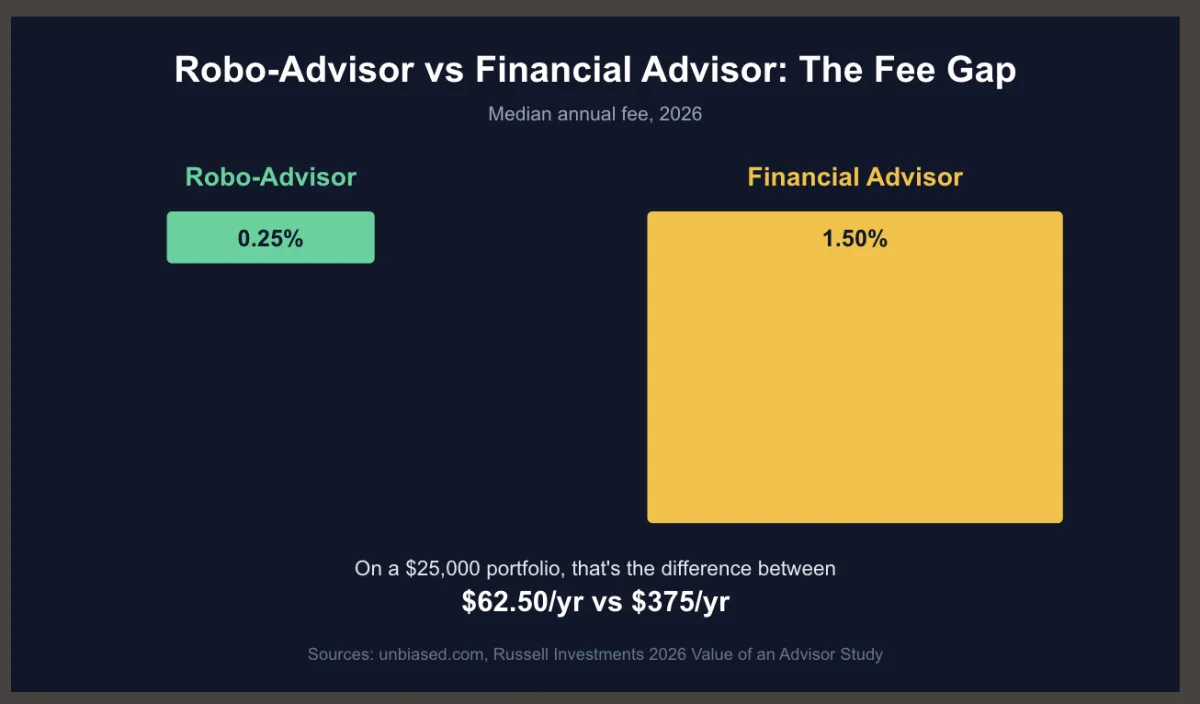
The cost reflects that scope. Citing AdvisorHQ data, the Russell Investments study puts the average financial advisor fee at roughly 1.50% on a typical account, versus 0.25%–0.50% for robo-advisors over the same period — a gap of about one to 1.25 percentage points a year, which is effectively the price of human coordination and access.
According to advisory firm TenCap, a financial advisor adds clear, measurable value when you hold multiple asset classes or accounts, when you're approaching or managing retirement income, when you're navigating an inheritance or business sale, or when you simply want direct, ongoing access to a professional. That's not a rare edge case — it describes a large share of investors in their 40s, 50s, and beyond.
The Fee Gap, in Dollars: What 1 Percentage Point Costs You Over Time
A difference of one to 1.25 percentage points a year sounds small in isolation. Over a 20-year horizon, it isn't. Fees compound against you the same way returns compound for you — quietly, every year, on a shrinking base. On a meaningful portfolio, the gap between paying 0.25% and 1.50% annually doesn't just dent this year's return; it reduces the principal future returns get calculated on, year after year.
That doesn't mean lower fees automatically win. If a human advisor stops you from making one large behavioral mistake — panic-selling during a downturn, for instance — that single intervention can outweigh years of fee savings. If an advisor structures a Roth conversion, optimizes Social Security timing, or reduces estate tax exposure for your heirs, that guidance can be worth far more than the fee differential. The Russell Investments study frames advisor value across behavioral coaching, tax planning, and portfolio management specifically because most of the measurable value sits outside raw investment returns.
For smaller portfolios, the math tilts hard toward automation: a 1.50% fee on a $25,000 portfolio is $375 a year; a 0.25% fee on the same balance is $62.50. At that scale, the question usually isn't which option performs better — it's whether paying for human advisory is proportionate to the assets involved. At $250,000 or more, both the dollar cost and the potential planning value grow large enough that the comparison becomes genuinely close.
One nuance worth confirming before you assume it applies to you: some robo-advisors offer tax-loss harvesting that can partially offset their fee in taxable accounts. It isn't universal across platforms, and its value depends heavily on your tax bracket and account type — check the specific platform rather than treating it as a given.
Who Should Use a Robo-Advisor in 2026

A robo-advisor isn't a consolation prize for people who can't afford an advisor. For a specific investor profile, it's genuinely the better tool.
You're a strong fit if you're early in building wealth, your financial situation is straightforward — one account type, a standard risk profile, no estate or business complexity — and you want low-cost, automated management without ongoing hand-holding. Astor's advisor-comparison research describes this as "set-and-forget automation": investors who want a properly diversified portfolio without the cost or access barriers of traditional advisory.
If you're already on a major platform for your 401(k), a robo-advisor within that same ecosystem can be the path of least friction. NerdWallet notes that 24.8 million people already use Fidelity for their 401(k); for many of them, adding Fidelity Go means the same login, the same interface, and consolidated tax reporting.
CNBC Select identifies a similar set of best-fit profiles: beginners who want an accessible entry point, parents investing on behalf of children, and investors who simply prioritize hands-off, automatic investing. The common thread is a financial life that hasn't yet grown complex enough to need coordinated human judgment across multiple domains.
Who Should Use a Financial Advisor in 2026
A financial advisor earns their fee once decisions in one part of your financial life start meaningfully affecting another — and once getting that wrong gets expensive. Per Astor's research, that threshold tends to land around $100,000 or more in assets, or during a major life transition, whichever comes first.
Approaching or entering retirement is one of the clearest triggers. Income sequencing — which accounts you draw from, and in what order — affects your tax bill, your Medicare premiums, and how long your portfolio lasts. Social Security timing involves trade-offs tied to your health, your spouse's situation, and your other income sources — not a single "correct" algorithmic answer.
Major life transitions are another clear category: an inheritance, a business sale, a divorce, or the loss of a spouse all carry financial and emotional complexity automated platforms aren't built to handle. Decisions made in these moments — how to structure a lump sum, how to update beneficiaries, how estate documents should change — can ripple for decades.
Behavioral coaching matters more than people expect. The Russell Investments study treats it as a core component of advisor value, not a soft perk: an advisor who calls during a market drop and talks you out of selling can generate more value in that one conversation than years of fee savings would offset. If you already know you make emotional investment decisions during volatility, that's a strong signal toward human advisory.
Astor's framework shows human advisors as the only category that covers estate planning, insurance, and holistic financial planning end to end — if your situation touches any of those areas, you've already moved past what automated platforms are designed to handle.
The Hybrid Model: Why It's Becoming the Default

The robo-advisor-versus-human framing is increasingly outdated. According to market research firm Fortune Business Insights, hybrid robo-advisors — platforms combining automated portfolio management with access to a human advisor — are projected to make up 56.53% of the global robo-advisory market in 2026. That's the dominant model, not a niche one.
The logic is straightforward: investors want both cost efficiency and human judgment, and hybrid platforms deliver some version of both. Fortune Business Insights notes that high-net-worth individuals gravitate toward hybrid platforms specifically because they want algorithmic efficiency paired with human input on complex decisions. For investors whose assets and life complexity are both growing, a hybrid model can serve as a practical bridge before committing to full human advisory.
CNBC Select points out that human-advisor access is increasingly a key differentiator between robo-advisor platforms, sometimes gated behind a premium tier. The real question when evaluating a "hybrid" option is whether that human access means substantive financial planning, or just customer service with a finance veneer — a 15-minute call with a generalist rep isn't the same thing as a fiduciary CFP reviewing your full financial picture.
The growth numbers back the trend: Fortune Business Insights reports North America generated 25.20% of the global robo-advisory market in 2025, and separate research cited in that report found advisors who integrated digital tools saw a 77% increase in client retention — a sign that technology and human advisory are complementing each other more than competing.
How to Evaluate a Robo-Advisor: What Actually Separates Platforms
If a robo-advisor fits your situation, the differentiators that matter are more specific than most "best of" lists suggest:
| Factor | Why it matters |
|---|---|
| Account minimum | Ranges from $0 to several thousand dollars — a hard threshold if you're starting small. |
| Total fee load | The headline management fee isn't the whole cost. Check embedded ETF expense ratios, premium-feature fees (like CFP access), and any cash-sweep program that could drag on uninvested cash. |
| Portfolio breadth | Ranges from narrow, one-size-fits-all to highly configurable. Schwab's 80+ portfolios across 20 asset classes sits at the high end. |
| Tax-loss harvesting | Can meaningfully improve after-tax returns on taxable accounts — confirm it applies to your account type and balance tier. |
| Ecosystem fit | A robo-advisor inside an institution where you already bank can simplify tax reporting and reduce admin friction. |
| Human advisor access | Confirm exactly what's included before treating it as a meaningful feature. |
| App usability & support | Affects whether you actually use the platform consistently over time. |
CNBC Select's evaluation framework weighs largely the same factors — account minimums, investment selection, additional fees, human advisor access, available account types, and tax tools — which lines up with what separates platforms that look similar on paper but perform differently in practice. For a direct comparison of specific platforms against these criteria, see our best robo-advisors guide comparing Betterment, Wealthfront, and Fidelity.
How to Evaluate a Financial Advisor: Questions That Reveal Real Value
Choosing a financial advisor is a different exercise than comparing software — you're evaluating a relationship, and the quality of that relationship determines whether you get what you're paying for.
Start with fiduciary status. Ask directly: "Are you a fiduciary, and are you required to act in my best interest at all times?" A clear yes or no tells you a lot. An advisor who hedges or adds conditions is telling you something about how that relationship will actually work.
Understand the full fee structure. The 1.50% AUM average is just one model — advisors also charge flat fees, hourly rates, or retainers. If your needs are complex but your assets are modest, a flat-fee or hourly advisor can be more cost-effective than an AUM-based one.
Ask what's actually included. Does the advisor coordinate estate planning, insurance review, and tax strategy — or mainly manage investments? If it's mostly investment management, you're paying human-advisor prices for something a robo-advisor can do for a fraction of the cost.
Verify credentials. A CFP (Certified Financial Planner) designation reflects a specific education standard and ethical obligation. Other designations exist with varying levels of rigor, so knowing what your advisor's credentials actually represent helps you calibrate expectations.
Decision Framework: Choose Based on Your Situation
This isn't a quality judgment — it's a fit judgment. Use this as a direct checklist against your own situation.
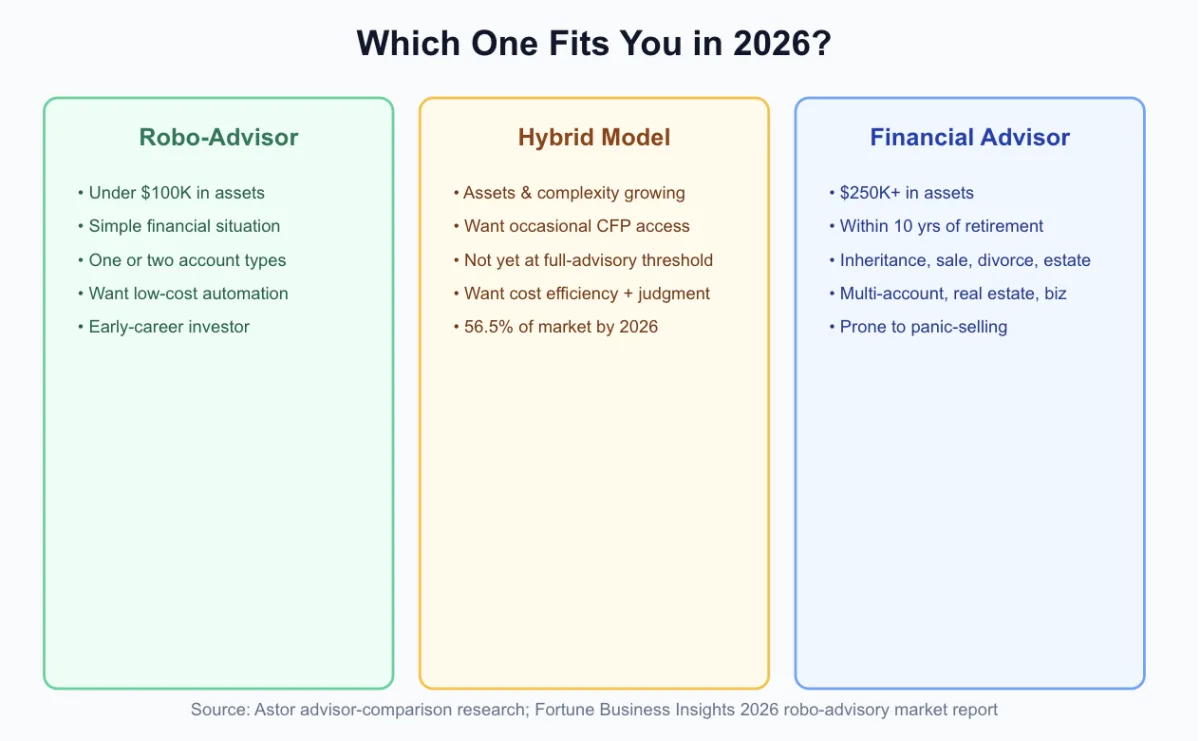
Choose a robo-advisor if:
- You have under $100,000 in investable assets and a straightforward financial picture
- You want low-cost, automated management without ongoing advisor interaction
- Your financial life involves one or two account types, with no estate, business, or complex tax considerations
- You're already on a major platform (like Fidelity) and want automated investing in the same ecosystem
- You're an early-career investor building your first real portfolio
Choose a financial advisor if:
- You have $250,000 or more in assets, especially spread across multiple account types
- You're within 10 years of retirement, or already drawing retirement income
- You're navigating a major life transition: inheritance, business sale, divorce, or estate planning
- Your situation involves real estate, business interests, or multi-generational wealth
- You know from experience that you make emotional investment decisions during volatility
Consider a hybrid model if:
- Your assets and financial complexity are both growing, but you're not yet at the threshold for full human advisory
- You want automated management with occasional CFP access for specific questions
- You want cost efficiency without giving up human judgment entirely on the decisions that matter most
The 56.53% projected hybrid market share for 2026 reflects a real shift: most investors don't fit cleanly into either extreme — and increasingly, the platforms don't expect them to.
FAQ
Is a robo-advisor as safe as a financial advisor? Regulated robo-advisors are registered investment advisors and carry SIPC coverage on cash and securities up to standard limits, same as most brokerage accounts. Safety isn't the differentiator here — service scope is.
Can I switch from a robo-advisor to a financial advisor later? Yes, and many investors do exactly this as their assets and complexity grow. There's no penalty baked into the robo-advisor model for outgrowing it.
Do robo-advisors work for retirement accounts? Most major robo-advisors support IRAs and Roth IRAs, though support for employer-sponsored 401(k) management specifically varies by platform — confirm this before assuming it's included.
Is a 1.50% advisor fee too high? Not necessarily — it depends entirely on what you're getting for it. If the advisor is providing estate planning, tax strategy, and behavioral coaching, the fee can be justified. If the service is mostly investment selection, that's the same work a robo-advisor does for a fraction of the cost.
This article was researched and drafted with AI assistance, then reviewed and fact-checked by our editorial team before publishing. It's based on published research, advisor-fee data, and industry market reports — it does not reflect hands-on testing of any specific platform. Trusted Buyer Report may earn a commission from links on this page. How we review · How we use AI
Note: This article is for general informational purposes and isn't personalized financial advice. Consider consulting a licensed financial professional about your specific situation.