

How this guide was researched: Fees and feature data come from official platform disclosures (Betterment, Wealthfront, Fidelity), cross-referenced with NerdWallet's 2026 robo-advisor rankings, NerdWallet's Betterment vs Wealthfront comparison, unbiased.com's 2026 robo-advisor analysis, and iAdviser's March 2026 fee comparison. This is an independent research synthesis — Trusted Buyer Report is not affiliated with any platform listed.
This article was drafted with AI assistance and fact-checked by our editorial team. We may earn a commission from purchases made through links on this page, at no additional cost to you. This is not financial advice — consult a qualified advisor before making investment decisions.
TL;DR — Which Robo-Advisor Should You Use?
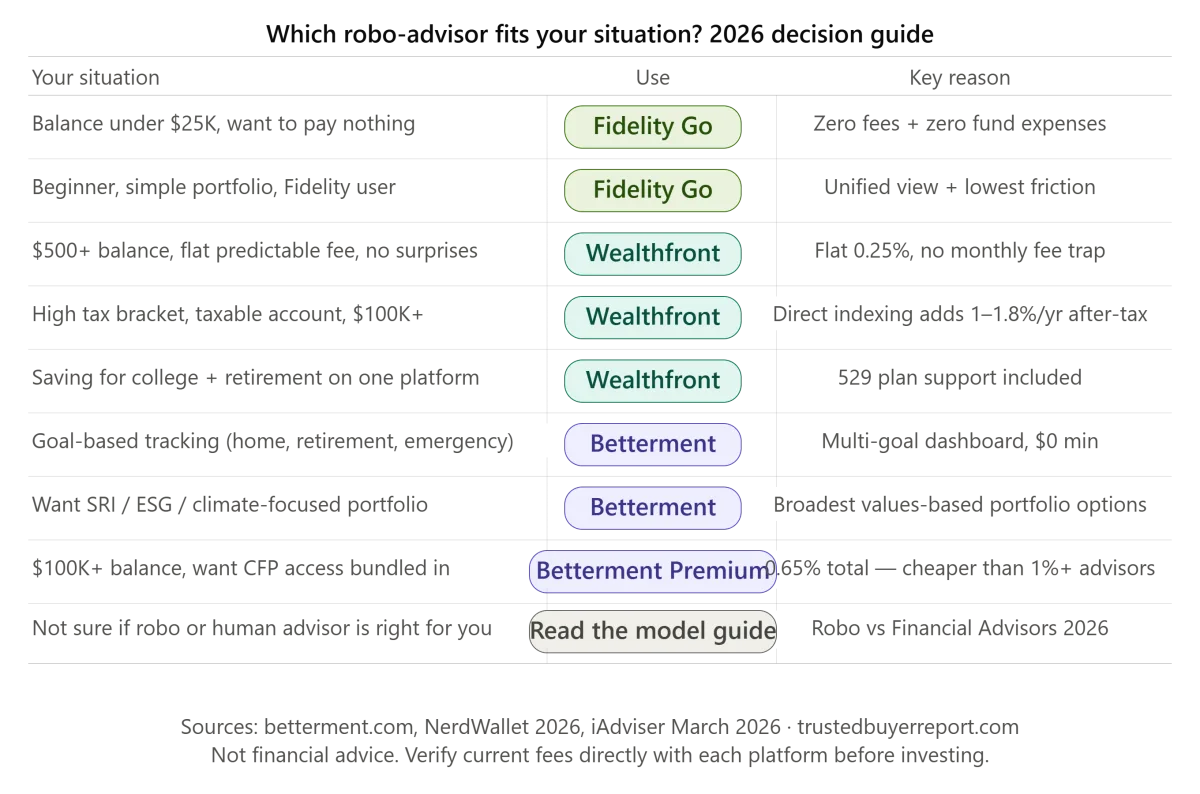
Choose Fidelity Go if: Your balance is under $25,000. You pay zero management fees and get zero-expense-ratio funds. No other platform beats this for small balances.
Choose Wealthfront if: You have $500+ and want a flat 0.25% fee with no minimums drama, the broadest asset class diversification (up to 17 global asset classes), and the strongest tax-loss harvesting including direct indexing above $100K. No human advisor access — deliberately.
Choose Betterment Digital if: You want goal-based investing with no minimum balance, daily tax-loss harvesting, and the flexibility to upgrade to human CFP access as your balance grows.
Choose Betterment Premium if: You have $100,000+ and want unlimited access to salaried CFP professionals alongside automated portfolio management at 0.65% total (0.25% Digital + 0.40% Premium). Far cheaper than a traditional advisor at 1%+.
The single most impactful factor at low balances: Betterment charges $5/month under $24,000 — that's effectively 1.2% annually on a $5,000 account, nearly five times the advertised rate. Know this before you open an account.
Quick Comparison: Betterment vs Wealthfront vs Fidelity Go
| Feature | Betterment Digital | Wealthfront | Fidelity Go |
|---|---|---|---|
| Management fee | $5/mo (under $24K) or 0.25%/yr | 0.25%/yr (flat) | Free under $25K; 0.35% above |
| Account minimum | $0 (invest from $10) | $500 | $0 |
| Tax-loss harvesting | Yes, all balances | Yes, all balances; direct indexing at $100K+ | No |
| Human advisor access | Premium plan only ($100K+, 0.65% total) | No | No (Fidelity institution separately) |
| Asset diversification | 12 asset classes (Core Portfolio) | Up to 17 global asset classes | Fidelity Flex funds (simplified) |
| Underlying fund costs | ETF expense ratios 0.04%–0.17% | ETF expense ratios 0.03%–0.07% | 0% (proprietary funds) |
| Best for | Goal-based investors; those wanting CFP upgrade path | Tax-focused hands-off investors, $500+ | Beginners, balances under $25K, Fidelity users |
Fee Structures: What You Actually Pay at Every Balance Level
Headline percentages mislead. "0.25% annually" sounds nearly identical across platforms, but the actual dollar cost diverges significantly depending on balance size and fee structure.
Betterment's two-tier pricing
Betterment charges $5/month for accounts with household balances below $24,000 that don't have $200/month or more in recurring deposits enabled. Per Betterment's official pricing page, this automatically switches to 0.25% annually once your balance hits $24,000 or you set up $200/month in recurring deposits.
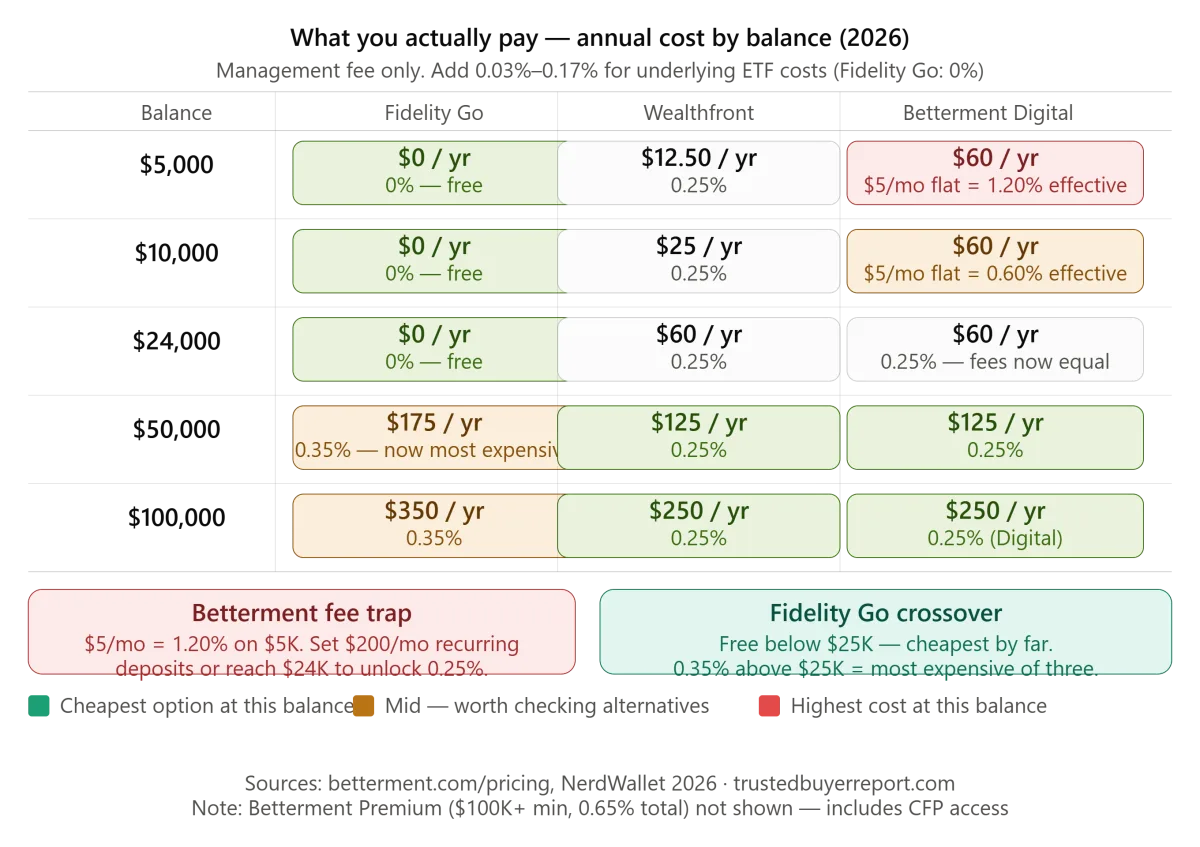
The math matters: on a $5,000 balance, $5/month equals $60/year — that's 1.20% annually, nearly five times the advertised rate. On a $10,000 balance it's 0.60%. The fee only becomes competitive with Wealthfront's flat rate around the $24,000 threshold.
Betterment Premium costs 0.65% annually (0.25% Digital base + 0.40% Premium fee) with a $100,000 minimum balance, per Betterment's premium page. This unlocks unlimited access to salaried CFP professionals. On a $100,000 account, the incremental Premium cost over Digital is $150/year — less than two sessions with an independent CFP.
Wealthfront's flat fee
Wealthfront charges a flat 0.25% annually with a $500 minimum — no monthly flat fee, no tiered pricing, no surprise escalation. Per NerdWallet's Wealthfront review, underlying ETF expense ratios average 0.03%–0.07%. On a $10,000 balance: $25/year management fee plus roughly $3–$7 in fund expenses.
Fidelity Go's structural advantage
Fidelity Go is free for balances below $25,000 and charges 0.35% above that threshold, per NerdWallet's 2026 robo-advisor analysis. The structural advantage most comparisons miss: Fidelity Go invests in proprietary Fidelity Flex mutual funds that carry zero expense ratios. Most robo-advisors add 0.05%–0.20% in underlying ETF costs on top of their management fee. Fidelity Go eliminates that layer entirely.
Annual cost comparison by balance
| Balance | Betterment (effective) | Wealthfront | Fidelity Go |
|---|---|---|---|
| $5,000 | $60/yr (1.20%) | $12.50/yr (0.25%) | $0 (0%) |
| $10,000 | $60/yr (0.60%) | $25/yr (0.25%) | $0 (0%) |
| $24,000 | $60/yr (0.25%) | $60/yr (0.25%) | $0 (0%) |
| $50,000 | $125/yr (0.25%) | $125/yr (0.25%) | $175/yr (0.35%) |
| $100,000 | $250/yr (0.25%) | $250/yr (0.25%) | $350/yr (0.35%) |
The fee crossover is important: below $25,000, Fidelity Go is unambiguously cheapest. Between $25,000 and roughly $50,000, Betterment and Wealthfront are identical at 0.25% while Fidelity Go costs more at 0.35%. Above $50,000, Betterment and Wealthfront remain tied on fee rate, with Wealthfront having a slight edge on underlying fund costs (0.03%–0.07% vs 0.04%–0.17%).
Tax-Loss Harvesting: Who Benefits and Which Platform Does It Better

Tax-loss harvesting is one of the most marketed robo-advisor features and one of the least understood. The plain version: when an investment drops in value, the platform sells it at a loss (capturing a tax deduction), then immediately reinvests in a similar asset to maintain your market exposure. The captured loss offsets capital gains elsewhere, reducing your tax bill.
Both Betterment and Wealthfront offer tax-loss harvesting with no minimum balance, per NerdWallet's robo-advisor rankings — a genuine differentiator from many competitors. Fidelity Go offers no tax-loss harvesting.
Where Wealthfront leads: direct indexing
Wealthfront goes further with direct indexing for accounts over $100,000 — buying individual stocks to mirror an index rather than buying ETFs. This creates far more tax-loss harvesting opportunities because you can sell individual losing stocks while holding winners, instead of selling the entire ETF. Wealthfront claims this can add 1.0%–1.8% in after-tax annual returns for large taxable accounts. iAdviser's 2026 comparison names Wealthfront the clear winner for pure tax optimization: "Wealthfront wins on tax-loss harvesting, direct indexing ($100K+), and cash management."
Where Betterment counters: tax-coordinated portfolios
Betterment's counter-feature is tax-coordinated portfolios — automatic asset placement across your taxable and tax-advantaged accounts. If you hold both a taxable account and an IRA at Betterment, the algorithm places tax-inefficient assets (like bonds) in your IRA and tax-efficient assets (like growth stocks) in your taxable account. Per the Zogby Betterment review, Betterment estimates tax-loss harvesting adds roughly 0.77% in after-tax annual returns for taxable accounts — enough to more than offset the 0.25% management fee in favorable conditions. Betterment also offers direct indexing above $100,000, matching Wealthfront's threshold.
Who actually benefits?
Tax-loss harvesting delivers meaningful value primarily for investors who meet all three criteria:
- In the 22% federal tax bracket or above
- Holding a taxable (non-retirement) account
- Large enough balance that harvested losses are material (above ~$25,000–$50,000)
If your only account is a Roth IRA, tax-loss harvesting is irrelevant — gains in a Roth are already tax-free. If you're in the 12% bracket, the savings are real but modest. If you're below $25,000 in a taxable account, Fidelity Go's zero fees likely produce better net outcomes than Betterment or Wealthfront's tax harvesting offsetting their fees.
Portfolio Diversity: What Each Platform Actually Invests In

Wealthfront: broadest asset class exposure
Wealthfront diversifies across up to 17 global asset classes including domestic and international equities, emerging markets, real estate investment trusts, natural resources, dividend stocks, and multiple bond categories. NerdWallet names Wealthfront as its 2026 winner for "best robo-advisor for portfolio options." The platform uses Vanguard and iShares ETFs with average expense ratios of 0.03%–0.07%.
Wealthfront has also added individual stock investing and crypto portfolios for investors who want direct exposure beyond the automated allocation.
Betterment: broadest customization
Betterment's Core Portfolio covers 12 asset classes, with Flexible Portfolio options allowing adjustment of asset-class weights. The differentiator is choice: socially responsible investing (SRI) portfolios, climate-focused options, income portfolios for retirees, Goldman Sachs Smart Beta allocations, and BlackRock target income portfolios. Per NerdWallet's comparison, "Betterment also asks about your goals during initial setup, which can feel like a more personalized approach than most."
Betterment has expanded through acquisition — acquiring Goldman Sachs' Marcus Invest accounts in 2024 and Ellevest's automated investing business in February 2025, signals of a platform broadening its investor base and product depth.
Fidelity Go: deliberate simplicity
Fidelity Go uses Fidelity Flex mutual funds — a deliberately simplified structure for investors who want to set it and forget it. No ETFs to understand, no asset class selection, no rebalancing decisions. Appropriate for beginners. Investors wanting exposure to real estate, commodities, or international small-cap equities won't find it here.
Account Types and Retirement Support
All three platforms support traditional IRAs, Roth IRAs, and taxable brokerage accounts. The differences matter for specific situations.
Wealthfront supports 529 college savings plans — meaningful for investors saving simultaneously for retirement and a child's education. It also offers a portfolio line of credit allowing borrowing against invested assets without selling positions, and cash accounts with high-yield savings features (FDIC coverage up to $8M).
Betterment supports Traditional, Roth, and SEP IRAs, with goal-based planning tools for tracking multiple financial objectives in one dashboard. Its retirement income planning tools — helping investors draw down assets efficiently in retirement, not just accumulate — are a noted differentiator. Unbiased.com's 2026 analysis ranks Betterment second among all robo-advisors for retirement savings.
Fidelity Go's practical advantage is ecosystem integration. If you hold a 401(k), HSA, or existing brokerage account with Fidelity, Fidelity Go gives you a unified view of your financial picture. Human financial advisors and retirement planning services are available through Fidelity as an institution (not through Fidelity Go itself), which matters for Fidelity customers who want that pathway.
One platform worth noting for IRA-specific features: NerdWallet names Schwab Intelligent Portfolios as best for IRA investors in 2026. If IRA optimization is your primary goal, Schwab's offering is worth researching alongside these three.
Human Advisor Access: When You Need More Than an Algorithm

Robo-advisors are designed for straightforward situations: consistent contributions, long time horizons, standard risk tolerance. When your financial life gets complicated — an inheritance, business sale, divorce, near-retirement withdrawal strategy, stock options — algorithms reach their limits.
Betterment Premium is the only platform in this comparison with built-in access to human financial advisors. At 0.65% total with a $100,000 minimum, it provides unlimited access to salaried CFP professionals who cover retirement income planning, tax strategy, Roth conversion strategies, and major financial decisions, per Betterment's premium page. The CFPs are salaried (never commissioned) and fiduciary. On a $100,000 account, the incremental Premium cost over Digital ($150/year) is less than a single independent CFP consultation.
Wealthfront has no human advisor access — a deliberate design choice that keeps costs low and automation consistent. For hands-off investors with straightforward goals, this is not a gap. For investors navigating complex decisions, it is.
Fidelity Go includes no human advisor access within the product, but Fidelity as an institution offers comprehensive advisory services. Fidelity customers who need human guidance can access it separately.
If you're still deciding whether you need a human advisor at all — or trying to understand what robo-advisor automation can and cannot handle — the Robo-Advisors vs Financial Advisors 2026 guide covers that decision framework in full, including the asset thresholds where each model tends to make more sense.
Who Should Choose Each Platform in 2026
Choose Betterment if:
- Your balance is under $24,000 and you'll set up $200/month in recurring deposits (avoids the $5/month flat fee)
- You want goal-based investing that tracks multiple financial objectives — retirement, home purchase, emergency fund — in one dashboard
- You're in a higher tax bracket with a taxable account and want tax-loss harvesting available from day one with no minimum
- You plan to grow your balance toward $100,000 and want the option to add CFP access without switching platforms
- You prefer socially responsible, climate-focused, or values-aligned portfolio options
- You want SEP IRA support for self-employed retirement savings
Watch out for: The $5/month flat fee at low balances. On a $5,000 balance it's 1.20% annually. Calculate your effective rate before opening an account.
Choose Wealthfront if:
- You have at least $500 to invest and want a predictable, flat 0.25% fee with no flat-fee traps
- You're in a higher tax bracket with a taxable account above $100,000 where direct indexing delivers meaningful after-tax advantage
- You want the broadest asset class exposure — up to 17 global classes — without managing it yourself
- You're saving for both retirement and education and want 529 plan support on one platform
- You're a fully hands-off investor who wants complete automation and has no interest in human advisor access
- You want a high-yield cash management account with competitive FDIC coverage ($8M per account)
Choose Fidelity Go if:
- Your balance is under $25,000 and you want to pay nothing in management fees
- You're a beginner who wants the simplest possible entry into automated investing
- You already use Fidelity for other accounts and want unified portfolio visibility
- You're not in a high tax bracket and tax-loss harvesting isn't a meaningful factor
- You want the lowest total cost (management fee + underlying fund expenses) at small to mid balances
- You want the option to transition to human advisory through Fidelity's broader institutional offerings as your needs evolve
Frequently Asked Questions
Is Betterment or Wealthfront better for tax-loss harvesting?
Both offer tax-loss harvesting with no minimum balance required. For accounts under $100,000 in taxable accounts, the practical difference is small — both harvest daily, and both can meaningfully offset capital gains. Above $100,000 in a taxable account, Wealthfront has a clear edge through direct indexing (harvesting at the individual stock level rather than the ETF level), which Wealthfront claims adds 1.0%–1.8% in annual after-tax returns. Betterment's tax-coordinated portfolio feature — placing tax-inefficient assets in IRAs and tax-efficient assets in taxable accounts — adds value if you hold both account types at Betterment simultaneously.
What does Betterment's $5/month fee mean in practice?
It means that for accounts with household balances below $24,000 without $200/month in recurring deposits enabled, you pay $60/year regardless of balance size. On a $5,000 account, that's 1.20% annually. On a $10,000 account, it's 0.60%. The fee switches to 0.25% annually once your balance reaches $24,000 or you enable $200/month in recurring deposits. If you're starting small and can't set up monthly deposits, Fidelity Go is substantially cheaper at zero management fees.
Can I use Fidelity Go if I already have a Fidelity 401(k)?
Yes, and the integration is one of Fidelity Go's most practical advantages. Fidelity Go accounts appear alongside existing 401(k), IRA, and brokerage accounts within your Fidelity dashboard, giving you a consolidated view of your total invested assets. Fidelity Go itself doesn't manage your 401(k), but the unified visibility helps you see your full financial picture without switching platforms.
Is Betterment Premium worth the $100,000 minimum?
It depends on your planning needs. The incremental cost over Digital is $150/year on a $100,000 account — less than a single independent CFP consultation, which typically runs $200–$400/hour. If you have specific complex needs (Roth conversion strategy, stock option exercise timing, retirement withdrawal sequencing, estate questions), Premium often pays for itself in a single advisor call. Below $250,000, the marginal benefit is modest. Above $500,000, compare it against Vanguard Personal Advisor Services (0.30%, $50K minimum) and Schwab Intelligent Portfolios Premium before deciding.
How does Wealthfront's 0.25% fee compare to the total cost after fund expenses?
Wealthfront's ETFs have average expense ratios of 0.03%–0.07%, making the all-in cost approximately 0.28%–0.32% annually. Betterment's ETFs average 0.04%–0.17%, making the all-in Digital cost roughly 0.29%–0.42%. Fidelity Go's proprietary funds carry 0% expense ratios, making the all-in cost 0% below $25,000 and 0.35% above that. When evaluating fee competitiveness, always ask about total cost including underlying fund expenses — not just the management fee headline.
Which platform is best for socially responsible investing?
Betterment offers the broadest SRI options: climate-focused portfolios, broad ESG portfolios, and values-specific allocations. Wealthfront also offers socially responsible and sector-specific ETFs but with fewer preset portfolio configurations. Fidelity Go does not offer SRI-specific portfolio options.
This article was drafted with AI assistance and fact-checked by our editorial team. Fee figures are sourced from official platform disclosures and verified against NerdWallet, iAdviser, and unbiased.com as of June 2026. Fees and features change — always verify directly with each platform before investing. This is not financial advice. Trusted Buyer Report may earn a commission from links on this page. Full methodology · Affiliate disclosure