How this guide was researched: We aggregated data from the ALIX Partners 2026 Media and Entertainment Predictions Report, Deloitte 2026 Media and Entertainment Industry Outlook, Omdia's 2026 Trends to Watch: Music, Spotify's 2026 Investor Day disclosures, Research and Markets' Entertainment Market Report, and Forrester's Buyer Insights 2026. We did not personally test these services. We may earn a commission from purchases made through links on this page. Drafted with AI assistance, fact-checked editorially. How we review →
The Real Problem With Building a Media Library in 2026
Here is the most common misconception about media consumption in 2026: that the hardest part of building a books, music, and entertainment library is choosing the right service. It is not. The hardest part is building a media diet that survives what the market does to those services after you commit to them.
Platforms merge. Prices rise. Content moves. The audiobook you bought last year may now require a subscription you cancelled. The playlist you spent three years curating lives on a server you don't own, in a format you can't export. The show you're midway through may disappear when two streaming companies consolidate their catalogs. This guide addresses that real problem — not which service has the best interface, but how to make media decisions that hold up over time.
The 2026 Media Landscape: What Changed and Why Every Purchase Looks Different Now
The scale of change in the media market between 2024 and 2026 is not incremental — it is structural. According to the ALIX Partners 2026 Media and Entertainment Predictions Report, over $42 billion in media M&A activity is projected for 2026 alone. That figure is not background noise for investors — it directly affects which platforms exist, which content libraries survive, and what you will pay for access next year.
The same report identifies YouTube and Netflix as converging in functionality, blurring the boundary between user-generated content and premium subscription programming. If you subscribe to both today assuming they serve distinct purposes, that assumption may not hold by the end of 2026.
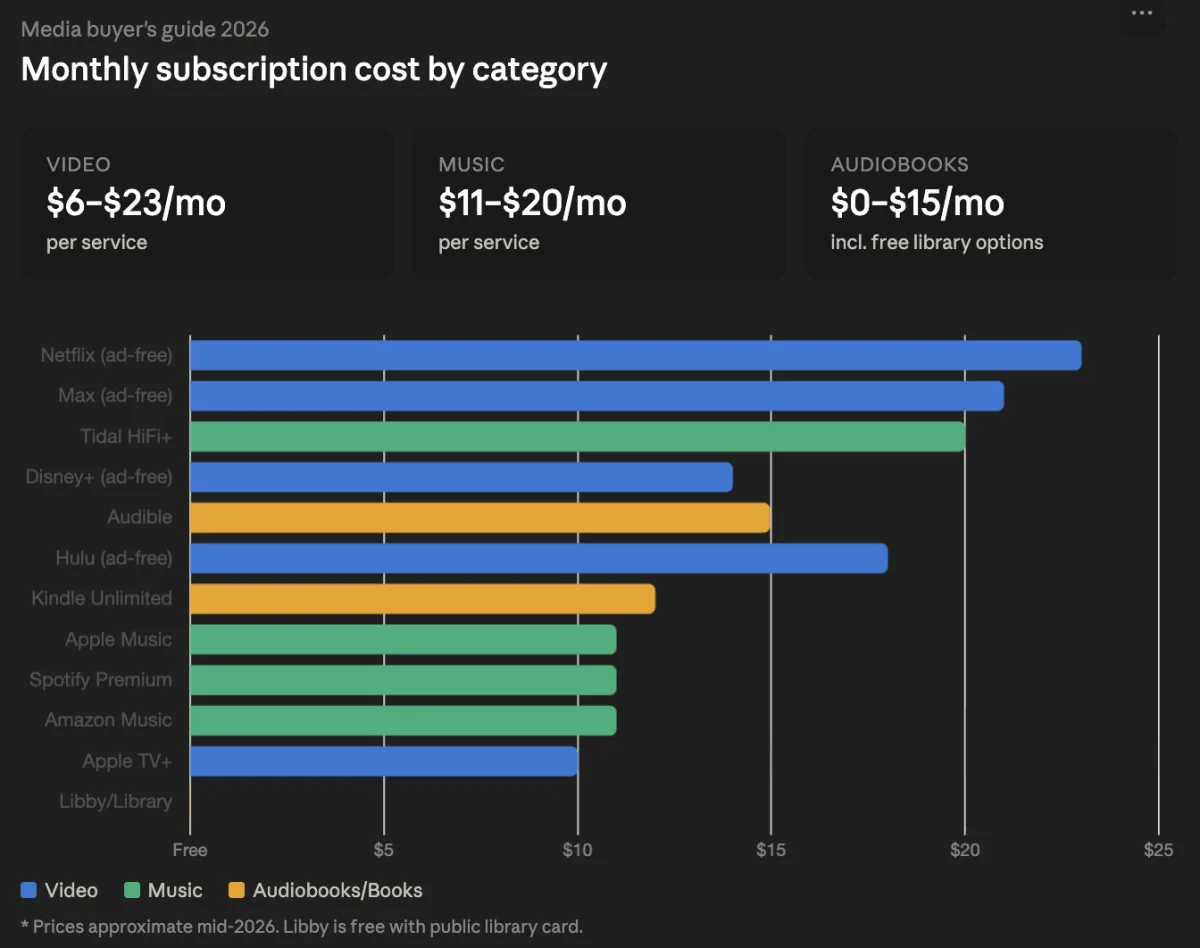
Meanwhile, the Deloitte 2026 Media and Entertainment Industry Outlook confirms what many subscribers already feel in their wallets: the era of cheap streaming is over. Citing reporting from the Los Angeles Times (October 2025), Deloitte documents that SVOD price increases have moved from exception to industry norm. Services that held $9.99/month price points for years have now crossed $15–$20/month for ad-free access, with ad-supported tiers becoming the effective entry point rather than the premium skip.
AI is the second major force reshaping your media experience. The ALIX Partners report flags AI as a significant driver of change specifically in search and discovery, but its effects extend across every category in this guide — from which books surface in your recommendations to how playlists are assembled to which shows a platform decides to renew. The practical implication: recommendation engines are now platform retention tools, not neutral discovery services.
The bottom line: buying habits formed in 2020 or even 2023 may actively work against you now. Locking into annual subscriptions, building libraries on single platforms, and trusting that a service will look the same in twelve months are all higher-risk behaviors than they were three years ago.
How to Audit Your Current Media Spending Before Adding Anything New
Before subscribing to anything new, map what you already pay for. Most people underestimate their monthly media spend because charges arrive on different billing dates, some are bundled with other services, and a few have been quietly auto-renewing for months without active use. A realistic audit takes about twenty minutes and typically surfaces at least one subscription that should be cancelled immediately.
Build a simple table with five columns:
| Service | Monthly cost | Last actively used | Content exclusive to this platform? | Switching cost if you cancel |
|---|---|---|---|---|
| Audible | $14.95 | 3 months ago | Yes — Audible Originals | Credits expire; purchased titles non-exportable |
| Spotify Premium | $10.99 | Daily | Some podcast exclusives | Playlists not portable; Wrapped data stays |
| Netflix Standard | $15.49 | Weekly | Netflix Originals | Watchlist and viewing history |
| Kindle Unlimited | $11.99 | 6 months ago | Self-published only | Nothing — no ownership anyway |
The switching cost column is the one most audits skip. Forrester's Buyer Insights 2026 research notes that modern buyers are more likely to churn when perceived value drops — but the data also shows that hidden switching costs (lost playlists, reading history, accumulated credits) keep people in subscriptions longer than rational value calculations would justify. Naming those costs explicitly helps you decide whether they are real or just inertia.
Pay particular attention to overlap. A reader paying for both Kindle Unlimited and a Scribd subscription is likely duplicating access to a significant portion of the same catalog. A household with Libby access through a public library card may be paying for audiobook credits on a service whose catalog overlaps substantially with what the library offers for free.
Books in 2026: Physical, Digital, and Audio — Which Format Actually Fits Your Life?
Physical books: the only format where you actually own what you buy

Physical books are the only format in this guide where you have genuine ownership. When you buy a paperback, no company can revoke your access, change the terms of use, or shut down a server that makes the file unreadable. The Microsoft e-book store closure in 2019 — which deleted purchased books from customers' devices with no recourse — remains the clearest precedent for what "buying" a digital book actually means in practice: it is a license, not a purchase, and that distinction has legal weight in the US.
For readers who want a permanent library that cannot be taken away, physical books remain the only reliable option. The trade-off is space, portability, and cost per book.
E-books: convenient, but you don't own them
E-books through Kindle, Kobo, or Apple Books are convenient and portable, but DRM (digital rights management) restrictions mean your library is tied to the platform's continued operation and your account's good standing. Kindle books cannot be read on a Kobo without stripping DRM, which is legally complex under the DMCA. If you read primarily on one device ecosystem and accept the dependency, e-books offer genuine value. If you want flexibility or long-term archival access, the format carries real risk.
Audiobooks: a fragmented market with one dominant player and one fast-moving challenger
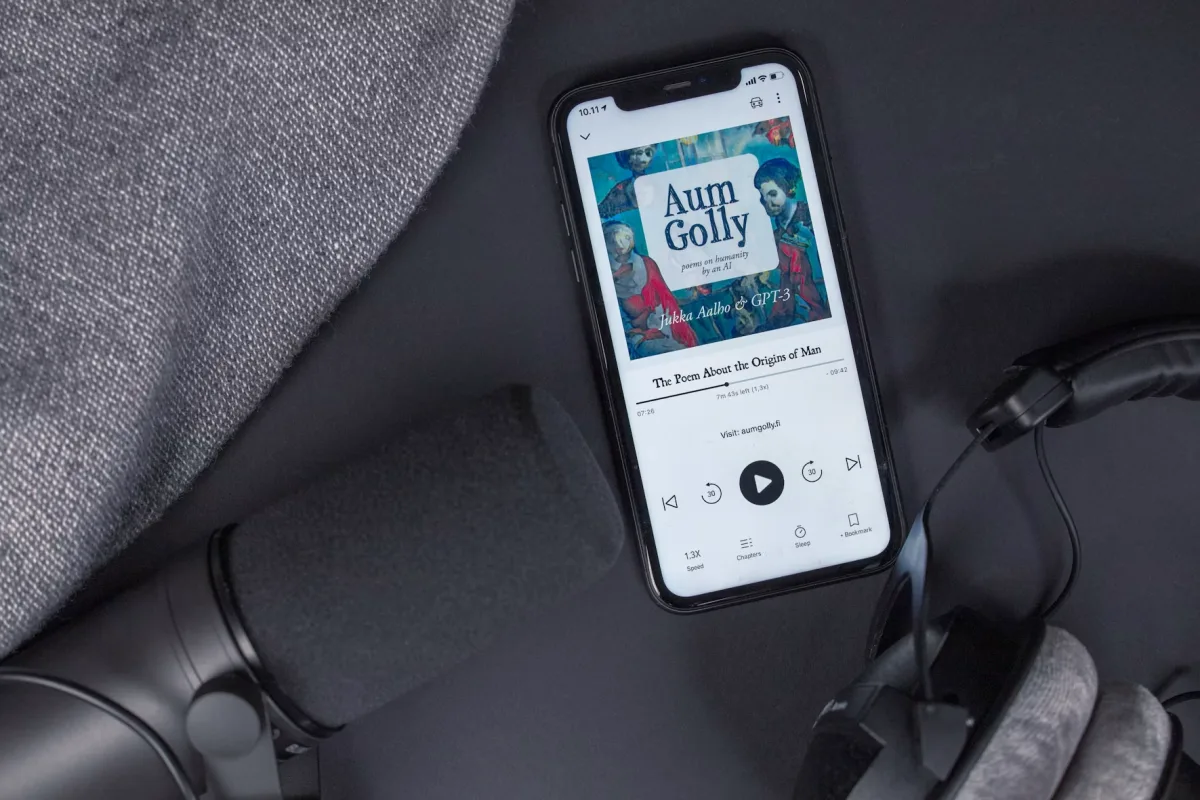
The audiobook market has grown substantially — Research and Markets' Entertainment Market Report tracks audiobooks as one of the faster-growing segments within the broader entertainment market. But the platform landscape shifted meaningfully in 2026.
Audible (Amazon) remains dominant. Its 1 million+ title catalog and Audible Originals carry real lock-in power — originals are platform-exclusive, and purchased credits do not transfer. The Immersion Reading feature, launched February 2026, lets users follow word-by-word highlighted Kindle text while listening to an audiobook, though it requires owning both a Kindle ebook and an Audible audiobook of the same title.
Spotify is the fastest-growing audiobook platform in 2026. At its May 2026 Investor Day, Spotify announced its audiobook catalog has grown to 700,000+ titles across 22 markets, with Audiobooks+ hitting 1 million subscribers and tracking toward $100M in annualized recurring revenue. Two significant 2026 features change the competitive calculus:
- Page Match: launched April 2026, lets readers scan a physical page with their phone camera and Spotify starts the audiobook at that exact point — 55% more audiobook hours per week among users who try it, per Spotify's own data
- Bookshop.org integration: Spotify users in the US and UK can now purchase physical books directly through the Spotify app, supporting independent bookshops
For existing Spotify Premium subscribers ($10.99/month), 15 hours of audiobook listening per month is included at no additional cost. That makes it the most cost-efficient entry point for casual audiobook listeners who already pay for Spotify music.
Libby (OverDrive) and Hoopla remain the most underused resources in book consumption. Both provide access to e-books, audiobooks, and digital magazines through public library cards, at no additional cost. A reader who consumes two books per month and currently pays for Kindle Unlimited ($11.99/month) or Audible ($14.95/month) should check their local library's digital catalog before renewing. Libraries saw a 13% increase in audiobook checkouts in the most recent tracking period, per audiobook distribution data, suggesting this behavior is growing.
Book format comparison: which option for which reader
| Reader profile | Best fit | Why |
|---|---|---|
| 2+ books/month, urban library | Libby + physical purchases | Free audiobooks/ebooks; buy what you want to keep |
| 5+ books/month, varied genres | Audible credit plan or Scribd | Credit model with broad catalog; Scribd for variety |
| Already Spotify Premium, casual listener | Spotify audiobooks (included) | 15 hrs/month at no extra cost; Page Match for hybrid reading |
| Collector, values ownership | Physical books from indie bookstores | Only true ownership; no platform dependency |
| Self-pub/indie focus | Kindle Unlimited ($11.99/month) | Extensive self-pub catalog; mainstream titles excluded |
Author compensation: a factor most comparison guides skip
On major audiobook subscription platforms, author royalty rates per listen are significantly lower than per direct sale. If you have a specific author whose work you want to support financially, purchasing directly from their website, through Bookshop.org, or from an independent bookstore delivers a meaningfully higher percentage of revenue to the creator. Bandcamp serves this function for music (covered below); Bookshop.org serves it for books.
Music in 2026: Streaming, Ownership, and the AI Curation Question
The economics underneath streaming convenience
Streaming now accounts for the overwhelming majority of music consumption, but the economics underneath that convenience matter for informed decisions. The per-stream royalty rate on major platforms — Spotify, Apple Music, Amazon Music — sits at fractions of a cent per play. Omdia's 2026 Trends to Watch: Music identifies streaming economics and AI-driven curation as two of the defining issues for the music industry this year.
Deloitte's 2026 research notes directly that streaming is changing the music industry's economics in ways that affect which artists can sustain careers — which has long-term implications for the diversity of music available to listeners.
Streaming tier comparison (mid-2026 pricing)
| Service | Price/month | Audio quality | Included audiobooks | Best for |
|---|---|---|---|---|
| Spotify Premium Individual | ~$10.99 | Standard (no lossless) | 15 hrs/month | Most users; huge catalog, best discovery |
| Apple Music Individual | ~$10.99 | Lossless + Dolby Atmos included | No | Listeners with compatible hardware; classical |
| Amazon Music Unlimited | ~$10.99 (~$8.99 Prime) | Lossless included | 1 Audible book/month (Amazon Music members) | Alexa/Echo households; Prime members |
| Tidal HiFi Plus | ~$19.99 | Hi-res lossless + spatial audio | No | Audiophiles; artists wanting higher royalty support |
Lossless audio caveat: the audible difference between lossless and standard streaming requires specific hardware — a DAC (digital-to-analog converter), quality headphones or speakers, and a quiet listening environment. Streaming through Bluetooth earbuds or a phone speaker means you are not hearing the difference that a premium tier implies. Pay for lossless audio only if your playback chain can actually reproduce it.
The AI curation problem: algorithms optimize for engagement, not your taste
Recommendation engines are now the primary gateway through which most people discover new music. But Omdia's 2026 analysis flags a specific risk: AI playlist generation optimizes for engagement metrics, not musical breadth. A listener who relies entirely on Spotify's AI DJ or Apple Music's algorithmic mixes will, over time, hear a narrower slice of music than one who actively seeks out new artists through human-curated sources.
Countermeasures require deliberate effort but cost nothing:
- Subscribe to human-curated music newsletters (Bandcamp Daily for independent music; Pitchfork for criticism; genre-specific Substack writers)
- After a genre deep-dive, manually search for content outside your usual pattern and rate it explicitly — this overrides algorithm momentum faster than waiting for self-correction
- Follow Bandcamp Friday (first Friday of each month): Bandcamp waives its platform fee, directing the full purchase price to the artist — relevant if supporting independent artists matters to you
Downloading and owning music: still viable, still underused
Download-and-own music files (MP3 or FLAC) through Bandcamp or directly from artists remains a viable option for listeners who want permanent access without subscription dependency. Bandcamp's model delivers a significantly higher revenue share to artists than streaming platforms. For listeners with specific genre interests — jazz, classical, experimental, or regional music — download purchases often provide access to catalog depth that streaming libraries do not match.
Video Entertainment in 2026: Navigating Consolidation Without Paying for Everything
The only strategy that works: rotation, not accumulation
The single most effective strategy for managing video streaming costs in 2026 is subscription rotation. Rather than maintaining four or five simultaneous subscriptions, subscribe to one or two services, watch what you want, then cancel and rotate to the next.
A household that cycles through Netflix, Max, Hulu, and Paramount+ over twelve months — spending two to three months on each — pays roughly $120–$180 for the year rather than $600–$840 for simultaneous access. The content does not disappear between visits; it waits.
The ALIX Partners 2026 report anticipates YouTube and Netflix converging more closely in 2026. If that convergence materializes, the case for subscribing to both simultaneously weakens further.
Current streaming landscape at a glance
| Service | Ad-supported tier | Ad-free tier | Primary differentiator | Password sharing policy |
|---|---|---|---|---|
| Netflix | ~$7.99/month | ~$22.99 (4K) | Broadest original content library | Paid sharing enforced; $7.99/extra member |
| Disney+ | ~$7.99/month | ~$13.99/month | Disney, Marvel, Star Wars, Pixar, FX | Household restrictions active |
| Max (HBO) | ~$9.99/month | ~$20.99/month | HBO prestige originals; Warner Bros films | — |
| Hulu | ~$7.99/month | ~$17.99/month | Next-day broadcast TV; FX exclusives | — |
| Peacock | ~$5.99/month | ~$13.99/month | NBC content, Premier League, some live sports | — |
| Paramount+ | ~$5.99/month | ~$12.99/month | CBS, NFL, Yellowstone universe | — |
| Apple TV+ | No ad tier | ~$9.99/month | Small but high-quality original catalog | — |
Prices approximate as of mid-2026; check each platform for current rates.
Free ad-supported streaming (FAST): the overlooked complement
Free ad-supported streaming television (FAST) has expanded to the point where it deserves serious consideration as a complement to one paid subscription rather than an afterthought. Tubi, Pluto TV, and the free tier of Peacock collectively offer thousands of titles — older films, classic television, and a growing selection of original content — at no cost.
The trade-off is advertising (roughly 4–6 minutes per hour) and a catalog that skews toward library content rather than current releases. For viewers who primarily want something to watch rather than a specific new release, FAST services eliminate the need for a second paid subscription.
The Deloitte 2026 outlook confirms that original content remains the primary differentiator between SVOD platforms. Licensed content — older shows and films — is increasingly available across multiple services or on FAST platforms. This means the genuine reason to pay for a specific subscription is usually one or two original series, not the breadth of the library. Identifying exactly which originals you want to watch, subscribing only when those titles are available, and cancelling afterward is a more disciplined approach than maintaining a subscription for general browsing.
Sports rights: still the most expensive category, now more fragmented
Sports rights remain the most expensive and volatile content category. The NBA's 11-year, $76 billion rights deal with Amazon Prime Video, NBCUniversal, and ESPN/ABC (starting with the 2025–26 season) means live NBA games are now split across at least three services. If live sports is your primary reason for subscribing to a service, evaluate sports-specific packages — ESPN+, Peacock for Premier League, Paramount+ for UEFA Champions League, Amazon Prime Video for some NBA games — before committing to a general entertainment bundle that includes sports as a secondary feature. The standalone sports package math often wins.
AI and Entertainment Discovery: What Algorithms Are Actually Doing to Your Media Diet
Recommendation engines are now the primary gateway through which most people discover new books, music, and shows. The Deloitte 2026 outlook identifies these systems as central to platform retention strategy — which is the key phrase. These algorithms are built to keep you on the platform, not to broaden your cultural exposure or match your long-term satisfaction. Those goals sometimes align, but not always.
The ALIX Partners report flags AI as a particularly significant driver of change in search and discovery in 2026. In practical terms, the results you see when you search for a book, song, or show are increasingly shaped by AI systems that factor in your past behavior, your demographic profile, and the platform's commercial relationships — not just relevance.
How to break out of the algorithm
Human-curated sources consistently surface content that algorithms deprioritize:
- Books: your public librarian's reading list, Literary Hub, Goodreads lists from trusted reviewers, independent bookstore staff picks
- Music: Bandcamp Daily, genre-specific Substack writers, music journalists on Letterboxd-equivalent platforms
- Film/TV: Letterboxd lists from critics you trust, the Criterion Channel's curated programming, A24's editorial
Subscribing to even one curated newsletter in each category costs nothing and breaks the filter bubble that pure algorithmic consumption creates. A librarian's reading recommendation list and a platform AI recommendation list for the same reader will diverge significantly — and the librarian's list will typically include more range.
One specific behavior to watch: after a binge-watching session on Netflix or a genre deep-dive on Spotify, the algorithm recalibrates heavily toward that content type. If you notice your recommendations have narrowed, the fastest reset is to manually search for content outside your usual pattern, consume several items from that category, and rate them explicitly if the platform allows. Manual intervention overrides the momentum of recent behavior faster than simply waiting for the algorithm to self-correct.
Platform Lock-In: What You're Actually Agreeing to When You Subscribe
Most media subscription terms have a clause that's easy to overlook: you are purchasing a license to access content, not ownership of content. That distinction has real consequences:
- Audible: purchased audiobook "credits" are exchangeable for titles, but those titles live on Audible's servers. If your account is closed (for any reason, including payment failure), access can end. Audible Originals cannot be transferred to any other platform.
- Kindle: ebooks purchased through Amazon are DRM-protected. They can be read on Kindle devices and apps, but not on Kobo or exported as standard files. Amazon has historically honored purchased libraries, but there is no legal obligation to continue doing so.
- Spotify: playlists live on Spotify's servers. There is no native export. Third-party tools exist, but they require ongoing maintenance as platform APIs change.
- Netflix, Disney+, Max: no content ownership at all. Content leaves and arrives based on licensing agreements. Shows you're midway through can be removed with short notice.
The practical implication: if you want to keep something permanently, the only reliable method is physical ownership (a paperback, a CD, a vinyl record, a DVD) or DRM-free digital files (FLAC audio files from Bandcamp, DRM-free ebooks from Smashwords, etc.).
The Media Spending Framework: How to Build a Stack That Makes Sense
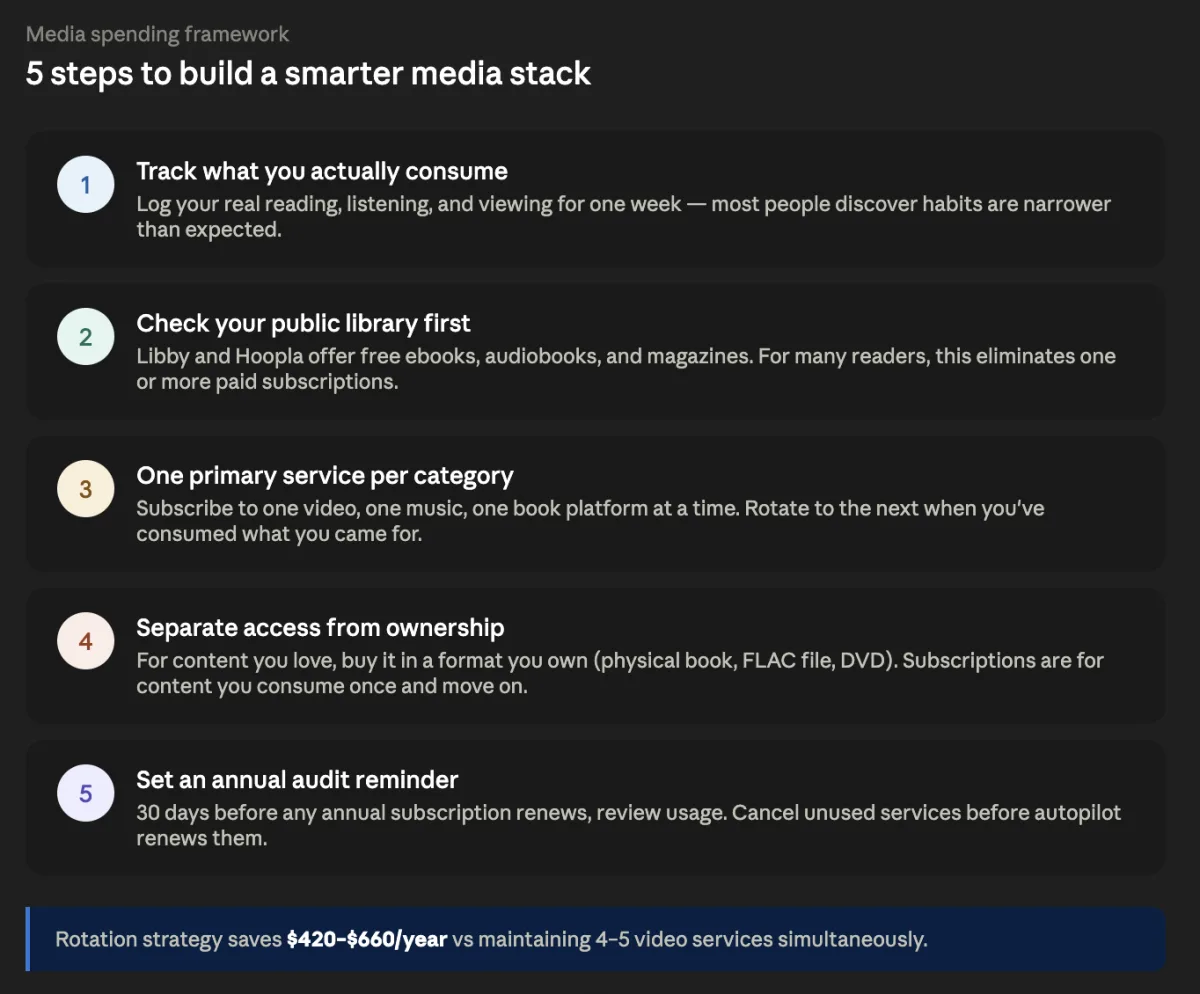
Step 1: Identify what you actually consume vs. what you think you consume
For one week, log what you actually read, listen to, or watch — not what you intend to. Most people discover their actual media consumption is narrower than they think. This is the most useful data you can have before making any subscription decision.
Step 2: Check what your public library already provides for free
Before subscribing to any book or audiobook service, check your library's Libby/OverDrive and Hoopla catalogs. For many readers, particularly in urban areas with well-funded library systems, the overlap with paid services is substantial enough to eliminate one or more subscriptions entirely.
Step 3: Pick one primary service per category
The rotation strategy works best with discipline. Rather than holding three video streaming services simultaneously, identify which one has the most content you want right now and subscribe to that one. Cancel the others. When you've exhausted what you came for, cancel and rotate.
Step 4: Separate "access" from "ownership" decisions
For content you love and want permanently — specific albums, specific books, specific films — buy it in a format you own. For content you consume once and move on from, subscription access is fine. The mistake is treating subscription access as equivalent to ownership for content that matters to you.
Step 5: Set a calendar reminder to audit annually
Put a reminder in your calendar for 30 days before any annual subscription renews. Annual subscriptions are cost-efficient when used consistently and wasteful when not. The 30-day lead time gives you enough runway to decide without autopilot renewals.
Frequently Asked Questions
Is Kindle Unlimited worth it in 2026? It depends almost entirely on what you read. Kindle Unlimited's catalog skews heavily toward self-published and independent titles — traditionally published bestsellers and most major publisher releases are excluded. If you read across genres and frequently discover books through the platform itself, it can deliver value at $11.99/month for heavy readers. If you read primarily traditionally published fiction or nonfiction, you will find most of what you want either in your public library or as individual purchases.
Is Audible worth it vs. Spotify for audiobooks in 2026? For heavy audiobook listeners (3+ books/month): Audible's credit plan typically delivers better per-book value for mainstream titles, and its catalog depth and Audible Originals are still unmatched. For casual listeners already paying for Spotify Premium: Spotify's 15 free hours per month (included in Premium) may cover your needs at no additional cost, especially with the new Page Match feature for hybrid physical/audio reading. For listeners who prioritize supporting independent artists and publishers: neither platform is ideal — purchase directly from the author's website or via Bookshop.org where possible.
Which music streaming service has the best audio quality in 2026? Apple Music and Amazon Music Unlimited both include lossless and hi-res audio at the standard subscription price (~$10.99/month). Tidal HiFi Plus (~$19.99/month) offers hi-res lossless and spatial audio. The honest caveat: the audible difference requires specific hardware to be perceptible. Bluetooth earbuds, phone speakers, and standard headphones under $100 will not meaningfully benefit from lossless audio. If your listening setup includes wired headphones with a DAC or quality speakers, lossless is worth paying for. If not, the standard streaming quality from Spotify ($10.99/month) is indistinguishable in practice.
How do I stop paying for streaming services I don't use? First, list every subscription and its billing date. Second, set a monthly calendar event to check which services you actively used that month. Third, pause or cancel any service you haven't used in the past 30 days — most allow easy reactivation. The rotation strategy described in the video section above (two to three months per service, then cycle) is the most cost-effective approach for households watching multiple streaming libraries over the course of a year.
What are the best free streaming services in 2026? Tubi, Pluto TV, and Peacock's free tier are the strongest FAST (free ad-supported streaming television) options for on-demand library content. For live sports specifically, some events are now free on YouTube or Peacock's free tier. For films, the Criterion Channel and Mubi (both paid but modest, ~$7–$12/month) offer curated catalogs that outperform the algorithm-driven recommendations of larger services.
Does my public library offer free audiobooks and ebooks? Yes — and this is genuinely underused. Most US public libraries offer free access to Libby (OverDrive) and/or Hoopla, which provide e-books, audiobooks, and digital magazines at no cost beyond your library card. Libby titles have wait lists for popular books; Hoopla titles are typically available immediately with a monthly borrow limit. Check your library's website or ask a librarian what's available in your system.
We may earn a commission from purchases made through links on this page, at no extra cost to you. Full disclosure →