
How this guide was researched: We aggregated data from ReSubs subscription spending statistics, Attest's 2026 streaming retention research, Technavio's subscription market analysis, Coherent Market Insights, and N+ Global's e-learning research. We did not personally test these services. We may earn a commission from purchases made through links on this page. Drafted with AI assistance, fact-checked editorially. How we review →
The Subscription Problem in 2026 (And Why It Gets Worse Every Year)
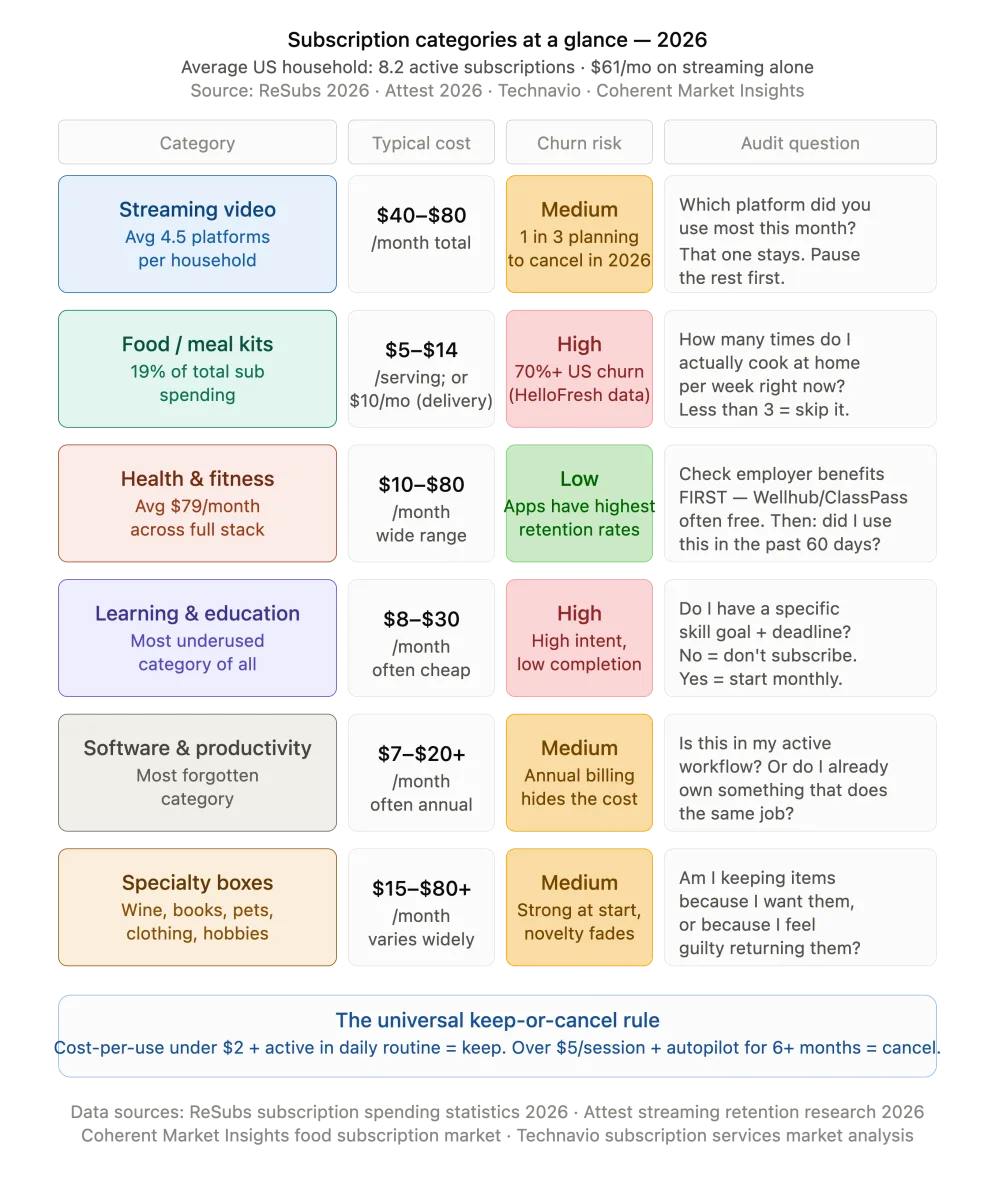
The average US household now holds 8.2 active subscriptions — and a meaningful portion of those are either barely used or completely forgotten, according to ReSubs subscription spending statistics. That number isn't a badge of modern convenience. For most households, it's a slow accumulation of auto-renewals that never triggered a conscious decision.
Here's the honest number that makes this real: households spending $40–$80 per month on streaming alone — the average, per Deloitte's 2025 Digital Media Trends data cited in ReSubs, is $61 — often can't name every platform they're paying for without checking a bank statement. The charges arrive separately, on different billing dates, in amounts small enough to feel ignorable.
The market is only going to get more crowded. According to Technavio's Subscription Services Market Growth Analysis, the global subscription services market is projected to reach USD 463.2 billion by 2030, growing at a CAGR of 17.8%. More services are launching every quarter. More bundles are being constructed to capture wallet share.
Consumers are fighting back. Attest's 2026 streaming retention research found that more than one in three subscribers plan to cancel at least one video streaming service in 2026. Inflation pressure is real, and the passive subscription stack is becoming a visible household expense worth actively managing.
This guide covers six categories — streaming video, food delivery and meal kits, health and fitness, learning and education, software and productivity, and specialty boxes — with a consistent focus: is this category worth keeping, given how you actually use it?
How to Measure Subscription Value: One Framework That Works Across Every Category
Before comparing specific services, you need a consistent metric. Monthly price is the least useful one.
Cost-per-use is the honest number. A $15/month streaming service you watch every single day costs roughly $0.50 per session. The same service watched twice a month costs $7.50 per session — more than a movie ticket. That math changes the conversation.
Flexibility is the second dimension. According to Attest's 2026 consumer research, 32% of subscribers specifically prioritize services that offer easy cancellation, pausing, or restarting. A further 22% actively avoid services that charge cancellation fees. A service that lets you pause without penalty is signaling confidence in its own value. A service that traps you behind an opaque cancellation flow is signaling the opposite.
Bundling obscures the math. Amazon Prime bundles free shipping, Prime Video, Prime Music, and cloud photo storage into one monthly charge. That can be genuine savings — or it can hide how much you're paying for components you never use. Before subscribing to any bundled service, list the components you would actually use and estimate what those would cost separately.
The 30-day audit question applies to every subscription you hold: in the past 30 days, how many times did I actively use this? A service that "could be useful" is not the same as a service you use. The honest answer to that question, applied across your current stack, is the most productive starting point for any subscription audit.
The 5-Minute Subscription Audit Checklist
Use this before the next billing cycle:
- List every subscription and its monthly cost (check bank statements — most people miss 1–2)
- For each, answer: how many times did I use this in the past 30 days?
- Calculate cost-per-use for each: monthly price ÷ sessions used
- Flag anything over $5 per session for review
- Check whether ad-supported or lower tiers exist for services you use moderately
- Check whether an employer benefits portal covers any of your fitness or wellness subscriptions
1. Streaming Video — What 4.5 Platforms per Household Actually Costs You

The average US household subscribes to 4.5 streaming video platforms in 2026, according to ReSubs. Monthly video streaming spending ranges from $40 to $80 depending on platform mix and tier selection. Most households don't consciously track this because the charges arrive separately across different billing dates.
The major platforms and what they're actually for
The major streaming platforms — Netflix, Hulu, MAX, Disney+, Peacock, Paramount+, and Apple TV+ — each occupy a distinct content niche. That's both the reason households accumulate multiple subscriptions and the reason rotation strategies are becoming more common: subscribe to one platform, finish a specific series, pause or cancel, then move to the next.
| Platform | Rough Monthly Cost (Standard) | Ad-Supported Tier? | Pause Feature? | Primary Strength |
|---|---|---|---|---|
| Netflix | ~$15–$23 | Yes (~$7) | No | Broadest library, original content |
| Hulu | ~$8–$18 | Yes (~$8) | No | Next-day TV episodes, live TV add-on |
| MAX (HBO Max) | ~$10–$20 | Yes (~$10) | No | Premium HBO and Warner originals |
| Disney+ | ~$8–$14 | Yes (~$8) | No | Disney, Marvel, Star Wars, Pixar |
| Peacock | ~$6–$14 | Yes (~$6) | No | NBC content, sports, live events |
| Paramount+ | ~$6–$12 | Yes (~$6) | No | CBS content, NFL, Paramount films |
| Apple TV+ | ~$10 | No | No | Small but high-quality originals |
Prices approximate as of mid-2026; check each platform for current rates.
Ad-supported tiers: the most underused cost lever
Most major streaming platforms now offer ad-supported tiers at $3–$6 below their standard plans. If you watch a platform regularly but not obsessively, an ad-supported tier can save $36–$72 per year per service. Over a year, across two or three platforms, that's real money. The tradeoff — roughly 4 to 6 minutes of ads per hour — is worth calculating against your actual viewing time rather than dismissing on principle.
The retention data from Attest is direct: value for money is the single biggest factor in whether a subscriber stays or cancels. Content quality matters, but it operates within a price tolerance threshold. When a platform raises prices without a corresponding improvement in catalog quality, cancellation intent spikes. That dynamic explains why more than one in three subscribers plan to cancel at least one service in 2026.
Streaming rotation strategy: the practical approach
Rather than holding 4–5 platforms simultaneously, consider rotating quarterly:
- Maintain one primary platform that you use most consistently
- Add a second platform for 1–2 months to finish a specific show or series
- Cancel or pause platforms you've finished with before the next billing date
- Most platforms allow reactivation without losing watch history
The platforms most likely to justify year-round retention are the ones with live content (sports, news) or a continuous stream of originals you actually follow. For everything else, rotation nearly always beats passive simultaneous subscriptions.
2. Food Delivery & Meal Kits — High Promise, Higher Churn

Food delivery and meal kits account for approximately 19% of total subscription spending — one of the largest single categories by share of wallet, according to ReSubs. This category also carries the highest churn rate of any subscription type. HelloFresh reported over 70% US market churn, meaning most subscribers cancel within a year of signing up.
The global food subscription market reached USD 150 billion, according to Coherent Market Insights, which reflects genuine demand for convenience. But the churn data tells a different story: the appeal of meal kits is strongest at sign-up, when the idea of cooking fresh, pre-portioned meals feels realistic. The actual behavioral requirement — cooking on a schedule, with specific ingredients, every week — erodes that appeal quickly for many subscribers.
Delivery fee memberships vs. meal kits: very different value propositions
These are two distinct subscription types that often get grouped together:
Delivery fee waivers (DoorDash DashPass, Uber One) operate on calculable math. Both waive delivery fees and reduce service fees in exchange for a monthly membership fee of roughly $9–$10/month. If you order delivery three or more times per week, the membership pays for itself in saved fees quickly. If you order once a week or less, the savings rarely justify the cost. One of the few subscription categories where value is directly calculable.
Meal kit services (HelloFresh, Blue Apron, Home Chef, Factor, Dinnerly) require consistent behavioral change to deliver value — cooking at home, on a schedule, using specific ingredients. The honest question before subscribing is not "do I want to cook more?" but "how many times per week do I actually cook at home right now?" If the answer is fewer than three, a meal kit subscription is likely to become an expensive source of unused ingredients rather than a useful tool.
The best use case for meal kits
Meal kit subscriptions work best for:
- Households transitioning from frequent takeout toward home cooking, who need the structure of pre-portioned ingredients and step-by-step recipes
- Single-person or two-person households where buying full quantities of fresh ingredients results in significant food waste
- People with a specific dietary goal (higher protein, lower sodium, vegetarian) that a curated meal kit aligns with
They work poorly for households that already cook regularly from their own recipe rotation, large families where per-serving cost becomes prohibitive, or anyone whose schedule makes consistent delivery timing unreliable.
Coherent Market Insights notes that providers like Gousto are using AI to predict consumer demand and reduce food waste — improvements that may increase long-term retention. But the fundamental behavioral requirement doesn't change.
Quick cost comparison: meal kit per serving
| Service | Starting Price / Serving | Format | Flexibility |
|---|---|---|---|
| HelloFresh | ~$9–$12 | Recipe kits (raw ingredients) | Weekly skip, easy cancel |
| Blue Apron | ~$10–$13 | Recipe kits; à la carte option | Weekly skip available |
| Home Chef | ~$10–$12 | Recipe kits + prepared options | Weekly skip available |
| Factor | ~$11–$14 | Fully prepared, heat-and-eat | Weekly skip available |
| Dinnerly | ~$5–$8 | Budget recipe kits | Weekly skip available |
| DoorDash DashPass | ~$9.99/month | Delivery fee waiver | Cancel anytime |
| Uber One | ~$9.99/month | Delivery fee waiver + 5% off | Cancel anytime |
Prices approximate; promotional introductory rates are often significantly lower.
3. Health & Fitness Subscriptions — The Widest Price Range in Any Category

No subscription category spans as wide a price range as health and fitness. A basic gym membership runs $20–$50 per month. McKinsey's 2025 Wellness Consumer Report, cited by ReSubs, estimates average monthly wellness subscription spending at $79 when you include fitness apps, meditation services, and health tracking. The gap between $20 and $79 reflects how quickly a wellness stack accumulates when each individual service seems affordable in isolation.
Fitness apps have some of the highest retention rates in the subscription market. The explanation is behavioral: fitness apps integrated into a daily routine become habit infrastructure. They're part of a morning or workout schedule in a way that makes cancellation feel disruptive. The challenge is getting to that level of integration.
The passive ownership problem
The most common waste in this category: the gym membership that goes unused. A $40/month gym membership visited once a month costs $40 per visit — more expensive than a drop-in class at most boutique studios. Before renewing any fitness subscription, check your actual visit or usage frequency for the past 60 days.
Fitness subscription tiers at a glance
| Category | Examples | Typical Cost | Best if you... |
|---|---|---|---|
| Gym membership | Planet Fitness, Equinox, local gyms | $10–$80/month | Visit 3+ times per week |
| Fitness apps | Peloton Digital, Nike Training, Apple Fitness+ | $10–$45/month | Prefer home/on-demand workouts |
| Meditation/wellness | Calm, Headspace | $5–$10/month (annual) | Practice daily |
| Running/training platforms | Strava Premium, Garmin Connect Premium | $8–$20/month | Active athlete who uses device data |
| Wearable ecosystem | Whoop, Apple Fitness+, Oura | $15–$30/month | Committed to tracking and recovery |
| Corporate wellness | Wellhub (Gympass), ClassPass | Often employer-subsidized | Check employer benefits first |
The underused option: employer fitness benefits
Many employers and health insurers offer subsidized or fully covered fitness subscriptions as part of benefits packages. Platforms like Wellhub (formerly Gympass) and ClassPass are increasingly included in corporate wellness programs. Before paying retail for any fitness subscription, check your employer benefits portal. This is one of the most underutilized cost reductions in this category — potentially saving $20–$80/month for something you'd pay for anyway.
Meditation and wellness apps like Calm and Headspace sit at $60–$120/year for annual subscriptions. At that price point, daily use delivers excellent value. Weekly use is borderline. Monthly use is waste.
4. Learning & Education Subscriptions — High Intent, Low Completion

News and education subscriptions are among the most affordable in any stack — typically $8–$30/month, per ReSubs. They're also, by the same source's assessment, among the most underused: purchased with genuine good intentions and often abandoned within weeks.
The model for online learning is shifting. As N+ Global's 2026 analysis notes, the per-course model — where learners paid $50–$300 upfront for a single course — is declining in favor of subscription access that unlocks hundreds or thousands of courses for a flat monthly fee. Platforms like Coursera, LinkedIn Learning, Skillshare, and Udemy are built around this model.
The appeal is clear: lower upfront commitment, more flexibility, no pressure to finish one course before moving on. The problem is equally clear: open-ended course libraries create decision paralysis. Without a specific goal, most subscribers browse, start a course, and drift away.
When subscription learning actually works
Completion rates improve significantly when the platform offers structured, role-based learning paths — where the platform sequences content toward a defined skill outcome — rather than just a catalog of individual courses. If you're evaluating a learning subscription, check whether the platform offers structured paths toward specific skills or certifications.
Digital news subscriptions follow a similar pattern. Sign-up rates spike during major news cycles — elections, economic crises, major investigations — and engagement drops sharply once the triggering event passes. One well-used news subscription is more valuable than three that sit unopened.
Learning subscription quick guide
| Platform | Cost | Best for | Weakness |
|---|---|---|---|
| Coursera | $49–$99/month | University-level credentials, structured paths | Can feel academic; not all courses have active cohorts |
| LinkedIn Learning | $40/month (~$200/year) | Business, tech, creative skills | Less depth than Coursera; included in some Premium plans |
| Skillshare | $14–$32/month | Creative skills (design, photography, writing) | Community-driven; quality varies by instructor |
| Masterclass | $10–$15/month | Inspiration-focused; celebrity instructors | Entertainment value > practical skill development |
| Udemy | One-time purchase (~$10–$20/course on sale) | Specific tech/coding skills | Not subscription — buy only what you need |
The 30-day rule for learning subscriptions: Set a specific goal before subscribing — not "learn something new" but "complete a data analysis certification before Q3." If you haven't completed at least one full module within 30 days of subscribing, reassess before the next billing date.
5. Software & Productivity Subscriptions — The Category Most People Forget to Audit

Software-as-a-service subscriptions are explicitly part of the subscription economy alongside streaming and digital content, according to Research and Markets. Yet this is the category most people skip when auditing. The charges are often annual, which means they arrive infrequently and get processed as routine expenses rather than conscious decisions.
The overlap problem
Many users pay for both iCloud storage and Google One without realizing the combined cost exceeds what a single, larger tier from either provider would cost. Households with both Microsoft 365 and Google Workspace are paying for two productivity suites when one covers nearly all use cases. Password managers, VPN services, and antivirus subscriptions are another layer that accumulates quietly.
Bundle value: when it works and when it doesn't
Amazon Prime is the most prominent bundle. Per Technavio, Amazon's model bundles digital media with e-commerce benefits to drive recurring revenue across business segments. For frequent Amazon shoppers who also use Prime Video, the bundle is cost-effective. For light shoppers who subscribed primarily for video, the value calculation is less clear.
Apple One bundles Apple Music, Apple TV+, Apple Arcade, and iCloud storage. If you use three or more of those services, the bundle saves money. If you use one or two, you're subsidizing services you don't need.
| Bundle | Monthly Cost | Worth it if you use... |
|---|---|---|
| Amazon Prime | ~$15/month ($139/year) | Prime Video + free shipping consistently |
| Apple One Individual | ~$20/month | Apple Music + iCloud + TV+ (at least 2 of 3) |
| Microsoft 365 Personal | ~$7/month ($70/year) | Word/Excel/PowerPoint + 1TB OneDrive |
| Google One 2TB | ~$10/month | Google Drive storage + Google services |
The audit question for every software subscription: Is this tool actively used in my current workflow, or am I paying for a capability I could access through something I already own?
6. Specialty & Niche Subscription Boxes — When Curation Has Genuine Value

The specialty subscription box category ranges from wine clubs and book subscriptions to pet boxes and hobbyist gear. The global subscription box market is growing, with the personal care and beauty segment alone valued at significant scale per recent market reports.
The honest value proposition in this category is curation — paying someone with specific expertise to select items you'd otherwise spend time researching yourself. When that curation is genuinely expert and personalized, the price premium is justified. When it's a randomized assortment with a discount code, it usually isn't.
High-value specialty subscription categories
Wine subscription boxes — services like Firstleaf, Winc, and 90+ Cellars — work best for drinkers who genuinely want to discover new wines they wouldn't select themselves. For deeper comparison, see our Best Wine Subscription Boxes 2026: Monthly Clubs Compared guide.
Clothing subscription services — Stitch Fix and similar personal styling subscriptions — work best for buyers who are time-constrained and genuinely open to a stylist's choices. The value deteriorates if you return more than you keep, since the per-item economics shift quickly.
Book subscriptions — services like Literati, Book of the Month, and Bookish First — work well for readers who finish at least one book per month. A $15–$25/month book subscription that results in one book you'd have paid $18 for anyway is marginal value at best.
Pet subscription boxes — BarkBox, The Farmer's Dog (food), and Chewy Autoship — span from genuine value (Autoship discounts on regular purchases at Chewy) to pure novelty (monthly toy boxes with variable quality). For regular pet supply purchasing, Chewy Autoship offers 5–10% discounts on items you'd buy anyway — one of the clearest value propositions in this category.
When to skip specialty boxes
Specialty boxes frequently lose value when:
- You've been a subscriber long enough that curation feels repetitive
- You have enough of the product type (books you haven't read, wine you haven't opened)
- The "surprise" element was the main appeal and you've become desensitized to it
- You're keeping items out of guilt, not genuine use
Final Framework: Building a Leaner Subscription Stack
The goal isn't to cancel everything. The goal is to hold subscriptions that you actually use enough to justify the cost. Here's how to think about each category:
Keep with confidence if:
- Cost-per-use is under $2 for services you use multiple times per week
- The service has behavioral integration (it's part of a daily routine)
- No free or significantly lower-cost alternative exists for your actual use case
Review and consider reducing if:
- You've been on autopilot for 6+ months without consciously deciding to stay
- You're paying for two services in the same category that serve the same need
- Cost-per-use exceeds $5 per session
Cancel without guilt if:
- You opened it fewer than twice in the past 30 days
- A pause or seasonal cancellation would cover your actual usage pattern
- The cancellation process is opaque — that's a signal, not a reason to stay
For a comprehensive view on where to find the best prices on these services, see our Best Sneaker & Shoes Deals: Where to Buy in 2026 sister guide, which applies the same cost-per-use framework to retail purchasing. For warehouse club memberships — another recurring subscription decision — the Sam's Club vs Costco 2026 review walks through the same audit logic applied to annual membership fees.
Frequently Asked Questions
How many subscriptions does the average American household have in 2026? The average US household holds 8.2 active subscriptions, according to ReSubs subscription spending data. Streaming video accounts for a disproportionate share, with households subscribing to an average of 4.5 video platforms specifically.
What's the best way to track all my subscriptions? Check bank and credit card statements month-by-month and build a simple list. Services like Rocket Money or Truebill can automate this and flag recurring charges. The primary goal isn't an app — it's a clear picture of what you're paying for, against how often you actually use each service.
Is Amazon Prime worth the cost in 2026? It depends on two factors: how frequently you order from Amazon and whether you use Prime Video regularly. If you order from Amazon three or more times per month and watch Prime Video weekly, the bundle is cost-effective compared to paying for shipping and a standalone streaming service separately. If you order occasionally and don't watch Prime Video, the value case weakens significantly.
Should I pay for an annual or monthly subscription? Annual subscriptions typically offer 15–30% savings but only make sense if you're confident you'll use the service consistently for 12 months. For anything you're uncertain about, start monthly and switch to annual only after 3+ months of consistent active use.
How do I cancel subscriptions that make it hard to cancel? Most major streaming services now allow cancellation directly through account settings, following FTC guidance on clearer cancellation processes. For services that still require phone calls or chat, document the cancellation date and check your next bank statement to confirm the charge stopped. Credit card dispute is a legitimate remedy if a service continues charging after confirmed cancellation.
What's the most underused cost reduction for fitness subscriptions? Employer and health insurer benefits. Many corporate wellness programs cover access to Wellhub (formerly Gympass) or ClassPass at reduced or zero cost to the employee. Check your benefits portal before paying retail for any gym membership or fitness app subscription.
We may earn a commission from purchases made through links on this page, at no extra cost to you. Full disclosure →