This guide is based on manufacturer specifications, expert sources, and verified customer feedback aggregated from The Spruce Eats, Serious Eats, Reviewed.com, Everyday Health, and other independent testing outlets. It does not reflect hands-on testing by Trusted Buyer Report. We may earn a commission when you use our links to make a purchase. This article was drafted with AI assistance and fact-checked by our editorial team before publishing.
The Bottom Line (Read This First)
Best overall upgrade: Instant Pot Duo Plus 8-Quart — more capacity, same familiar interface
Best for crispy + tender in one pot: Ninja Foodi 9-in-1 (or newer Ninja SmartLid models)
Best for tech-forward cooks: Chef iQ Smart Pressure Cooker
Best for induction cooktops: Presto 01784 Stovetop (stainless-clad base)
Best budget pick: Instant Pot Rio 7-in-1 or Cosori 9-in-1
Best eco-conscious option: Seb 9L Eco Pressure Cooker
Most people don't need to abandon their current cooker entirely. They need to fix one specific gap. This guide is organized around those gaps — not brand rankings.
Why You're Searching for an Alternative (And Why That Matters)
Here's the thing most "best pressure cooker" lists won't tell you: what you're switching from is just as important as what you're switching to.
The standard Instant Pot Duo handles seven core functions — pressure cook, slow cook, rice, steam, sauté, warm, and yogurt — across 3, 6, and 8-quart sizes, according to Good Housekeeping's multi-cooker testing. For most households cooking four nights a week, that's genuinely enough.
But "most" isn't everyone. The most common reasons people start looking for alternatives fall into four clear buckets:
- Capacity: Running two batches of soup every Sunday night gets old fast. If you cook for 5+ people or batch cook regularly, an 8-quart or larger model isn't a luxury — it's a time saver.
- Texture: Pressure cooking is steam-based. It cannot produce a crispy chicken skin, browned crust, or crunchy fries — physics won't allow it. If you want both textures from one appliance, you need a dual-lid design.
- Induction compatibility: Traditional stovetop pressure cookers with aluminum bases are incompatible with induction cooktops. This is a hard wall, not a preference.
- Control granularity: Instant Pot presets are optimized for the average use case. Cooks who ferment, proof dough, or follow precise recipes often find them too rigid.
Identify your gap first. Everything below is organized around it.
How This Guide Was Researched
Our recommendations draw on hands-on testing data from multiple independent sources:
- The Spruce Eats tested and evaluated over a dozen Instant Pot models on design, ease of use, cooking performance, cleaning, and value.
- Serious Eats used sear quality on meat and pressure-cooking tenderness as core benchmarks.
- Reviewed.com weighted build quality and customizability of cook settings heavily.
- Everyday Health flagged cook-time accuracy for plant-based proteins and noted induction-specific model differences.
Where test data wasn't available for a specific model, this article notes that clearly rather than filling gaps with marketing copy.
Best Overall Alternative: Instant Pot Duo Plus 8-Quart
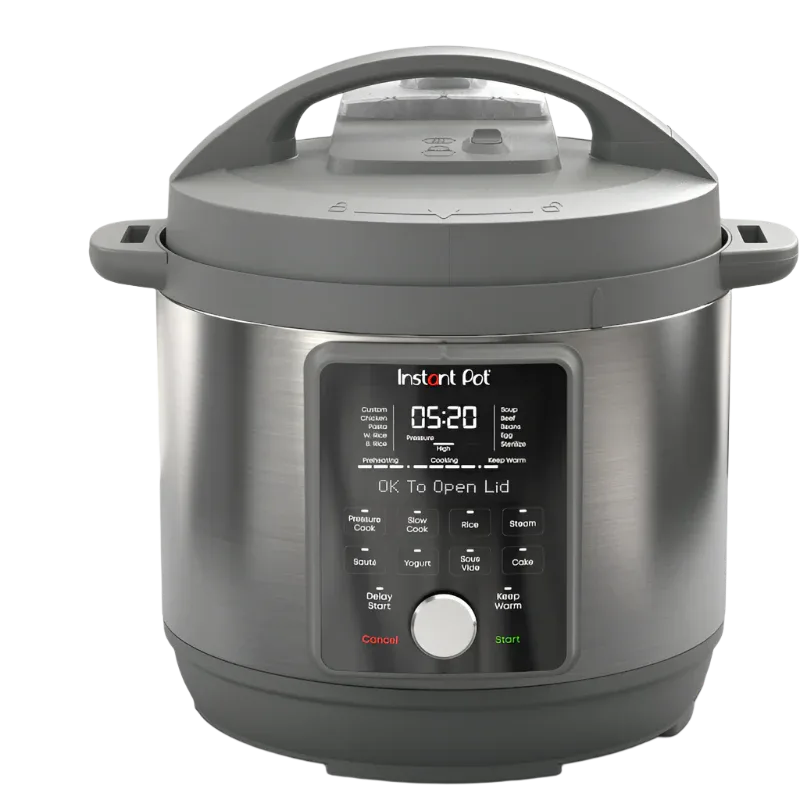
Best for: Existing Instant Pot users who need more capacity or a few extra functions
Capacity: 8 quarts (serves up to 8 people)
Functions: 9-in-1 (adds sterilize + sous vide over the base Duo)
Power: 1,200 watts
Trade-off: Still a single-lid design — no crisping capability
If your frustration is running two batches of chili or finding your pot too small for a full chicken, the Duo Plus 8-Quart is the simplest upgrade path. The Spruce Eats ranked it as their top overall pick, and Serious Eats named it the Best Large Multicooker in their 2026 roundup.
What the Duo Plus adds over the standard Duo: a sterilize setting (useful for canning jars and baby bottles), a cake/egg program, and the new Whisper Quiet steam release. The interface remains identical to the Duo — meaningful if you've already built cooking habits around it. The 8-quart pot handles a double batch of pulled pork, a full pot of bone broth, or a large family meal in one pass.
According to the Instant Pot official product page, it includes over 10 safety mechanisms, a stainless steel steam rack with handles, and two extra sealing rings. The 1-year limited warranty applies from purchase date.
Why it wins here: Zero learning curve for current Instant Pot users. You keep every habit you already have — just with more room.
Why it might not win for you: If your issue is texture (you want crispy results), smart controls, or induction, the Duo Plus doesn't solve those problems.
If you're building out your full kitchen appliance set at the same time, our Home & Kitchen Buying Guide: Appliances, Cookware & Smart Home 2026 covers how the pressure cooker category fits alongside other decisions like blenders, stand mixers, and dishwashers.
Best Alternative for Air Frying + Pressure Cooking: Ninja Foodi Line
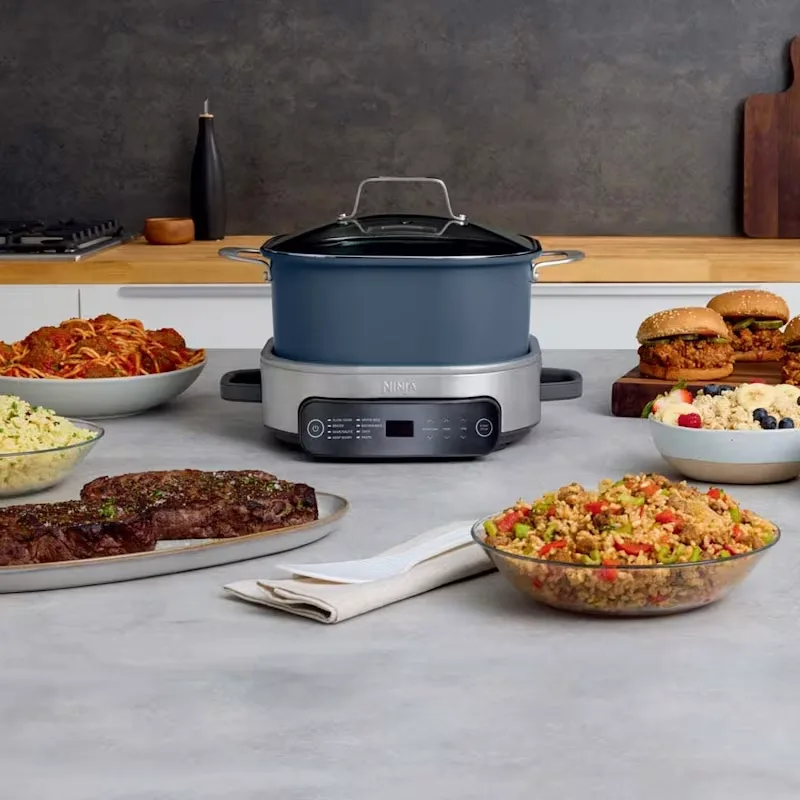
Best for: Cooks who want crispy AND tender results from one appliance
Key function: Dual-lid design — pressure lid + permanently attached crisping lid
Pot coating: Ceramic nonstick (PTFE/PFOA-safe per Reviewed.com testing)
Trade-off: Heavier (some models 25 lbs+), larger footprint, two lids to manage
This is the most common reason people leave the Instant Pot ecosystem — and the Ninja Foodi line is the most direct answer.
Here's the core physics problem with standard pressure cookers: they work by trapping steam, which is the opposite of what creates crispiness. You cannot get a browned chicken skin, crunchy sweet potato fries, or a caramelized crust from a single-lid pressure cooker. Period.
The Ninja Foodi solves this with a two-lid system: one pressure cooking lid (detachable) and one permanently attached crisping/air frying lid. According to Reviewed.com's hands-on testing, the Ninja Foodi Pressure Cooker Steam Fryer with SmartLid boasts 14 cooking functions. Their testing found the air fry results on chicken were "almost comparable" to traditional deep-frying, while the pressure cooking function handled everything from chili to yogurt to risotto. The ceramic nonstick coating on the pot and Cook & Crisp basket are dishwasher-safe.
Real-world advantage: You can pressure cook a whole chicken until tender, then switch to the crisping lid to brown the skin — without moving the food or dirtying a second pan. This is the workflow Ninja's TenderCrisp technology is built around.
The honest trade-offs:
- The permanently attached crisping lid means the unit is larger and heavier than a standalone pressure cooker. Some models weigh over 25 lbs.
- You can't tuck this under low kitchen cabinets — the crisping lid needs overhead clearance.
- The dual-lid design means two lids to store (one is attached, one isn't).
- Cord length on some models is only 33 inches — verify outlet placement before buying.
The Ninja Foodi 9-in-1 and the newer SmartLid models (which combine both functions into a single lid) appear consistently across buying guides as the top picks for this use case. The SmartLid design addresses the storage issue by eliminating the second separate lid.
Compared to the Instant Pot Pro Crisp & Air Fryer 8-Quart: The Spruce Eats lists the Instant Pot Pro Crisp at a significantly higher price point — roughly double the entry-level Ninja Foodi models. Both solve the same problem; the price gap is worth evaluating directly before buying. The Instant Pot Pro Crisp keeps you in the same accessory ecosystem; the Ninja Foodi typically costs less and has a more streamlined control panel.
Best Alternative for Tech-Forward Cooks: Chef iQ Smart Pressure Cooker
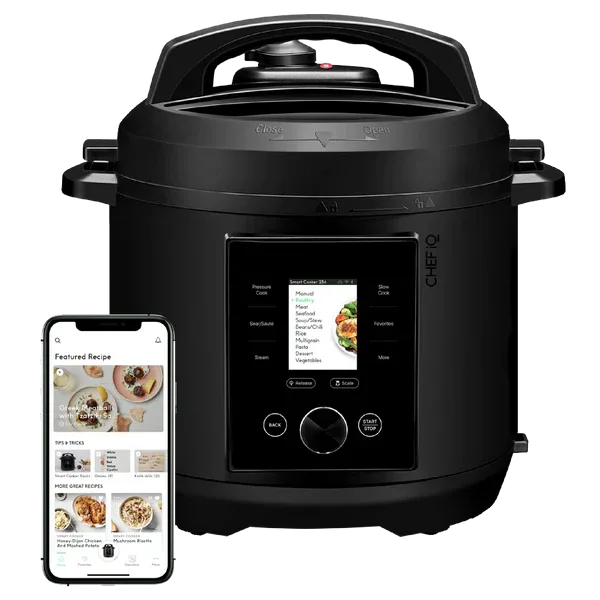
Best for: Experienced home cooks, fermenters, recipe developers
Standout features: Built-in scale, real-time pressure display, adjustable fermentation temperature
Trade-off: More complexity — casual cooks may never use most of these features
Standard Instant Pot presets are built for consistency, not precision. That's a feature for most users. It's a limitation for cooks who ferment, proof dough, follow metric recipes, or want to monitor what's actually happening inside the pot.
The Chef iQ addresses all of those gaps. Reviewed.com praised it for its customizable cook functions, describing it as "designed for chefs by chefs."
Here's what actually makes it different:
- Adjustable fermentation temperature: The Instant Pot's Yogurt setting locks you into one temperature range. The Chef iQ lets you dial in a specific temperature — meaningful for anyone making kefir, tempeh, or koji.
- Built-in tare scale: You weigh ingredients directly into the cooking pot. Fewer bowls, less cleanup, and more accurate recipes if you cook by weight.
- Real-time pressure display: Instead of staring at the lid wondering when it'll reach pressure, you watch it climb. It makes time-to-dinner estimates accurate rather than guesswork.
Who should skip it: If you use three or four preset functions and cook mostly soups, grains, and proteins, the Chef iQ's added features go unused. The learning curve is real, and the premium price isn't justified by features you'll never touch.
Who should consider it: If you ferment regularly, develop your own recipes, or cook from weight-based recipes — these are tools that change how you cook, not just how you feel about your appliance.
Best Stovetop Alternatives: Presto (Including Induction) and Fissler
Best for: Induction cooktops, minimalists, batch/canning cooks
Key advantage: No counter space, faster pressure buildup, works on any heat source (with right model)
Trade-off: No preset programs, slow cook, or yogurt functions
Electric multicookers occupy permanent counter space and need a dedicated outlet. If either of those is a constraint, stovetop pressure cookers eliminate both problems.
Presto 6-Quart Aluminum Pressure Cooker — The most straightforward stovetop option for cooks who already know pressure cooking basics. According to cookerswar.com, it carries a 12-year warranty and works on both regular and smooth-top ranges. No digital display, no preset programs, no smart features. That's the point.
Critical note on induction: The standard Presto aluminum model will not work on induction cooktops. Everyday Health specifically flagged the Presto 01784 as the induction-compatible version — it has a stainless-steel-clad base engineered for induction. If your cooktop is induction-only, this model distinction is non-negotiable.
Presto 23-Quart Pressure Canner — For large-batch cooking and seasonal food preservation, Everyday Health highlighted this model as a dual-use option: it functions as both a pressure canner and a standard pressure cooker. Useful for households that put up beans, broths, or shelf-stable meals in volume.
Fissler Vitaquick — At the premium end of stovetop options, the Fissler appears in multiple buying guides for its precise pressure control and long-term build quality. It costs meaningfully more than the Presto line, but the construction difference reflects it.
Stovetop vs. electric — the real difference: Stovetop models reach pressure faster than electric models because they draw directly from a burner rather than a heating element. They're also simpler mechanically, which often means longer service life. The trade-off is that they require you to monitor heat level manually and don't have slow cook, yogurt, or warm functions.
Best Eco-Conscious Alternative: Seb 9L Eco Pressure Cooker
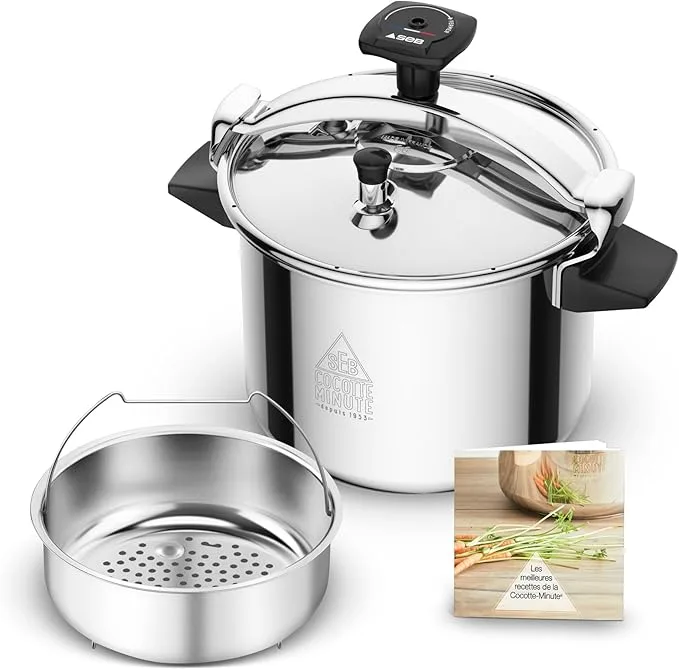
Best for: Daily cooks who care about energy efficiency and nutrient retention
Key specs: 9L capacity, stainless steel construction, 10-year tank warranty
Trade-off: Stovetop only — no electronic functions
Energy efficiency rarely leads the conversation in pressure cooker marketing, but for households cooking daily, it's a real variable.
According to cookerswar.com, the Seb 9L Eco cooks roughly twice as fast as conventional cooking methods and retains up to 80% more vitamins compared to standard boiling. Shorter cook times mean less energy consumed per meal — not a marketing claim, but a direct result of pressure cooking's efficiency.
The 9-liter capacity handles large-family meals or batch cooking without additional cycles, which further reduces energy per serving. The 10-year tank warranty signals confidence in long-term durability. Stainless steel construction avoids concerns about aluminum reactivity and the longevity limits of non-stick coatings.
For households that prioritize nutrient quality and appliance longevity alongside cooking convenience, the Seb 9L is a credible alternative to both standard electric multicookers and cheaper stovetop models.
Best Budget Alternatives: Instant Pot Rio 7-in-1 and Cosori 9-in-1
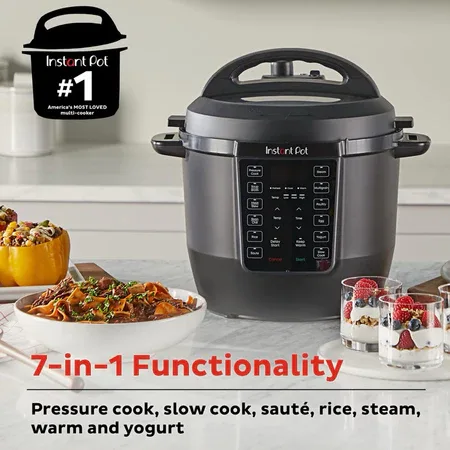
Best for: First-time buyers, smaller households, strict budgets
What you get: Core pressure cook, slow cook, sauté, steam, rice, yogurt, warm functions
What you give up: Wi-Fi, advanced pressure control, premium build materials, custom settings
Spending more doesn't always mean cooking better. Two budget picks consistently appear across testing sources in 2026:
Instant Pot Rio 7-in-1 Multi-Cooker (6-quart): According to Yahoo Shopping, this model covers the core seven functions at 1,200 watts in a footprint of 13.2"D × 12.2"W × 12.5"H. It's the lean version of the Instant Pot lineup — no sous vide, no sterilize, no air fryer — but it handles everything most households cook week to week. Also available in 8-quart at approximately $119 per Walmart listings.
Cosori 9-in-1 Electric Pressure Cooker: Appears in multiple buying guides as a value pick that offers more cooking modes than the base Instant Pot Duo at a competitive price. Worth evaluating directly if you want a wider function set without paying Pro or Plus pricing.
The budget model reality check:
Good Housekeeping's testing framework identified that some budget models offer only high pressure, while others include both high and low. Low pressure is genuinely useful for delicate items — fish, rice, custards, and even cakes. Before buying any budget model, confirm it has the pressure settings your actual recipes require. This is the most commonly overlooked spec comparison when shopping by price.
Quick-Decision Table: Which Alternative Fits Which Gap
| Your Primary Gap | Best Alternative | Why It Fits |
|---|---|---|
| Need more capacity, same interface | Instant Pot Duo Plus 8-Quart | Familiar controls, larger pot, same accessory ecosystem |
| Want crispy + tender from one pot | Ninja Foodi 9-in-1 / SmartLid | TenderCrisp dual-lid design, ceramic pot |
| Need precision / smart controls | Chef iQ Smart Pressure Cooker | Built-in scale, real-time pressure, adjustable fermentation |
| Induction cooktop only | Presto 01784 Stovetop | Stainless-clad base, induction-engineered |
| Prioritize energy efficiency + nutrients | Seb 9L Eco Pressure Cooker | 2× faster cooking, up to 80% more vitamins retained, 10-yr warranty |
| Budget-first, core functions only | Instant Pot Rio 7-in-1 / Cosori 9-in-1 | 7–9 functions, proven reliability, lower price |
| Large-batch cooking and canning | Presto 23-Quart Pressure Canner | Dual canner/cooker, large volume capacity |
Frequently Asked Questions
Is the Ninja Foodi actually better than the Instant Pot?
It depends entirely on what you cook. If crispy textures matter — roasted vegetables, chicken skin, breaded proteins — the Ninja Foodi's air-crisping function gives it a physical capability the standard Instant Pot cannot match. Reviewed.com's hands-on tests found results "almost comparable to deep-frying." If you cook primarily soups, stews, beans, and braises, the Instant Pot's interface and accessory ecosystem may serve you equally well at a lower price. This isn't a question of overall quality — it's a question of which cooking methods you actually use.
Can I use a stovetop pressure cooker on an induction range?
Only if the base is magnetic. Aluminum bases — including the standard Presto 6-Quart — will not activate on induction cooktops. The Presto 01784 model specifically includes a stainless-steel-clad base for induction compatibility, as confirmed by Everyday Health. Always verify induction compatibility before purchasing any stovetop model. When in doubt, hold a magnet to the bottom of the pot at the store.
Do I actually need both high and low pressure settings?
Possibly. Good Housekeeping's testing identified three tiers: high pressure only (sufficient for most everyday proteins, soups, and grains), high and low (low is useful for fish, rice, and delicate items like custards or cakes), and max pressure (fastest cook times, best for concentrated bone broth). If your cooking is primarily hearty proteins and legumes, high-only works fine. If your recipes include delicate ingredients, a model with both settings is worth the small price difference.
Is the Chef iQ worth the premium?
For casual cooks who rely on three or four preset functions: no. For cooks who ferment, develop original recipes, or want data visibility during cooking: yes. Reviewed.com's assessment was direct — it's built for cooks who want to control the details, not follow presets. The built-in scale and real-time pressure display are features that actively change how you cook. If you won't use them, they add cost and complexity without benefit.
What size pressure cooker do I actually need?
A commonly cited rule: a 6-quart model comfortably feeds four to six people for most recipes. An 8-quart makes sense for larger families, batch cooking, or liquid-heavy recipes like bone broth. Note that electric pressure cookers should not be filled more than two-thirds full (half full for liquids that expand), so actual usable capacity is less than the stated size. If you're cooking for 6+ people or routinely batch cooking, start with 8 quarts.
How does a pressure cooker alternative compare to a blender or stand mixer?
Pressure cookers and other countertop appliances serve different cooking functions. If you're evaluating your whole kitchen setup, our guides on the best blenders for 2026 and best stand mixers can help you prioritize which appliances actually earn their counter space.
Should I also look at water filtration for my kitchen?
If you're cooking with tap water in soups, broth, or rice, water quality does affect the taste of pressure-cooked meals. Our best water filters and purifiers guide for 2026 covers pitcher, under-sink, and whole-house options across all budgets.
Final Recommendation by Cooking Profile
You cook for 5+ people or batch cook weekly → Instant Pot Duo Plus 8-Quart. Familiar, reliable, just bigger.
You want to pressure cook AND air fry in one pot → Ninja Foodi 9-in-1 or SmartLid. Expect a larger footprint in exchange for the dual function.
You ferment, proof dough, or cook by weight → Chef iQ Smart Pressure Cooker. The precision features are tools, not features.
You have an induction cooktop → Presto 01784 specifically. Don't buy any stovetop pressure cooker without confirming induction compatibility.
You cook daily and care about energy/nutrients long-term → Seb 9L Eco. The 10-year warranty alone makes this a different value proposition from most.
You're buying your first pressure cooker on a budget → Instant Pot Rio 7-in-1 or Cosori 9-in-1. Both cover the core use cases at an accessible price.
See also: Best Coffee Makers & Espresso Machines for Every Budget (2026) — another kitchen appliance category where the "best overall" pick varies significantly by how you actually use it.