
This guide was researched and drafted with AI assistance, then reviewed and fact-checked by our editorial team before publishing. Our analysis synthesizes manufacturer specs, independent lab results (RTINGS.com, TechGearLab, Wirecutter, Serious Eats), and verified buyer feedback. We cite every source. We don't accept payment for rankings. How we review · Affiliate disclosure
Quick Verdict: Which Blender Wins in 2026?
Here's the one-sentence answer before the detail: the right blender depends entirely on what you're making.
- Vitamix (VX1 or E310) — best overall for daily blending, nut butters, and hot soups
- NutriBullet Pro 900 or Ultra — best personal blender for solo users and quick morning smoothies
- Ninja Foodi system — best multi-function pick for households that blend, chop, and cook
Not sure which fits your kitchen? The decision framework at the bottom of this article will tell you in under a minute. Or keep reading for the full breakdown.
TL;DR — Key Takeaways
- Vitamix 5200 scored a perfect 10/10 on both green and berry smoothies in TechGearLab's independent testing — no other blender in their pool matched it on both.
- The Cleanblend Commercial Blender (1,800W) outperformed even the Vitamix 5200 on cold smoothies in Wirecutter's testing — but sent hot liquid shooting toward the lid during soup tests. It is the wrong machine if you make soups.
- Ninja's biggest strength is not smoothie quality — it's functional range. The Foodi Cold & Hot Blender is the only model in this comparison with built-in heating capability.
- Wattage alone doesn't predict safety with hot liquids. Whether the lowest speed setting is genuinely slow matters more.
- Blade design beats wattage numbers in personal blenders. The NutriBullet Ultra's six-blade configuration outperforms the higher-wattage NutriBullet Rx in Wirecutter testing.
Why Most People Buy the Wrong Blender — and How to Avoid It
Most blender buyers focus on motor wattage and brand name. Both are secondary to a simpler question: what are you actually going to make?
A blender optimized for silky frozen smoothies can be genuinely unsafe for hot soups — not hypothetically, but in documented independent testing. Wirecutter found that the Cleanblend, which beat the Vitamix 5200 on smoothie quality, caused hot liquid to shoot toward the lid on its lowest setting during soup tests. The issue isn't power; it's that the machine runs too fast even at minimum speed.
The same problem plays out in reverse. A compact personal blender that makes the fastest, cleanest morning shake is completely incompatible with batch cooking for a family. The Ninja BlendBoss has a 26 oz jar. The Vitamix E310 has a 48 oz jar. The Cleanblend Commercial has a 64 oz jar. That's not a minor spec gap — it determines whether you're blending one portion or dinner for four.
Three use cases, three different machines:
- Smoothies: Strong blade speed, a tamper for thick frozen blends, and enough jar capacity for your household size. Variable speed control gives you texture precision.
- Hot soups: A genuinely slow lowest speed setting, a well-sealed lid, and ideally Tritan plastic rather than glass (handles thermal shock better than glass, which can crack).
- Heavy-duty daily use: Minimum 1,400W motor, a 5-year warranty as a durability signal, and a blade design rated for sustained hard-ingredient processing (ice, nuts, fibrous greens).
Identify your primary use case before comparing specs. That single step is what separates a blender that earns its counter space from one that collects dust.
How This Guide Was Researched
This is a research-based guide — not a hands-on test by Trusted Buyer Report. Our analysis draws from:
- RTINGS.com: independently bought and tested 137 blenders across categories
- TechGearLab: expert panel blind-scored smoothie outputs; Vitamix 5200 received the only perfect 10/10 on both green and berry smoothies
- Wirecutter: hands-on testing including documented soup safety failures
- Serious Eats: noise measurement (recorded 93 dB for the KitchenAid blender during almond milk testing)
- Forbes Vetted and Bon Appétit: both named their picks for 2026 after hands-on evaluation; Bon Appétit tested 35 blenders for their 2026 update
- Consumer Reports: lab-tested NutriBullet models including the Lite NBI50200
- Yahoo Shopping: updated February 2026, with expert input from chef Katie Button (co-founder of Cúrate restaurant)
- EverythingKitchens.com: direct Vitamix vs Ninja head-to-head testing across multiple tasks
Warranty length is used throughout as a meaningful durability proxy. A 5-year warranty vs a 1-year warranty reflects real differences in manufacturer confidence about motor lifespan under regular use.
Full Comparison at a Glance
| Model | Wattage | Jar Capacity | Speed Control | Best Use Case | Warranty |
|---|---|---|---|---|---|
| Vitamix VX1 | 1,440W | 64 oz | Variable dial + tamper | All-purpose daily blending | 5 years |
| Vitamix 5200 | ~1,380W | 64 oz | Variable dial + tamper | Professional-grade all-purpose | 7 years |
| Vitamix E310 Explorian | 1,400W | 48 oz | Variable dial + tamper | Smoothies + soups, Vitamix entry point | 5 years |
| Cleanblend Commercial | 1,800W | 64 oz | Variable dial + pulse | Cold blending — smoothies, nut butters | 5 years |
| NutriBullet Pro 900 | 900W | 32 oz (personal cup) | One-touch extraction | Single-serve smoothies | 1 year |
| NutriBullet Ultra | ~1,200W | 32 oz (personal cup) | Multiple speeds | Single-serve, superior blade design | 1 year |
| NutriBullet Full-Size Combo | 1,200W | 64 oz | Extract, low, med, high, pulse | Budget full-size blending | 1 year |
| Ninja Foodi Power Blender Ultimate | 1,200W+ | 72 oz | Preset modes | Blending + food processing combo | 1 year |
| Ninja Foodi Cold & Hot Blender | 1,000W+ | 64 oz | Preset + heat modes | Hot soup blending | 1 year |
| Ninja BlendBoss | 1,200W | 26 oz | Blend, smoothie, ice crush, pulse | Personal single-serve | 1 year |
Vitamix in 2026: When the Premium Price Is Actually Worth It
Short answer: if you blend at least four times a week, Vitamix pays for itself.
The evidence is specific. TechGearLab's expert panel gave the Vitamix 5200 a perfect 10/10 on both green smoothie and berry smoothie taste evaluations — the only blender in their testing pool to achieve that on both metrics. Every other machine, including the Blendtec Total Classic and Ninja Professional Plus BN701, scored lower on at least one category.

Vitamix VX1 vs 5200: Which Should You Buy?
Bon Appétit tested both after their 2026 update and describes the VX1 as producing comparable output to the 5200 at a lower price. The VX1 runs at 1,440 watts across 10 speeds with a 64 oz pitcher and a 5-year warranty. The 5200 carries a 7-year warranty and has the longer track record. For most home users, the VX1 is the more practical entry point.
One practical detail worth knowing: both the VX1 and 5200 include a tamper stick. When you're blending frozen smoothies or nut butter, the tamper lets you push dense ingredients toward the blade without stopping the machine. That sounds minor until you've had a frozen smoothie seize up and watched your blender motor strain against it. It's not a gimmick — it's the feature that separates genuinely smooth output from "good enough."
Vitamix E310: The Smoothie-and-Soup Option
The Vitamix E310 Explorian at 1,400W is the brand's most accessible entry point, with a 48 oz jar (smaller than the 5200/VX1), variable speed dial, tamper, and a 5-year warranty.
Here's the distinction that matters for soup: the E310's variable dial starts at a genuinely slow speed. Food and Wine's 2026 testing shows soup being made in the E310 safely — because gradual speed ramp-up prevents the steam pressure buildup that makes hot blending dangerous. This is the same dial interface the Cleanblend uses, but the Cleanblend doesn't actually deliver slow-speed control. The E310 does.
Real-world user feedback from Reddit's r/culinary confirms the lab data: users describe the E310 as capable of "liquefying ice in drinks, pureeing anything, grinding nuts into flour." The phrase "they live up to the hype, period" appears repeatedly in community discussions about daily blending.
Buy a Vitamix if: you blend at least four times per week, you make nut butters or hot soups regularly, you want one machine that handles every task at the highest quality level for a decade or more.
Skip it if: you blend occasionally, your kitchen is small, or your budget is under $300.
NutriBullet in 2026: The Best Personal Blender — With Real Caveats

Forbes Vetted named the NutriBullet Pro 900 the best personal blender of 2026. That designation is meaningful and narrow: the Pro 900 is not competing with Vitamix for all-purpose kitchen dominance. It wins specifically for solo users or couples who want a fast, clean smoothie every morning — and on that use case, it delivers.
The Blade Design Insight Most Reviews Miss
Here's something most NutriBullet coverage gets wrong: wattage isn't the key spec. Wirecutter found that the higher-wattage NutriBullet Rx left marble-sized frozen banana chunks in smoothies during testing, while the lower-wattage NutriBullet Ultra produced a smoother result. The difference is blade design — the Ultra's six longer blades outperform the Rx's four shorter blades regardless of the watt numbers.
If you're choosing between NutriBullet models, look at blade count and length, not just the wattage printed on the box.
The Wide Cylinder Advantage
NutriBullet's personal cups use a wide cylindrical shape rather than a tapered design. That means you can load large chunks of frozen fruit, leafy greens, and ice in any order and the machine handles it without careful sequencing. Wirecutter specifically contrasts this with the Vitamix Personal Cup Adapter's narrow-bottomed design, which requires loading smaller pieces first to blend effectively.
For someone throwing ingredients in before work without much thought, that difference is real and daily.
NutriBullet Full-Size: The Honest Tradeoff
The NutriBullet Full-Size Blender Combo (64 oz, 1,200W) is a reasonable budget full-size option. But Wirecutter's testing found it produces a liquified smoothie texture rather than a creamy one. It blends thoroughly — there's just a mouthfeel difference that matters to some users and doesn't to others. If texture precision is important to you, be aware of that before buying.
One practical limitation for households: personal blenders require decanting and cleaning the cup between users. If two or more people blend daily, that workflow friction eliminates much of the convenience advantage. A full-size machine serves shared households better.
Buy a NutriBullet if: you're a solo user or couple, your kitchen is small, you want the simplest morning routine, and you don't need batch capacity or hot blending.
Skip it if: multiple people blend daily, you make soups, or you want creamy rather than liquified texture from your smoothies.
Ninja in 2026: The Versatility Choice for Kitchens That Do More Than Blend
Ninja's strongest 2026 argument is not smoothie quality — and if you're primarily buying for smoothies, Ninja shouldn't be your first choice. What Ninja does that no other brand in this comparison matches is functional range.
Ninja Foodi Power Blender Ultimate System: The Best Blender-Food Processor Combo
Forbes Vetted named the Ninja Foodi Power Blender Ultimate System the best blender-food processor combo of 2026. The system combines blending with food processing attachments in a single machine. For a household making soups, salsas, dips, and smoothies with equal frequency, a dedicated blender plus a separate food processor is a more expensive, more counter-space-consuming solution than one Ninja system.
Ninja Foodi Cold & Hot Blender: The Soup Specialist

The Ninja Foodi Cold & Hot Blender has a capability neither Vitamix nor NutriBullet can match: built-in heating. You blend and heat soup in the same container. That eliminates the hot-liquid transfer step entirely — no pouring scalding bisque from pot to blender jar, no burn risk, no mess. RTINGS.com includes this model in their 2026 popular blenders list.
If you make blended soups two or more times a week, this machine deserves serious consideration, and it's the safest option for hot liquid processing in this comparison.
Where Ninja Falls Short
Pure blending performance. TechGearLab gave the Ninja Professional Plus BN701 a 6/10 on green smoothies and 7/10 on berry smoothies — solid mid-range scores, but a genuine gap below Vitamix's perfect 10s. EverythingKitchens.com's direct head-to-head found visible apple skin chunks and carrot pieces remaining in Ninja smoothies that the Vitamix rendered completely smooth.
Ninja's product line is also genuinely confusing to navigate. The Detect Kitchen System TB401, Foodi Power Nutri DUO, Professional Plus with Auto-iQ, and Detect Duo Power Blender Pro are all distinct products that appear on RTINGS.com's popular models list. If you buy Ninja, spend time identifying the specific system that matches your use case — the brand name alone doesn't tell you what you're getting.
Buy a Ninja if: you want one appliance for blending, chopping, and cooking; you make soups and salsas as often as smoothies; you have a mid-range budget; or you specifically want hot-blending without a separate pot.
Skip it if: your primary goal is the smoothest possible smoothie or nut butter.
Best Blender by Use Case: What the Test Data Actually Shows
Best for Smoothies
Winner: Vitamix 5200 or VX1
TechGearLab's scoring is the clearest evidence in this category:
| Model | Green Smoothie Score | Berry Smoothie Score |
|---|---|---|
| Vitamix 5200 | 10/10 | 10/10 |
| NutriBullet Combo | 7/10 | 8/10 |
| Ninja Professional Plus BN701 | 6/10 | 7/10 |
For daily smoothie drinkers who care about texture, that gap is consistent across multiple testing sources. For occasional blenders using frozen fruit and protein powder, Ninja and NutriBullet produce perfectly acceptable results.
Budget smoothie alternative: Serious Eats named the Breville Fresh & Furious their best smoothie blender at a lower price point. The KitchenAid blender produces "creamier smoothies than budget picks without requiring as much investment as pricier options," according to Serious Eats — a middle-ground choice if the Vitamix price is a barrier.
Best for Hot Soups

Winner: Vitamix E310 (safest variable-speed option) or Ninja Foodi Cold & Hot Blender (built-in heating)
Hot liquid blending is the most technically demanding and safety-sensitive use case. Here's the core principle: what matters is not wattage — it's whether the lowest speed setting is genuinely slow.
Steam pressure builds inside a sealed jar when hot liquid meets a spinning blade. A machine that runs at high speed even on its lowest setting creates real splatter risk — exactly what Wirecutter documented with the Cleanblend.
Safe soup blending requires:
- A variable speed dial that starts at a true low speed (Vitamix E310 qualifies; Cleanblend does not despite having a similar dial)
- A well-sealed or vented lid
- Jar filled no more than halfway
- Lid held firmly with a folded kitchen towel while starting at minimum speed
For users whose primary kitchen task is soups, an immersion blender is also worth considering. Food and Wine covers the 6 best immersion blenders for 2026 in a dedicated roundup — immersion blenders eliminate the jar transfer risk entirely by letting you blend directly in the pot.
Best for Heavy-Duty Daily Use
Winner: Vitamix 5200, Vitamix Ascent X4/X5, or Cleanblend Commercial Blender
Heavy-duty use means blending multiple times per day, processing hard ingredients (frozen fruit, whole ice cubes, fibrous kale stems, raw nuts), and expecting consistent performance for years.
Budget blenders rated at 1,200W with 1-year warranties are not designed for this workload. The minimum threshold for serious daily blending is 1,400W and a 5-year warranty.
The Vitamix 5200 is the long-standing benchmark. A 2026 YouTube review from the Valid Consumer channel, which tested five blenders specifically for "real-world power and reliability," ranked it first. Their top five also included the Vitamix Ascent X5 at third — the newer generation with a digital display and self-detecting container technology.
The Cleanblend Commercial Blender (1,800W, 5-year warranty) is a lower-cost alternative that outperformed the Vitamix 5200 on smoothies in Wirecutter's testing — but only for cold blending. If heavy-duty use includes soups, stick with Vitamix.
Blendtec is a serious contender here that's underrepresented in most 2026 guides. Reddit's r/culinary community consistently names it alongside Vitamix as one of two brands that genuinely holds up to daily punishment. Their flat blade design and WildSide jar are engineering choices aimed specifically at high-volume blending.
Best for Ice Crushing and Frozen Drinks
Both Vitamix and Ninja handle ice crushing well. The Vitamix VX1's 1,440W motor processes whole ice cubes without strain. Ninja's mid-range models perform adequately for frozen cocktails. The Ninja BlendBoss includes a dedicated ice crush preset for personal-sized frozen drinks.
For large-batch frozen drinks (parties, batch cocktails), a 64 oz jar at 1,400W or above is the right tool. Personal blenders aren't sized for the task.
Best Budget Pick for 2026
Winner: NutriBullet Full-Size Blender Combo
Yahoo Shopping's best budget pick for 2026. At 1,200W with a 64 oz jar, it includes a tamper, a 32 oz cup, a 24 oz handled cup, and two to-go lids. The honest limitation: the 1-year warranty reflects its motor class. For light to moderate use — a few smoothies per week — this machine delivers reasonable results. For daily heavy blending, it's not rated for that workload.
Noise, Footprint, and Daily Usability
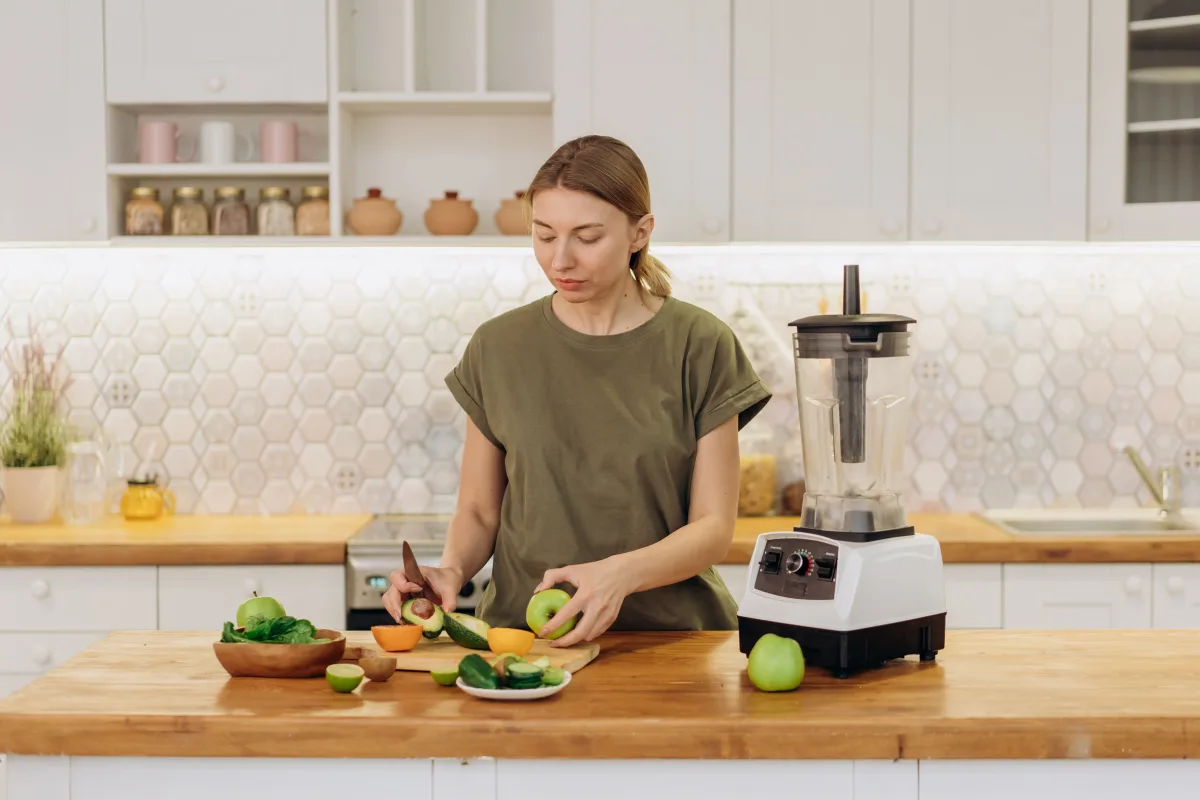
Performance scores don't capture the experience of blending at 6:30 a.m.
Noise is a real quality-of-life factor. Serious Eats measured the KitchenAid blender at 93 decibels during almond milk testing — roughly equivalent to a lawnmower at close range. Wirecutter describes the Ninja BL480D Nutri 1000 Watt Auto-IQ as "horribly loud" with a high whiny pitch, and noted it walked on the counter during pesto blending. That's not just annoying; it's a safety and stability issue.
Counter footprint: A full-size Vitamix with a 64 oz pitcher is a substantial countertop commitment. NutriBullet personal blenders take up a fraction of that space and can be stored in a cabinet between uses. Ninja's multi-function systems often require the most counter real estate of all three, given the additional attachments.
Cleaning: NutriBullet's cups go directly into the dishwasher. Vitamix pitchers are self-cleaning — fill with warm water and a drop of dish soap, run on high for 60 seconds, rinse. Ninja's multi-component systems have more parts to disassemble after each use. That friction adds up over months of daily blending.
Final Decision Framework: Which Blender Is Right for You?
Rather than naming a single winner, here's a use-case map based on the evidence above:
→ Buy a Vitamix VX1 or 5200 if:
You blend at least four times per week, you make nut butters or hot soups, you want one machine that handles every task at the highest quality level, and you're prepared to invest in something built to last a decade. Forbes Vetted, Bon Appétit, and TechGearLab all independently land on the same conclusion.
→ Buy a Vitamix E310 if:
You want Vitamix performance at the most accessible entry price, you make soups occasionally (the genuine variable speed dial handles hot liquids safely), but you can live with a 48 oz rather than 64 oz jar.
→ Buy a NutriBullet Pro 900 or Ultra if:
You're a solo user or couple making daily smoothies, your kitchen is small, and you want the fastest and simplest morning routine. Forbes Vetted's best personal blender designation is supported by Wirecutter and Consumer Reports testing. Choose the Ultra over the Rx if you're comparing NutriBullet models — the six-blade design outperforms higher wattage alone.
→ Buy a Ninja Foodi Power Blender Ultimate System if:
You want one appliance for blending, chopping, and food processing at a mid-range price. Accept the tradeoff: you're getting functional breadth, not peak smoothie quality.
→ Buy a Ninja Foodi Cold & Hot Blender if:
You make blended soups two or more times per week and want the safest, most convenient hot-blending setup. Built-in heating eliminates the hot-liquid transfer risk entirely.
→ Buy the NutriBullet Full-Size Blender Combo if:
Budget is the primary constraint and you blend a few times per week. Understand that texture will be more liquified than creamy compared to Vitamix, and the 1-year warranty reflects the motor's durability ceiling.
The worst outcome here is buying based on brand recognition alone — a Vitamix that collects dust because it's too large for your kitchen, or a NutriBullet that frustrates every time you try to make soup, is money spent twice regardless of how it scores in a lab.
Frequently Asked Questions
Is Vitamix worth the price compared to Ninja in 2026?
For users who blend frequently and care about texture: yes. TechGearLab's testing gave the Vitamix 5200 perfect 10/10 scores on both green and berry smoothies; the Ninja Professional Plus BN701 scored 6/10 and 7/10. EverythingKitchens.com found Vitamix outperformed Ninja on every task in direct head-to-head testing — smoothies, nut butter, and pureed soups. If you blend occasionally or primarily use protein powder with frozen fruit, the price difference is harder to justify.
Which Ninja blender is best for hot soups?
The Ninja Foodi Cold & Hot Blender. It's purpose-built for hot blending with heating elements or dedicated speed profiles for hot liquids, and it's the only model in this comparison that eliminates the hot-liquid transfer step entirely. For traditional blending with soups transferred from the stovetop, the Vitamix E310's genuine variable slow speed is the safer choice among standard blenders.
What is the best NutriBullet model in 2026?
Forbes Vetted names the Pro 900 as the best personal blender of 2026. For users who want a meaningful upgrade, the NutriBullet Ultra's six-blade design outperforms the higher-wattage Rx in Wirecutter testing — blade configuration matters more than wattage in the NutriBullet lineup.
Can I blend hot soup in any blender?
No. A blender safe for hot soups needs a genuinely slow lowest speed setting — not just a dial that claims variable speeds but still runs fast at minimum. Wirecutter's testing documented the Cleanblend causing hot liquid to shoot toward the lid even at its lowest setting. Fill the jar no more than halfway, hold the lid with a folded towel, and start at the absolute minimum speed before gradually increasing — regardless of which blender you use.
What wattage do I actually need?
For occasional smoothies and light blending: 1,200W is adequate. For daily use, frozen ingredients, or nut processing: 1,400W to 1,800W provides the headroom you need. The Vitamix E310 (1,400W) and Cleanblend (1,800W) represent the practical range for serious home blending. Budget blenders at 1,200W with 1-year warranties are not designed for sustained daily heavy-ingredient processing.
What is the difference between a variable speed dial and preset buttons?
A variable speed dial lets you start at the slowest speed and increase gradually — essential for hot liquids and for controlling smoothie texture at exactly the right consistency. Preset buttons automate the speed profile for common tasks, which is convenient but removes granular control. The Vitamix E310 and Cleanblend use variable dials; the Ninja BlendBoss uses presets. For safety with hot soups, a true variable dial is the critical feature.
Is the Cleanblend better than Vitamix?
On cold smoothies and piña coladas, yes — Wirecutter found the Cleanblend produced the smoothest results of any blender they tested, including the Vitamix 5200. But it is explicitly not recommended for hot soup blending due to a safety concern Wirecutter documented in testing. If your use is purely cold blending, the Cleanblend's 5-year warranty and lower price make it a compelling Vitamix alternative. If you ever blend hot liquids, choose Vitamix instead.
We may earn a commission when you use our links to make a purchase, at no additional cost to you. This helps fund this independent site. Our editorial rankings are completed before any affiliate link is applied and are never influenced by commercial relationships. Full disclosure →