How this guide was researched: This guide synthesizes publicly available market data (IBISWorld 2026, Future Market Insights, Global Market Insights), expert review data from Garage Gym Reviews and OutdoorGearLab, manufacturer specifications, and consumer pricing analysis from chestpressmachine.com and The Fitness Outlet's 2026 Buying Guide. Trusted Buyer Report has not hands-on tested every product listed. We synthesize expert and market sources so you can make a faster, better-informed decision.
TL;DR — Which Home Gym Tier Is Right for You?
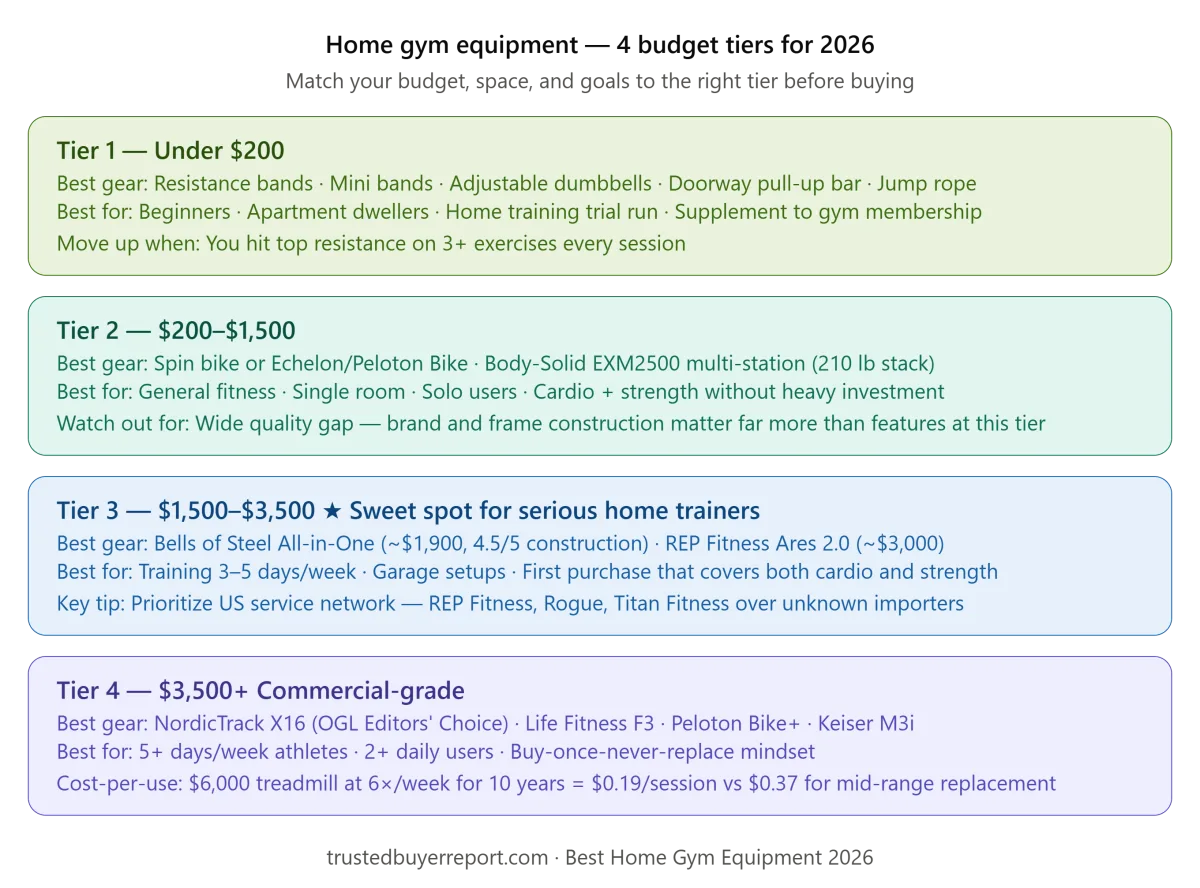
- Under $200 — Resistance bands, adjustable dumbbells, pull-up bar. Best for beginners, apartments, or anyone testing home training before committing more.
- $200–$1,500 — Spin bike or connected cardio + multi-station home gym (e.g., Body-Solid EXM2500). Best for general fitness with limited space.
- $1,500–$3,500 — Full combo: squat rack/functional trainer (e.g., Bells of Steel All-in-One) + quality cardio. Best for serious home trainers who want both categories covered.
- $3,500+ — Commercial-grade machines (NordicTrack X16, Life Fitness, Peloton Bike+, Keiser M3i). Best for households with 2+ daily users or athletes training 5+ days/week.
The most common mistake: buying the wrong tier and upgrading 18 months later — which typically costs 30–40% more than buying the right tier once.
Why Home Gym Buying Decisions Feel Harder Than They Should
Home gym equipment prices have risen over 95% in the last decade, according to chestpressmachine.com's 2026 fitness price analysis. That means a wrong purchase today costs nearly twice what the same mistake cost ten years ago.
The market itself hasn't made things easier. The pandemic pulled forward years of home fitness demand between 2020 and 2021, then triggered a sharp correction as gyms reopened. According to IBISWorld's 2026 Gym & Exercise Equipment Manufacturing report, US manufacturers have since faced escalating tariffs on key inputs, supply chain disruptions, and input price spikes — all of which have left the mid-range flooded with products of wildly uneven quality. Price no longer reliably signals durability. A $400 spin bike from a reputable brand and a $400 spin bike from an unknown importer share almost nothing except their price tag.
Here's what that means practically: the research burden on buyers is higher than it's ever been. The right question is never "which product is objectively best" — it's "which product is best for my specific budget, space, and training pattern." This guide answers that question tier by tier.
Is a Home Gym Actually Worth It Financially?
Before comparing any specific equipment, the math deserves a direct answer.
A $3,000 equipment build plus $500–$1,000 in flooring and setup totals $3,500–$4,000 in upfront investment. Five years of a $60/month premium gym membership costs $3,600 — roughly the same figure, but with no residual asset value. At a household with two members each paying $60/month, the home gym pays back in under 2.5 years and continues generating savings after that.
The break-even calculation shifts by usage pattern:
| Scenario | Monthly gym cost | Home gym payback period |
|---|---|---|
| Solo user, $30/month budget gym | $30 | ~9 years (equipment only) |
| Solo user, $60/month premium gym | $60 | ~5 years |
| 2-person household, $60/month each | $120 | ~2.5 years |
| 2-person household, $80/month each | $160 | ~2 years |
The hidden variable most buyers miss: the cost of buying the wrong tier and upgrading. Buyers who purchase entry-level equipment and replace it 18 months later typically spend 30–40% more than they would have buying the right tier once. That upgrade penalty is the most underappreciated number in home gym economics.
A properly outfitted home gym — particularly a garage conversion or dedicated spare room — also adds usable square footage that can contribute to property value in many markets, per the chestpressmachine.com analysis.
How to Pick Your Budget Tier Before Looking at Any Product

Tier selection should happen before product research, not during it. Three variables determine your correct tier:
1. Available floor space. This is often the binding constraint. A $2,000 all-in-one cable machine is worthless in a 100 sq ft spare bedroom where you can't safely complete a lat pulldown. Measure your usable floor space — and subtract clearance requirements — before looking at any product's dimensions. A functional trainer typically needs a 10×10 ft minimum footprint including movement clearance. A treadmill needs at least 8 ft of length plus a safety buffer behind the belt. Most manufacturers recommend leaving a full machine length of clear space behind the belt and up to 24 inches on each side, per OutdoorGearLab's treadmill testing.
2. Primary training goal. A runner needs a treadmill or rower first. A powerlifter needs a rack and barbell. A general fitness user benefits most from versatile equipment covering multiple movement patterns. Cardio equipment accounts for 63% of the home gym equipment market by segment, per Future Market Insights' 2026 report — reflecting consumer preference, not necessarily optimal training outcomes.
3. Household usage. A single set of fixed dumbbells serves one person at a time. Multi-user households need adjustable equipment that can be reset quickly between users, or enough redundancy to avoid conflicts. For households where two people want to train simultaneously, FitnessFactory.com's 2026 guide notes that dual-stack machines like the Body-Solid G9B are the most practical option at this price point.
Ceiling height. A standard 8-foot ceiling is marginal for overhead pressing and inadequate for Olympic lifting. You'll generally want at least 92 inches from floor to ceiling for pull-ups or overhead press movements, according to BarBend's Best Home Gyms 2026 guide. If your space has a low ceiling, prioritize horizontal cable movements, bench work, and machines over barbell overhead work.
Tier 1 — Under $200: What You Can Actually Accomplish
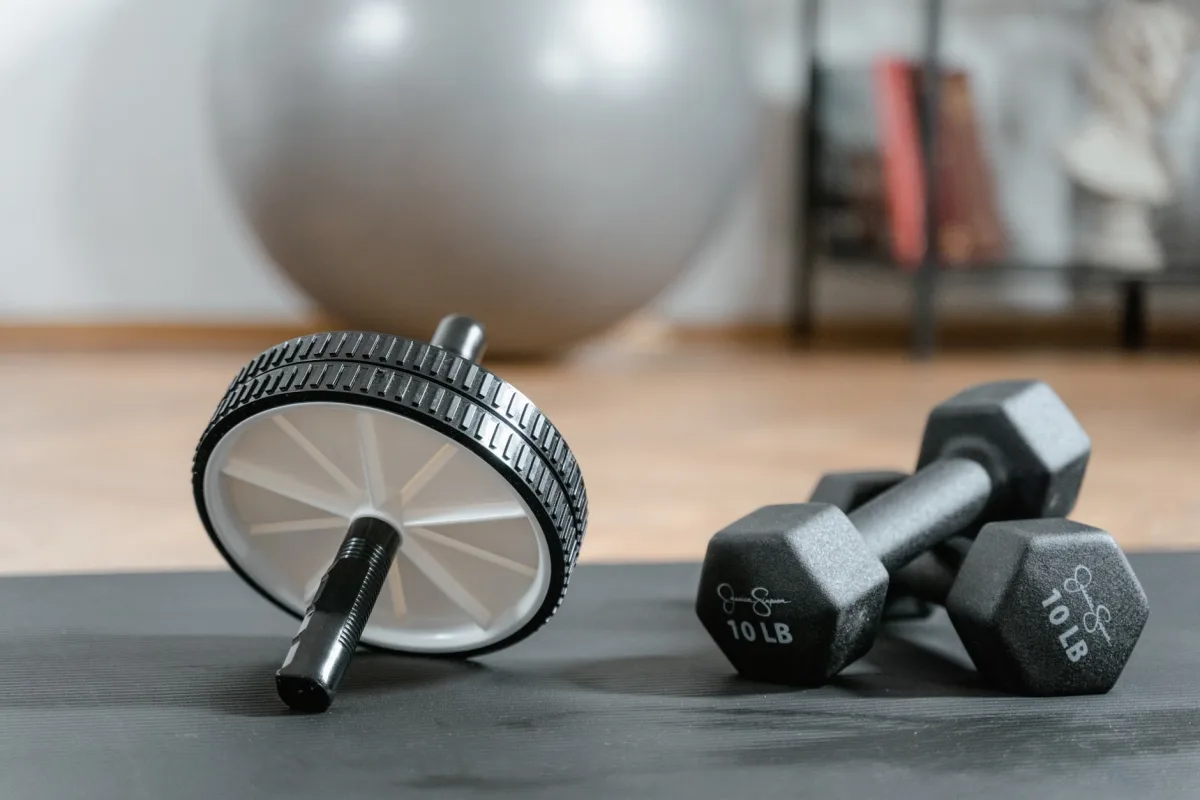
The under-$200 tier is more capable than its price suggests — if you understand what it is and is not built to do.
Best setup under $100: Resistance bands, mini bands, an exercise mat, and a jump rope, per RitFit Sports' 2026 Affordable Home Gym Equipment Guide. This combination supports beginners, mobility work, bodyweight circuits, and conditioning — and fits in a gym bag.
Best setup $100–$200: Add adjustable dumbbells and a doorway pull-up bar. Adjustable dumbbells are the single highest-value purchase for most home gym users because they support presses, rows, squats, lunges, Romanian deadlifts, curls, shoulder work, and core training — essentially the full menu of foundational strength movements. A pull-up bar adds vertical pulling and core work that dumbbells alone can't cover well. As RitFit's beginner home gym guide puts it, most people get the best results from a practical mix of one main strength station and a few versatile free weights rather than trying to replicate a full commercial setup.
Research comparing elastic resistance with conventional resistance, cited in RitFit's buying guide, indicates bands can support meaningful strength gains when programmed correctly. The limitation isn't effectiveness — it's load ceiling. Once you can perform 15+ reps of every movement with your heaviest band or dumbbell, this tier stops providing progressive overload.
Who this tier is for: Beginners, apartment dwellers with minimal floor space, people supplementing an existing gym membership with home accessory work, and anyone testing whether home training fits their lifestyle before a larger investment.
When to move up: As soon as you're consistently hitting the top of your resistance range on 3+ exercises per session.
Tier 2 — $200–$1,500: The Widest Quality Gap in Home Fitness

This is the most crowded and confusing price segment — and where quality variance between products is greatest. Same price, very different machine.
Cardio in this range
Basic spin bikes start at $300–$500 and deliver solid cycling without connectivity. Connected bikes with screens occupy the mid-range: the Echelon bike sits around $1,000, while the Peloton Bike lands at approximately $1,445 — the upper boundary of this tier for connected cardio. Both offer structured workout libraries and real-time metrics. OutdoorGearLab's exercise bike tests found that the Peloton Bike+ impressed testers most among screen-equipped models, with an excellent 23.8-inch HD touchscreen and Auto-Follow resistance mode — though the required All-Access membership adds ongoing cost to consider.
Smart equipment note: The subscription runs $12.99–$44/month on top of hardware. That's $780–$2,640 over five years before counting the machine itself. If external accountability and structured programming are what keep you training, it's often the most valuable part of the purchase. If you follow your own programming, it adds no training value.
Strength in this range
The Body-Solid EXM2500 Multi-Station Home Gym is the standout all-in-one option. Per FitnessFactory.com's Best All-In-One Home Gym Systems for 2026, it features a 210-pound selectorized weight stack and heavy-duty 12-gauge steel construction, covering chest press, lat pulldowns, leg extensions, and functional cable movements from a single footprint. It's described as "a top pick for the everyday lifter seeking maximum versatility without breaking the bank." The machine also carries a lifetime warranty on frame, welds, pulleys, cables, and upholstery — a significant advantage over cheaper alternatives with one-year coverage.
What to prioritize at this tier: Build quality and weight capacity over feature count. A sturdy, simple machine with a solid frame and smooth cable travel will outlast a feature-rich machine with a flimsy weld. Check weight stack size — a 150-pound stack limits upper-body pressing development faster than most buyers expect.
Who this tier is for: General fitness users who want real equipment without a commercial price tag, people with a single dedicated room rather than a full garage, and households where one person trains at a time.
Tier 3 — $1,500–$3,500: The Sweet Spot for Serious Home Trainers
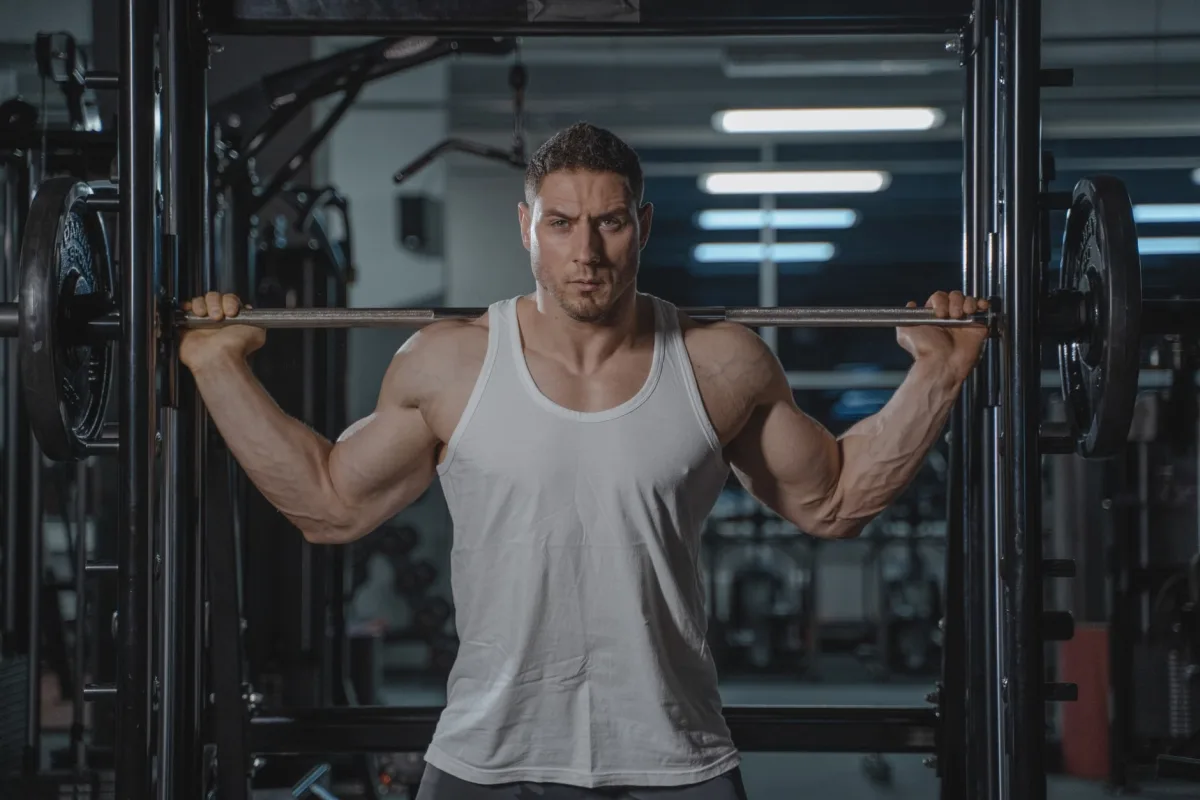
This is where home gym equipment becomes genuinely comprehensive. You're no longer choosing between cardio and strength — you can have both. Equipment at this level is built to handle regular, demanding use rather than occasional light sessions.
Best value pick: Bells of Steel All-in-One Home Gym (~$1,900)
According to Garage Gym Reviews' Best Home Gyms 2026, personally tested by their expert team, the Bells of Steel All-in-One combines a squat rack and functional trainer into a single unit — available in either a plate-loaded or 210-pound weight stack configuration. Their testers rated it 4/5 for value and 4.5/5 for construction. GGR founder Coop Mitchell specifically noted: "For something to be at the more budget end cost-wise for a stack version, to be able to have that feature is money." The 12-gauge steel construction and aluminum pulleys earned high marks for smoothness, and the machine comes with a limited lifetime warranty.
One genuine trade-off worth knowing: the proprietary 2.3-inch × 2.3-inch upright sizing makes it difficult to add attachments from brands like Rogue or REP Fitness — you're largely limited to the ~15 attachments Bells of Steel makes specifically for this unit. If you want maximum attachment compatibility, consider the REP Fitness Ares 2.0 instead.
Upper-end pick: REP Fitness Ares 2.0 (~$2,999)
The REP Fitness Ares 2.0 offers a 450-pound weight capacity and 57.6-inch width, per Garage Gym Reviews' testing data. For context, the average home gym in their database priced out at $1,855 — the Ares 2.0 sits comfortably above average but below commercial pricing. REP Fitness carries a practical advantage: an established US service network, readily available replacement parts, and a warranty that's actually serviceable.
What The Fitness Outlet's Summer 2026 guide confirms: The $1,500–$3,500 range supports a premium treadmill or elliptical alongside a functional trainer or bench-and-weight setup — meaning you don't have to make an either/or choice between cardio and strength at this tier.
Beyond the spec sheet: Warranty length, replacement part availability, and manufacturer support matter significantly when a $2,500 machine needs a cable replaced two years in. Brands with established US service networks — REP Fitness, Rogue, Titan Fitness — carry real practical advantages over lesser-known importers at this price point.
Who this tier is for: Athletes training 3–5 days/week who want a complete setup, multi-person households where two people train at different times, and buyers who want to make one purchase that doesn't need to be replaced or upgraded.
Tier 4 — $3,500 and Above: When Commercial-Grade Makes Sense
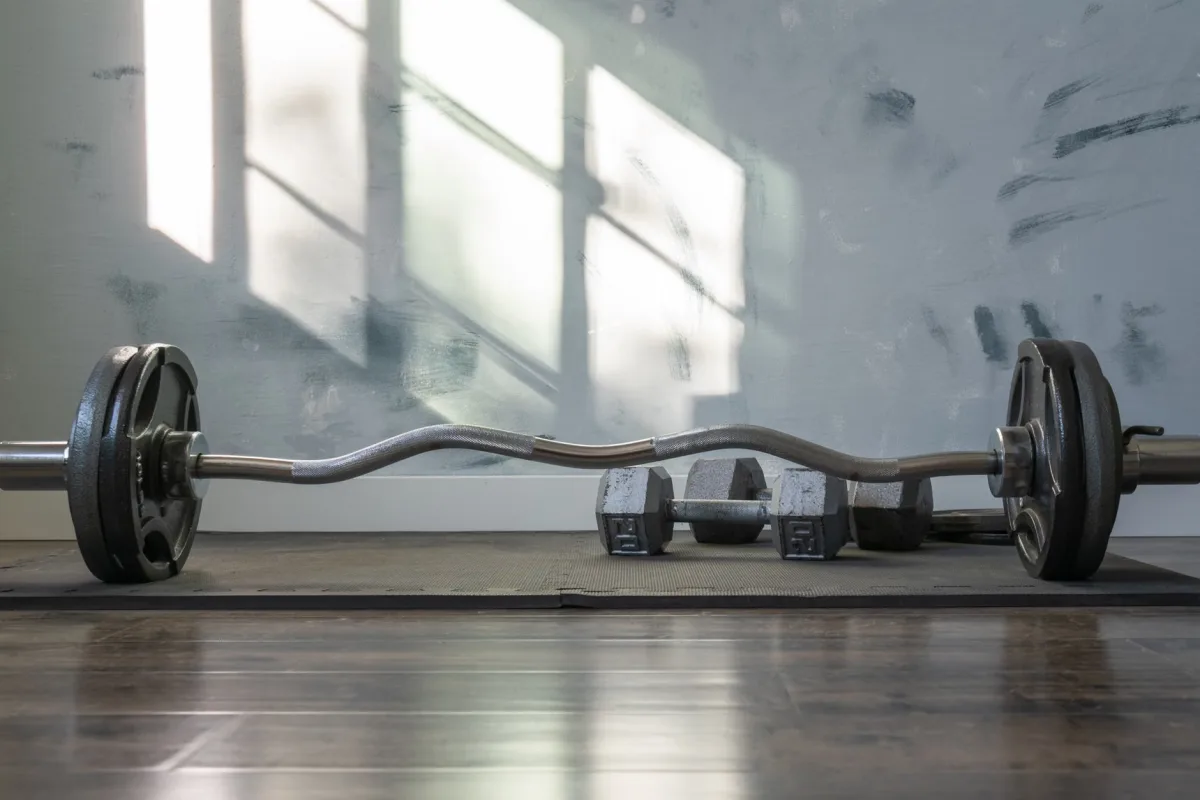
Above $3,500, you enter commercial-grade territory. Per The Fitness Outlet's Summer 2026 Buying Guide, equipment at this level is built for daily heavy use, carries longer warranties, and is designed to perform reliably for 10–20 years with proper maintenance.
This tier is genuinely justified in three scenarios:
- You're training 5+ days/week with heavy loads
- Your household has multiple daily users putting significant cumulative load on the equipment
- You want to buy once and never face a replacement decision
For casual users training twice a week, the upper mid-range tier delivers comparable results at half the cost.
Premium cardio picks
- NordicTrack X16 Treadmill (~$3,700) — OutdoorGearLab's #1-ranked treadmill in 2026, scoring 10/10 for exercise quality. Features a 4.25 CHP motor, 60×22-inch deck, and iFit integration with hands-free speed and incline adjustment. "There's simply no limit to how hard you can push on this machine," per their testers.
- NordicTrack Commercial 1750 — OutdoorGearLab Top Pick and Garage Gym Reviews' top recommendation, with a 4.25 CHP motor, 60×21.5-inch deck, and 2026 update adding Netflix and Spotify streaming alongside iFit.
- Life Fitness F3 Folding Treadmill — commercial-grade engineering in a space-saving folding design; strong choice for buyers who want premium build quality without a permanent footprint.
- Peloton Bike+ (~$2,495) — OutdoorGearLab's top pick among connected exercise bikes, with a 23.8-inch rotating HD touchscreen and Auto-Follow resistance. Note: Peloton now charges a $95 used-equipment activation fee for secondhand units.
- Keiser M3i (~$2,200) — preferred by cycling studios for flywheel feel; lower ongoing cost than Peloton due to optional (not mandatory) app subscription.
The cost-per-use math at this tier
A $6,000 treadmill used 6 days/week for 10 years = $0.19/session. A $1,200 mid-range treadmill replaced after 4 years at the same usage = $0.37/session — but only if it actually lasts 4 years under that load. Many mid-range motors don't.
Who this tier is for: Serious athletes training 5+ days/week, households with 2+ daily users, and buyers who place high value on long-term reliability and manufacturer support.
Cardio vs. Strength: Which Gets Your First Dollar?
If your budget forces a choice, the answer depends on your primary goal.
Choose cardio-first if: Weight management and cardiovascular fitness are your primary goals. A quality spin bike or treadmill paired with resistance bands covers the majority of health outcomes most people are seeking.
Choose strength-first if: Body composition, muscle building, or athletic performance are your goals. A barbell, rack, and adjustable dumbbells produce more measurable physical change per dollar than most cardio machines. As Garage Gym Reviews Chief Medical Advisor Dr. Raj Dasgupta notes, the most effective approach for body recomposition is combining both: "Combine aerobic exercises like walking or cycling with strength training like lifting weights to burn calories and build muscle." But if the budget forces a choice, strength equipment first is the call.
The practical recommendation for budget-constrained buyers: Start with versatile strength equipment — specifically adjustable dumbbells and a pull-up bar — and add cardio equipment once the strength foundation is established. Three reasons:
- Strength equipment holds resale value better than motorized cardio
- It takes less floor space per dollar of training value
- It requires less maintenance than machines with motors and belts
If outdoor running, cycling, or swimming is already part of your routine, there's little reason to prioritize indoor cardio equipment at all.
Smart Equipment vs. Conventional: Is the Screen Worth It?
Smart equipment — integrated screens, connected workout libraries, performance tracking — is projected to hold a 54% share of the home gym category, per Future Market Insights' 2026 forecast. Growth reflects genuine demand. It doesn't mean it's right for every buyer.
The case for smart equipment: Strongest when external accountability and structured programming are what actually keep you training. iFit's library of 10,000+ workouts filmed across all seven continents, per OutdoorGearLab's NordicTrack 1750 review, provides the kind of variety and motivation that many home gym users lack compared to a commercial gym environment. If you've historically struggled with self-directed training, the subscription cost may be the most valuable part of the purchase — not the hardware.
The case against:
- Subscription costs add up fast: $44/month × 5 years = $2,640 on top of hardware
- Screens can go obsolete or lose software support while the mechanical components remain perfectly functional; Echelon locks the machine entirely if your subscription lapses, per OutdoorGearLab's testing
- Experienced athletes who follow their own programming get zero training value from guided classes
The honest verdict: Conventional equipment is almost always cheaper, simpler to maintain, and longer-lived. Smart equipment earns its premium only if you'll actually use the connected features consistently.
Space Planning: The Step Most Buyers Skip
Equipment dimensions in product listings are almost always the machine's footprint — not the space you need to use it safely.
- A treadmill listed at 77 inches long needs 84–90 inches of clear space for safe dismount
- A cable machine listed at 40 inches deep needs clearance on both sides for cable movements
- Overhead pressing requires at least 92 inches of ceiling clearance; Olympic lifting needs more, per BarBend's home gym guide
Flooring cost — the most underestimated line item: Budget $1.75–$4 per square foot for interlocking rubber tiles, or $2–$6 per square foot for rolled rubber. A 200 sq ft garage gym requires $350–$1,200 in flooring alone before a single piece of equipment is purchased. This cost is included in the $3,500–$4,000 total investment figure cited earlier — it's not optional.
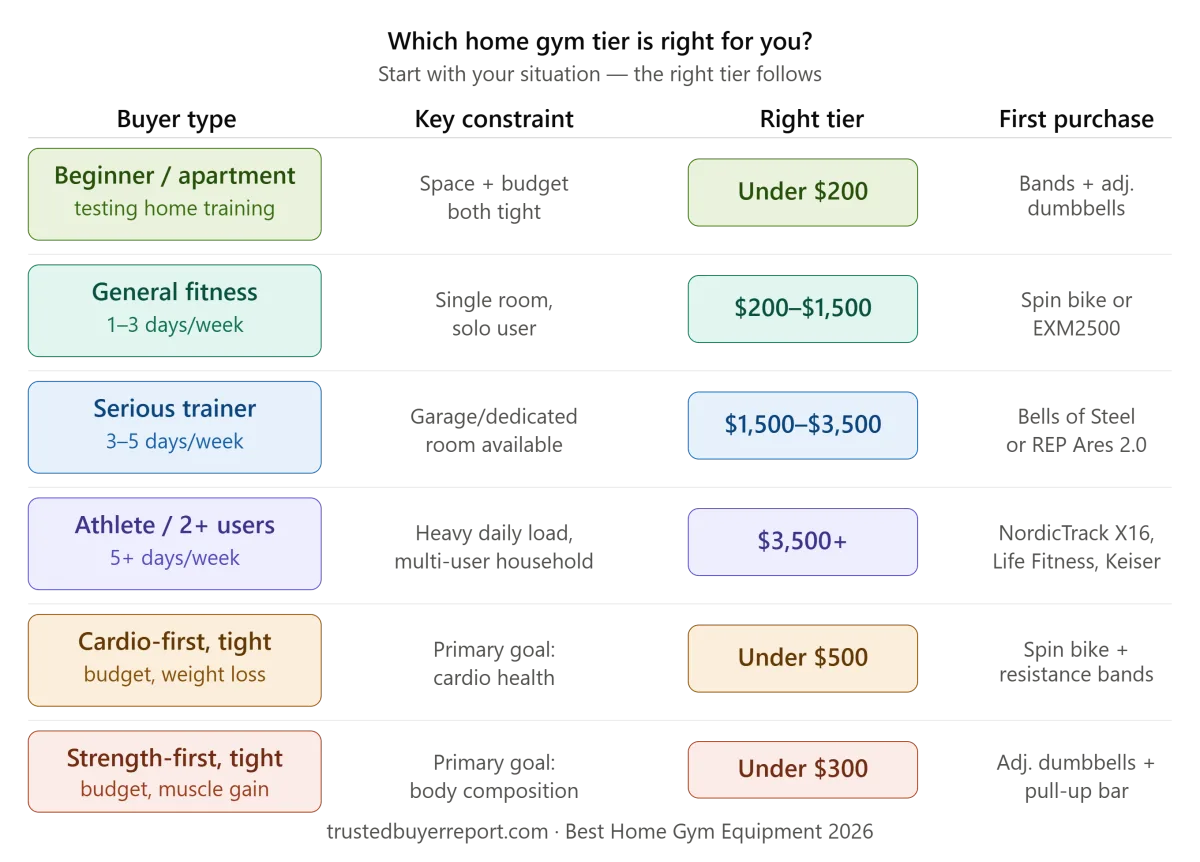
Final Decision Framework: Match Your Situation to a Tier
| Who you are | Right tier | Starting point |
|---|---|---|
| Beginner, apartment, testing home training | Under $200 | Resistance bands + adjustable dumbbells |
| General fitness, single room, solo user | $200–$1,500 | Spin bike or Body-Solid EXM2500 |
| Serious trainer, 3–5 days/week, garage | $1,500–$3,500 | Bells of Steel All-in-One or REP Ares 2.0 |
| 5+ days/week athlete or 2+ daily users | $3,500+ | NordicTrack X16 / Life Fitness / Keiser M3i |
| Cardio-first, tight budget | Under $500 | Spin bike + resistance bands |
| Strength-first, tight budget | Under $300 | Adjustable dumbbells + pull-up bar |
For readers also evaluating other major household investments, the Home & Kitchen Buying Guide 2026: Appliances, Cookware & Smart Home applies the same cost-per-use framework to appliance purchases. For outdoor training gear evaluated with the same tier structure, see the Outdoor & Sports Gear Buyer's Guide 2026.
Frequently Asked Questions
What is the minimum budget for a useful home gym in 2026?
Under $100 gets you resistance bands, mini bands, an exercise mat, and a jump rope — functional for beginners and mobility work. For a genuine starter strength setup, $150–$200 adds adjustable dumbbells and a doorway pull-up bar. Both figures come from RitFit Sports' 2026 buying guide and reflect the current US retail market.
Is the Bells of Steel All-in-One Home Gym worth the price?
For buyers in the $1,500–$2,500 range who want both squat rack and cable functionality from a single unit, yes — with one caveat. Garage Gym Reviews rated it 4/5 for value and 4.5/5 for construction after hands-on testing. The main limitation is proprietary upright sizing (2.3 × 2.3 inches) that restricts compatibility with attachments from other brands. If cable flyes and overhead tricep extensions are central to your training, also confirm range of motion before purchasing.
How long does home gym equipment typically last?
Mid-range equipment used moderately (3–4x/week) typically lasts 5–8 years before needing significant maintenance or replacement. Commercial-grade equipment above $3,500, per The Fitness Outlet's 2026 guide, is designed for 10–20 years with proper maintenance. Motorized cardio machines have shorter lifespans than strength equipment at every price tier — motors and belts wear faster than steel frames. Budget for periodic maintenance on any motorized machine regardless of initial cost.
Should I buy smart (connected) or conventional equipment?
Buy smart if structured programming and external accountability are what keep you consistent. Buy conventional if you follow your own programming, want to avoid ongoing subscription costs ($13–$44/month), or prioritize long-term hardware reliability. Note that some brands — Echelon in particular — completely lock the machine if your subscription lapses, per OutdoorGearLab's exercise bike testing. For most serious athletes, conventional equipment at the same price point is more durable and doesn't depend on ongoing software support.
Does a home gym add property value?
Per the chestpressmachine.com 2026 analysis, a properly outfitted home gym — particularly a garage conversion or dedicated spare room — does add property value in most markets. The value addition isn't guaranteed in every market, but the usable square footage improvement is consistent and measurable.
Where is the home gym equipment market headed through 2035?
Per Global Market Insights, the home gym equipment market was estimated at $9.4 billion in 2025 and is projected to grow to $15.8 billion by 2035 at a 5.4% CAGR. Smart equipment and cardiovascular training equipment are the two fastest-growing segments. For buyers, that growth signals continued product innovation — but also continued marketing noise that makes quality comparison more difficult.
This article was researched and drafted with AI assistance, then reviewed and fact-checked by our editorial team before publishing. Sources are cited throughout. Trusted Buyer Report may earn a commission from purchases made through links on this page — this does not affect our rankings or recommendations, which are finalized before any affiliate link is applied. Full methodology · Affiliate disclosure · AI ethics policy