
This guide was researched and drafted with AI assistance, then fact-checked by our editorial team before publishing. It synthesizes manufacturer specifications, publicly available market data, and expert sources — not hands-on product testing. See our methodology →
TL;DR: What You Actually Need to Know Before Shopping
If you take nothing else from this guide, take these four things:
Prices are volatile — and not in your favor. Tariff cycles have pushed furniture and appliance costs higher. Buying during major sale windows (Memorial Day, Labor Day, Black Friday) still delivers real savings, but waiting for "another sale" can backfire when popular items go out of stock.
Measure before you browse. Returns are expensive, inconvenient, and increasingly subject to restocking fees. Thirty minutes with a tape measure before you open a single browser tab prevents the most common (and most costly) furniture mistake.
Marketing language hides quality differences. "Solid wood" and "hardwood construction" are not the same claim. "Performance upholstery" means nothing without a rub-count rating. This guide tells you what to look for.
Online and in-store have different trade-offs — not one winner. For a $3,000 sofa, the inability to sit on it before buying is a genuine risk. For a $200 bookshelf, online is almost always the smarter play.
Why the 2026 Market Is Harder to Navigate Than It Looks
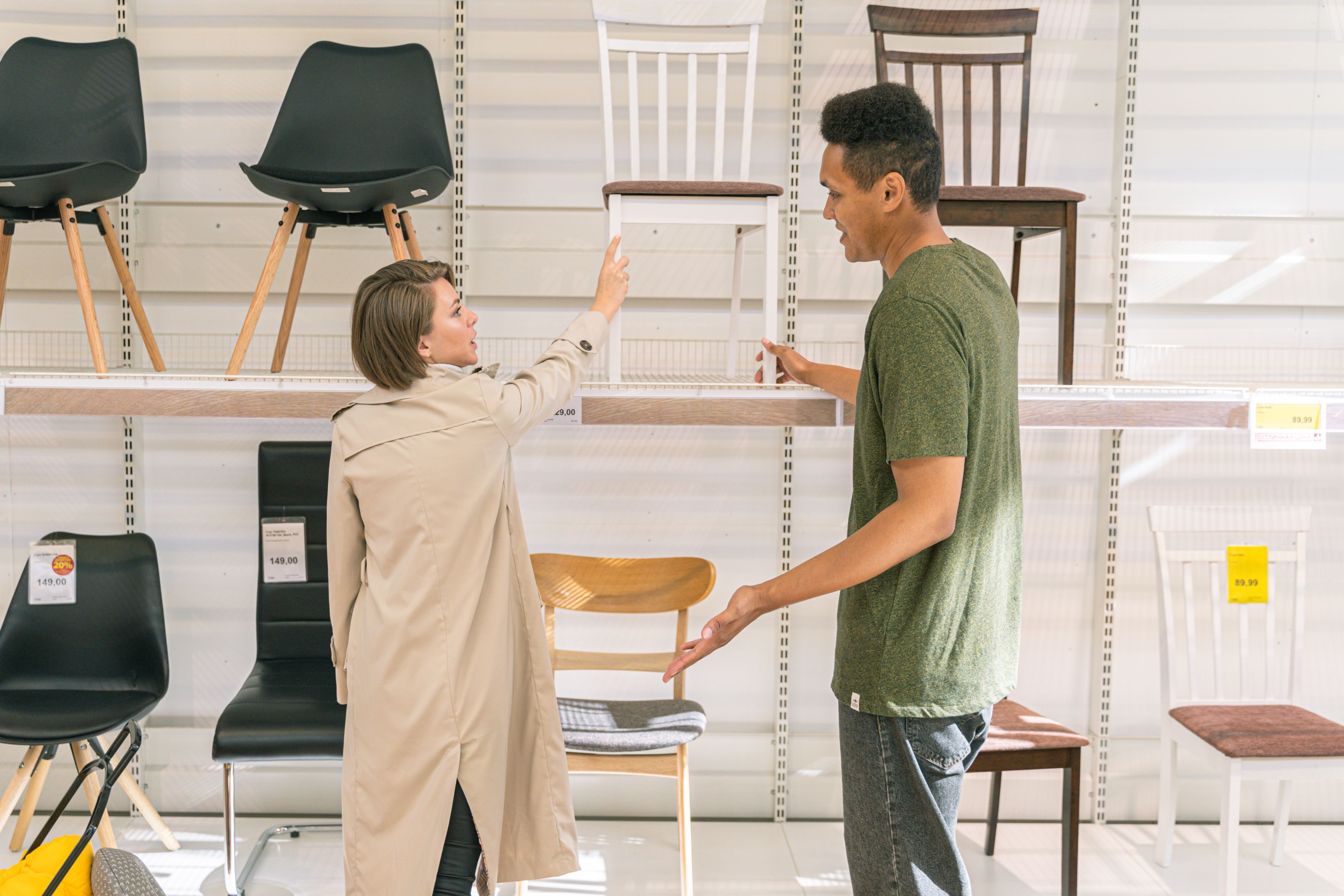
Your frustration shopping for furniture or appliances in 2026 is not a personal failing — the market has structurally changed in ways that make uninformed purchases riskier than they were five years ago.
The U.S. furniture market is now valued at $82.5 billion, with strong growth projected through 2035, according to Astute Analytica's 2026 U.S. furniture market report. More brands, more SKUs, and more distribution channels mean more noise before a confident decision.
Supply chain volatility is the central problem. Announced tariffs of 25% on goods from Canada and Mexico and 10% on Chinese imports have created cost uncertainty that ripples from manufacturers to retail price tags. In spring 2025, weekly furniture shipment bookings from China exceeded 44,000 TEUs as retailers raced to get inventory in before anticipated duty increases — a dynamic that caused port congestion and extended lead times. A buyer who ordered a sectional sofa in early 2025 and received a 14-week estimate was not experiencing a freak logistics failure; they were experiencing the downstream effect of an industry-wide inventory scramble.
The housing market is amplifying demand simultaneously. Home sales are projected to grow 9% in 2025 and 13% in 2026, per the same Astute Analytica report, with a median home price of $412,900 in Q1 2025. When more households move and invest in new spaces, competition for popular furniture categories tightens — and availability windows for in-stock items narrow.
Online retail accounts for 38% of top-10 retailer sales in 2026, up from just 18% in 2020, according to Actowiz Metrics' 2026 furniture retail analysis. The top 10 retailers have grown their combined market share from 48% in 2020 to 68% in 2026 — consolidation that reduces genuinely independent options while intensifying price competition. That competition looks like a buyer advantage on the surface, but it also drives cost-cutting in materials and construction that is invisible in product photography.
Despite these headwinds, Q4 2024 was the best quarter for furniture sales since 2022, according to Cylindo's State of the Furniture Industry report. Demand is real and growing. The challenge is navigating a market where strong demand, supply chain pressure, and a fragmented retail landscape all operate simultaneously.
Related: Wayfair Review 2026: Furniture Quality & Delivery Experience — a deep-dive into when Wayfair's 30-million-SKU catalog works well and when it doesn't.
Which Categories Are Under the Most Demand Pressure in 2026

Understanding which categories face the most demand pressure helps you plan purchases strategically — before stock tightens or prices spike. Actowiz Metrics tracks demand growth from 2020 to 2026 across major furniture segments.
| Category | Demand Growth (2020–2026) | Key Implication |
|---|---|---|
| Home Office Furniture | +85% | Longest lead times; least frequent sales |
| Modular / Sectional Furniture | +52% | Config options vary widely; measure first |
| Outdoor / Patio Furniture | +48% | Seasonal pricing; spring markups are real |
| Luxury Furnishings | +35% | Lead times of 8–20 weeks are common |
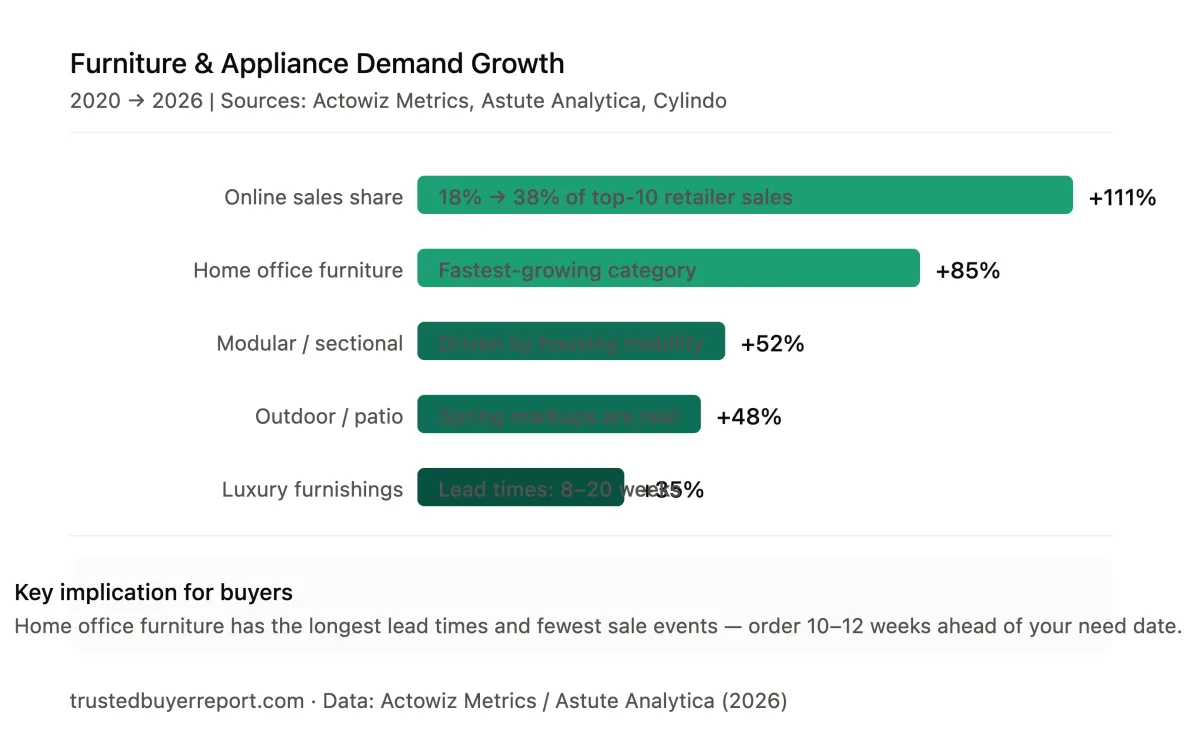
Home office furniture has grown 85% since 2020 — the fastest-growing furniture category — driven by the normalization of hybrid work. If you are furnishing a dedicated home office for the first time, you are entering the most supply-constrained segment in the market. Expect longer lead times on sit-stand desks, ergonomic chairs from brands like Herman Miller or Steelcase, and purpose-built storage. Sales events in this category are less frequent because demand is consistently high.
Modular furniture has grown 52%, reflecting buyers' desire for adaptable configurations. A modular sofa purchased in 2026 — such as those offered by Burrow or IKEA's SÖDERHAMN line — can be reconfigured when a household moves or its space needs change. This is a rational response to housing mobility, not just a style preference.
Smart furniture deserves specific attention because the marketing language around it is imprecise. More than 5 million smart beds were sold in 2024, with VC investment in smart furniture exceeding $150 million, according to Astute Analytica. "Smart" means different things across products: a Sleep Number bed uses air chamber technology and sleep tracking; a smart desk may simply have a programmable height memory. Before paying a premium for "smart" features, confirm which functions require the companion app to operate — if the manufacturer discontinues the app, those features disappear entirely.
Sustainability has moved from niche to mainstream. According to Astute Analytica, 76% of shoppers now express interest in sustainable furniture. That has driven a proliferation of eco-labeling — some rigorous (FSC-certified wood, GREENGUARD Gold certification for low emissions), some essentially meaningless marketing language. When evaluating sustainability claims, look for third-party certifications rather than self-reported brand statements.
How to Evaluate Furniture Quality Before You Buy

Product listings are designed to obscure construction details, not reveal them. "Wood construction," "premium upholstery," and "durable frame" appear in listings for both $400 sofas and $4,000 sofas and tell you almost nothing. Here is what actually differentiates furniture that lasts from furniture that fails within three years.
What Makes a Sofa Frame Last?
Solid hardwood frames — kiln-dried oak, maple, or ash — are the most durable option for upholstered furniture. Reinforced engineered wood (plywood with corner blocks) is an acceptable middle ground. Particleboard and MDF frames are the least durable and commonly found in flat-pack furniture at lower price points. As Mathis Home's furniture buying guide notes, solid or reinforced wood frames significantly outperform engineered composites in long-term durability — a distinction frequently obscured by vague listing language. When a product description says "solid wood legs" but does not specify the frame material, that gap is worth investigating.
How Do You Know If Sofa Cushions Will Hold Up?
Foam density is measured in pounds per cubic foot. High-density foam at 1.8 lb/ft³ or higher maintains its shape over years of regular use. Low-density foam — common in entry-level sofas — begins compressing and losing support within 12 to 18 months. Manufacturers rarely advertise foam density in consumer-facing listings, but it is often available in product specifications or by direct inquiry with a sales representative.
What Does "Performance Fabric" Actually Mean?
Fabric durability is measured in double rubs — a standardized abrasion test. Performance fabrics rated at 30,000 or more double rubs are appropriate for high-traffic households, children, or pets. Decorative fabrics rated below 15,000 are better suited for accent chairs or low-use spaces. Crypton and Sunbrella are two widely available performance fabric brands with verifiable rub counts. Bonded leather — often marketed as "vegan leather" or "faux leather" in ambiguous listings — is a composite material that tends to peel within three to five years; genuine top-grain leather ages completely differently.
What Should You Look for in Dressers and Case Goods?
For dressers, cabinets, and case goods, joinery method is the key quality indicator. Dovetail joints on drawer boxes indicate quality construction — they interlock mechanically and do not rely solely on adhesive. Corner blocks inside cabinet frames add structural rigidity. Stapled or glued-only joints are signs of lower durability common in mass-market flat-pack. Warranty terms function as a proxy for manufacturer confidence: a 10-year frame warranty signals fundamentally different build quality than a 1-year limited warranty.
Measuring Your Space: The Step Most Buyers Skip (and Regret)
Returns are expensive for retailers and deeply inconvenient for buyers. The most common cause is not dissatisfaction with quality — it is furniture that physically does not fit the intended space. This problem is entirely preventable.
What to measure before you shop:
- Room dimensions including ceiling height
- Doorway widths on every path from the front door to the intended room
- Stairwell clearances if applicable
- Architectural features: radiators, columns, built-in shelving, outlets
- Swing radius for doors and appliance doors (refrigerators, dishwashers)
The Mathis Home buying guide identifies spatial measurement as the foundational step before any furniture purchase — and the step most buyers skip because they are shopping by inspiration rather than specification.
A scenario that plays out constantly: a buyer purchases a king-size bed frame with a 30-inch headboard, only to discover the bedroom doorway is 28 inches wide. The headboard cannot be brought in without disassembly, and some designs cannot be disassembled at all. Checking assembled dimensions against the delivery path — not just the room dimensions — is a separate measurement exercise that prevents this outcome.
Home Office Planning

Given that home office furniture is the fastest-growing category at 85% demand growth, many buyers in 2026 are furnishing dedicated work spaces for the first time. A functional home office requires more than a desk and chair. Account for:
- Desk depth relative to monitor size: a 27-inch monitor needs at least 24 inches of desk depth for comfortable viewing distance
- Chair roll-back clearance: at least 36 inches behind the desk
- Lighting position: to avoid screen glare from windows and overhead fixtures
- Cable management: an afterthought in furniture marketing, an immediate frustration after setup
See also: Best Webcams for Remote Work & Streaming 2026 — if you're building a home office setup from scratch, the right webcam is part of that equation.
Appliance Cutouts and Utility Connections
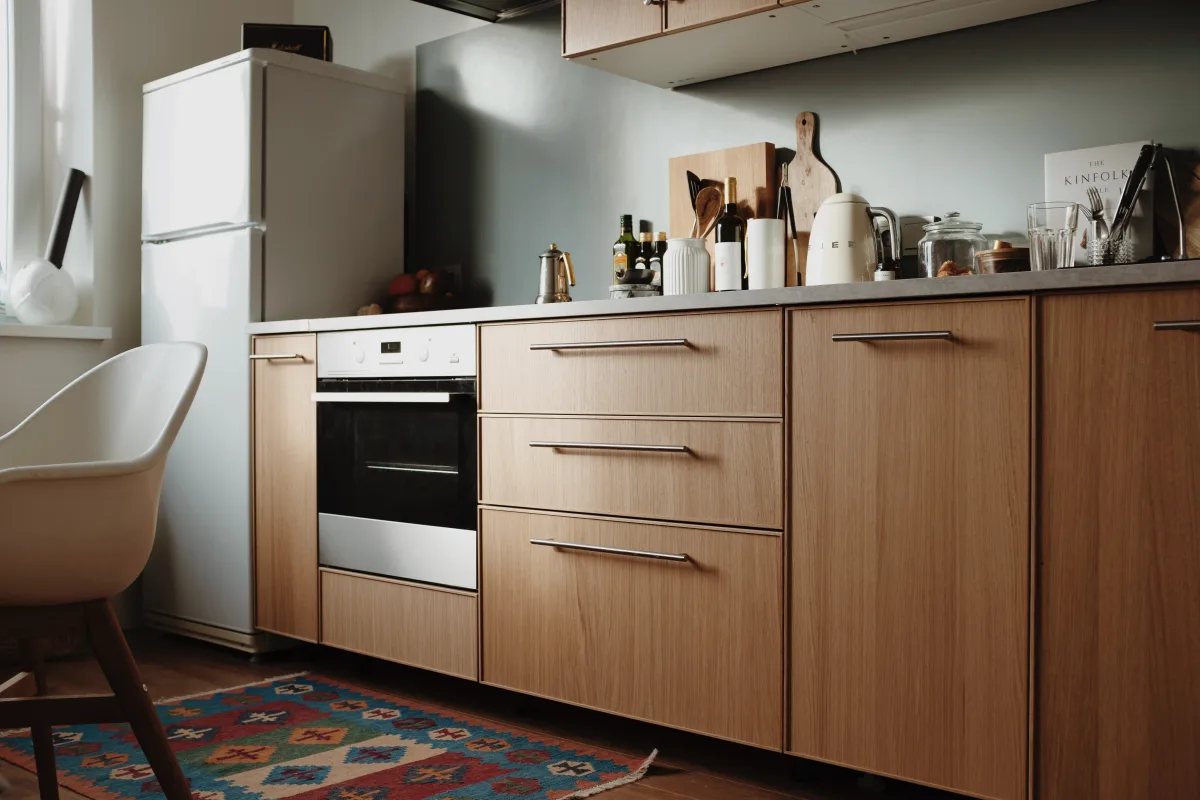
Appliance planning requires a different measurement discipline. Standard refrigerator depth runs approximately 30–34 inches; counter-depth models run 24–27 inches and sit flush with cabinetry. The visual difference is significant, but so is the internal capacity trade-off — counter-depth models typically offer 15–20% less storage volume.
Before purchasing any built-in or integrated appliance, confirm:
- Cutout dimensions (width, height, and depth)
- Ventilation clearance requirements
- Utility connection locations (gas line vs. 240-volt electrical circuit for ranges; proper drain connection for dishwashers)
These are not details to discover after delivery.
Where to Buy in 2026: Retail Channels Compared

According to Resonate's 2026 furniture shopping analysis, nearly 80 million U.S. consumers intend to purchase home furniture between now and early 2027. The retail landscape is fragmented across online marketplaces, specialty retailers, mass merchants, and direct-to-consumer brands — each with genuine trade-offs.
| Channel | Best For | Key Advantage | Key Risk |
|---|---|---|---|
| Online Marketplace (Amazon, Wayfair) | Entry-level, functional, smaller pieces | Price transparency; easy comparison | Can't assess texture, firmness, or scale |
| Specialty Furniture Retailer | High-investment upholstered pieces, custom orders | White-glove delivery standard; customization options | Higher price floor |
| Mass Merchant (Walmart, Target) | Budget functional pieces, accessories | Highest price competition | Very limited selection depth |
| Direct-to-Consumer Brand | Mattresses, sofas, single-category specialists | Trial periods (30–365 days); direct support | Variable delivery quality |
Buying a $3,000 sofa online vs. in-store is a genuine trade-off. Online, you gain price transparency and the ability to compare dozens of options quickly — but you lose the ability to assess cushion firmness, fabric texture, and scale in your actual space. In a specialty store, you can sit on the sofa, examine the frame construction, and speak with a sales associate who can confirm lead times and customization options. White-glove delivery — which includes room placement, assembly, and packaging removal — is typically standard at specialty retailers and an add-on fee online.
AI-driven inventory management is now standard among the largest retailers, according to Actowiz Metrics. These systems detect regional demand patterns and adjust stock levels accordingly — meaning a home office desk that shows as "in stock" nationally may be depleted in your metro area before national inventory data reflects that. If you are purchasing a high-demand item, checking local store availability (rather than relying on website stock status) is a practical precaution.
One important note on online research: Cylindo reports that 62.3% of online furniture searches in the U.S. carry transactional intent — meaning search results are heavily populated with retailer listings rather than independent editorial content. When you search for a sofa or refrigerator online, the first page of results is almost entirely commercial. Actively seeking out independent review sources — Consumer Reports for appliances, editorial buying guides from non-retail publications — requires deliberate effort but significantly improves decision quality.
Use our Price Trend Analyzer to check historical pricing on specific items before you buy — especially useful during sale events when "40% off" claims may be measured against inflated original prices.
Appliance Buying in 2026: What Brand Reliability Data Actually Shows
Which Kitchen Appliance Brands Are Most Reliable?
Kitchen appliance brand reliability varies significantly even within the same price tier, and marketing language is almost useless for distinguishing real-world performance. The most reliable methodology available to consumers remains Consumer Reports, which tests approximately 300 refrigerators, 190 ranges, 130 dishwashers, 75 cooktops, and 50 wall ovens annually — all purchased at retail, not supplied by manufacturers.
Their brand reliability rankings combine lab test results with large-scale member surveys covering tens of thousands of real ownership experiences. This methodology matters because a refrigerator that performs well in a 90-day lab test may still have a compressor failure rate that only appears after two years of household use. Brand-level reliability data captures that real-world pattern in ways that individual product reviews cannot.
What Consumer Reports consistently finds:
- Brand-to-brand reliability differences in refrigerators are among the most significant of any appliance category
- French-door refrigerators have historically had higher repair rates than top-freezer or bottom-freezer models at similar price points
- In dishwashers, reliability differences between brands tend to narrow at the mid-market price tier
- For ranges, induction performs differently from gas and electric — and repair patterns differ accordingly
When Is the Best Time to Buy Appliances?
The appliance buying calendar is more predictable than furniture pricing:
- Labor Day (early September): Historically the strongest sale window for major appliances, as retailers make room for new model year inventory
- Memorial Day (late May): The second-strongest window, particularly for refrigerators and dishwashers
- Black Friday / Cyber Monday: Strong discounting on appliances continues through November, but popular configurations sell out
- New model announcements (typically February): Prior-year models receive significant markdowns, often with no meaningful performance difference
Avoid: Buying a refrigerator or dishwasher immediately after moving into a new home when the purchase is urgent. Urgency eliminates your ability to wait for the right sale window, and retailers know it.
Refrigerator Sizing: The Decision Most Buyers Get Wrong
Counter-depth vs. standard-depth refrigerators is the single most common appliance sizing error. Here is the practical breakdown:
Standard-depth (30–34 inches): More interior capacity, lower price point for the same capacity, protrudes 6–8 inches past cabinet face.
Counter-depth (24–27 inches): Flush with cabinetry for a built-in look, 15–20% less storage volume, typically 15–25% higher price for equivalent capacity.
For most households, the visual appeal of counter-depth does not justify the capacity reduction unless kitchen layout or aesthetics are a specific priority. For households of four or more, the storage trade-off is frequently regretted within the first year.
Smart Furniture and Tech-Integrated Appliances: What's Real vs. Marketing
What Is Smart Furniture Worth Paying For in 2026?
The "smart" label is applied inconsistently across product categories, and the feature value varies accordingly. Here is a practical breakdown of where the technology creates genuine value vs. where it is largely marketing:
High genuine value:
- Smart mattresses with air chamber adjustment (Sleep Number): the adjustment mechanism is hardware-based and does not require app connectivity to function
- Adjustable-height desks with programmable height presets: simple, reliable, and the motor works independently of any app
Moderate value, check the implementation:
- Smart lighting integrated into furniture: depends heavily on compatibility with your existing smart home ecosystem
- Furniture with built-in wireless charging: useful only if the charging standard matches your devices
Low value or high dependency risk:
- Any feature that requires an active subscription or proprietary app to function: if the manufacturer discontinues the service, the feature disappears
- "AI-powered" sleep tracking in mattresses: most current implementations are less accurate than dedicated wearables
The $150 million in VC investment in smart furniture noted by Astute Analytica reflects category momentum, but it also means many products are early-generation iterations where the technology has not yet matured. A simple rule: buy for the furniture quality first; consider the smart features a bonus, not the primary reason to purchase.
The Best Time to Buy Furniture: A Seasonal Guide
Furniture pricing follows patterns, but the patterns are less predictable than appliance sales windows. Here is what the data actually shows:
Memorial Day weekend: Historically the strongest window for furniture discounts — particularly on sofas, sectionals, and bedroom sets. Retailers plan significant inventory moves around this weekend.
Labor Day weekend: Strong for both furniture and appliances — the combination of back-to-school and fall home refresh drives promotional activity.
Black Friday / Cyber Monday: Strong online discounting, but white-glove delivery slots fill quickly for popular items. Order early in the promotional window.
January: Post-holiday clearance creates opportunities on in-stock floor models and display pieces — particularly useful for items where condition can be verified in-store.
What does NOT reliably trigger sales:
- Tax refund season (the "spring buying season" is retailer marketing, not a genuine discount window)
- Presidents' Day (moderate discounts on mattresses; mixed on furniture generally)
For items with 8–20 week lead times (custom orders, luxury pieces), the sale price matters less than lead time management. Ordering during a sale event still means waiting — plan accordingly.
5 Mistakes to Avoid When Buying Furniture or Appliances in 2026
1. Buying before measuring delivery paths. Not just room dimensions — every doorway, stairwell, and turn from the front door to the final room. This prevents the most common and most frustrating furniture return.
2. Ignoring lead times on high-demand categories. Home office furniture (85% demand growth), custom upholstered pieces, and luxury furnishings routinely have 8–20 week lead times. If you need a desk by a start date, order 10–12 weeks early.
3. Confusing "solid wood" with frame material. "Solid wood legs" is a different claim than "solid wood frame." The legs are cosmetic; the frame is structural. Ask specifically about frame material before purchasing upholstered pieces.
4. Choosing appliances by brand name rather than reliability data. Premium price does not reliably predict reliability in any appliance category. Consumer Reports' owner survey data is the most useful tool available to distinguish real-world performance from marketing positioning.
5. Buying smart features you cannot evaluate. Before paying a premium for app-controlled functions, confirm whether the core hardware works without the app — and check the manufacturer's track record for app support longevity.
How to Use This Guide as a Pillar for Your Research
This guide is designed to orient your research before diving into specific categories. For deeper coverage, the following articles in our furniture and appliances cluster give you the specifics you need for individual purchase decisions:
- Best TV Stands & Entertainment Centers 2026 — the decision framework for living room furniture that accounts for room size, TV dimensions, and long-term adaptability
- Best Vacuum Cleaners 2026: Dyson vs Shark vs Bissell Compared — lab test data showing which vacuum performs for which floor type and household
- Best Water Filters & Purifiers 2026: Pitcher vs Under-Sink vs Whole House — how to match filter type to your actual contaminants and home setup
- Wayfair Review 2026: Furniture Quality & Delivery Experience — the conditions under which Wayfair succeeds and when it falls short
Use our AI Shopping Assistant to get specific guidance on any furniture or appliance purchase — including which brands to prioritize, how to evaluate a specific listing, and whether a sale price is actually a deal.
Frequently Asked Questions
Is 2026 a good year to buy furniture? It depends on your timeline and category. Demand is strong, which means popular items sell out faster than in prior years. Tariff-related cost pressure has pushed prices higher. That said, major sale events still deliver real discounts. If you need furniture now, buy during a sale window and prioritize in-stock items over custom orders unless lead time is not a constraint.
Which furniture stores are most reliable in 2026? Reliability varies significantly by product category and price tier, not just by store. Our store reviews cover the major retailers with specific assessment of delivery performance, return policies, and quality consistency by category.
What is the best time of year to buy appliances? Labor Day (early September) and Memorial Day (late May) are historically the two strongest windows for major appliance discounts. Black Friday is strong but sell-outs of popular configurations are common. Buying immediately after moving — when urgency eliminates your ability to wait — is consistently the most expensive approach.
How do I tell if furniture is good quality without seeing it in person? Look for three things you can verify without touching the product: (1) frame material specified as solid hardwood or reinforced plywood — not just "solid wood legs"; (2) foam density specified at 1.8 lb/ft³ or higher; (3) fabric rub count of 30,000 or more for high-traffic households. Warranty length is a reliable proxy: 10-year frame warranties signal meaningfully different build quality than 1-year warranties.
Are counter-depth refrigerators worth it? For households of 1–2 people with strong aesthetic priorities and kitchen layouts where standard-depth protrusion is a problem, counter-depth can be worth the trade-off. For households of 3 or more, the 15–20% reduction in storage volume is typically regretted. The price premium for equivalent capacity is usually 15–25%.
We may earn a commission when you use our links to make a purchase. This does not affect our editorial assessments — scores and recommendations are finalized before any affiliate link is applied. Read our full disclosure →