How this guide was researched: Trusted Buyer Report has not independently tasted, mixed, or tested the protein powders listed here. This guide synthesizes expert testing data from Garage Gym Reviews (who tested 150+ powders with an independent accredited lab, Ellipse Analytics, for purity and label accuracy), Forbes Vetted (registered dietitian panel), Fortune's RD-tested roundup, Everyday Health's six-expert nutrition panel, and Men's Health fitness editors. Protein intake guidance is drawn from ISSN's position stand on protein and exercise and Mayo Clinic Health System. We cite our sources inline and disclose where claims originate.
This article was drafted with AI assistance and fact-checked by our editorial team. We may earn a commission from purchases made through links on this page, at no additional cost to you. Rankings are finalized before affiliate links are applied. Read our full methodology →
TL;DR — Which Protein Powder Should You Buy?
- Best overall: Optimum Nutrition Gold Standard Whey — reliable, widely available, RD-backed, ~24g protein/serving. Best starting point for most people.
- Best for clean ingredients: Transparent Labs Grass-Fed Whey Isolate — full ingredient disclosure, no proprietary blends, grass-fed sourcing, Informed Choice certified.
- Best for taste: Momentous Whey Protein Isolate — consistently rated for flavor; 4.5/5 for taste by Garage Gym Reviews testers.
- Best for lactose sensitivity: NOW Sports Whey Protein Isolate — two ingredients, no artificial additives, isolate-filtered, budget-friendly.
- Best plant-based: Swolverine Plant Protein (pea + pumpkin blend) — complete amino acid profile, 25g protein/140 calories.
- Best budget: Nutricost Whey Protein Concentrate — ~$1/serving, 25g protein, GMP-compliant facility, hot-swappable flavors.
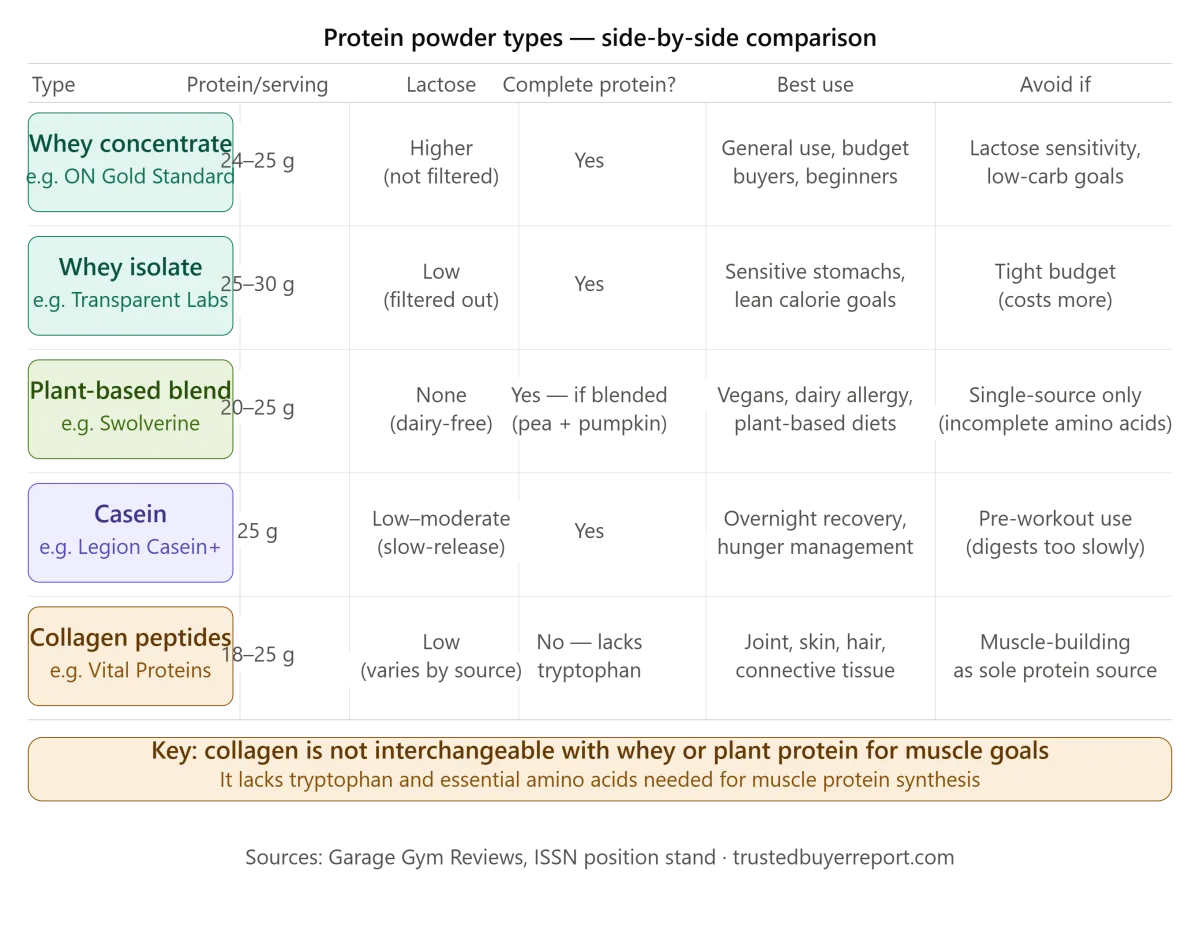
Collagen powders are not interchangeable with protein powders for muscle goals. Collagen is not a complete protein and lacks sufficient essential amino acids for muscle protein synthesis. If joint and skin health is your primary goal, see the Best Collagen Supplements 2026 guide instead.
Why Protein Powder Marketing Is Harder to Read Than It Should Be
Here's a fact that surprises most buyers: a protein powder labeled "25 grams of protein per serving" may be delivering that number only when mixed with milk — not water. Technically accurate. Practically misleading. That kind of gap between marketing claim and real-world result is one of several reasons independent testing matters more now than at any previous point in the supplement market.
The protein powder category has three structural problems that make comparison genuinely difficult:
No mandatory pre-market FDA approval. Dietary supplements in the US are not evaluated by the FDA before sale. Manufacturers are responsible for the safety and accuracy of their own labels — which is why third-party certifications like NSF Certified for Sport and Informed Choice exist. Without them, you're taking the manufacturer's word on protein content, purity, and absence of banned substances.
Proprietary blends obscure real dosing. Some products hide exact ingredient amounts behind a "proprietary blend" label. You know what's in the blend but not how much of each component — which makes it impossible to verify whether you're getting a meaningful dose of each ingredient.
Concentrate vs. isolate confusion. Most buyers don't know the practical difference. Whey protein isolate undergoes additional filtration that removes most lactose and fat, making it more digestible for sensitive stomachs and slightly more calorie-efficient. Whey protein concentrate skips that step — it's less expensive, but contains more lactose. Neither is universally "better"; the right choice depends on your digestion and budget.
This guide is organized around the decision you're actually making — not alphabetically, not by brand sponsorship.
How Independent Experts Evaluate Protein Powders

Before getting to specific products, the evaluation framework matters — because it lets you assess any new product on any shelf, including ones released after this article was written.
Garage Gym Reviews developed one of the most rigorous independent testing programs in the supplement space: their team collaborated with Ellipse Analytics, an independent accredited lab, to test over 150 protein powders for purity (heavy metals, bisphenols, phthalates, pesticides) and label accuracy (actual protein content vs. claimed). Their certified personal trainers and nutrition coaches also physically tested taste, mixability, and digestibility. The picks in this guide are filtered through that methodology.
The five criteria experts consistently weight most heavily:
1. Protein content and serving size accuracy. Quality powders in 2026 deliver 24–30 grams per serving. Check whether the label figure assumes mixing with water or milk — they're not the same.
2. Ingredient transparency. Full disclosure of every ingredient and its exact amount, no proprietary blends. This is the floor, not a premium feature.
3. Third-party certification. NSF Certified for Sport verifies label accuracy and screens for banned substances. Informed Choice (Informed Sport) is a UK-based equivalent accepted by most major athletic governing bodies. Products without either certification require more buyer trust in the manufacturer.
4. Digestibility. Isolate-based powders are substantially easier on lactose-sensitive stomachs. For anyone who has experienced bloating, gas, or discomfort with protein powder, switching from concentrate to isolate usually resolves the problem.
5. Taste and mixability. A powder you dislike will sit unused — which defeats the purpose. Taste is a legitimate performance variable. Mixability (whether it clumps in a shaker or blends smoothly) affects daily usability.
Best Overall Protein Powder in 2026: Optimum Nutrition Gold Standard Whey
If you want one recommendation that works for the widest possible range of people, Optimum Nutrition Gold Standard Whey is the answer that appears consistently across independent expert sources.
Forbes Vetted consulted registered dietitians who backed it for people new to protein powder or those who want something simple and effective. It delivers 24 grams of protein per serving from a blend of whey isolate, whey concentrate, and hydrolyzed whey peptides, blends easily across most liquid types, and costs less per serving than most premium alternatives.
Garage Gym Reviews notes it contains 5.5 grams of branched-chain amino acids per serving, is low in carbs (3–4g depending on flavor), and has the lactose in the whey isolate component heavily filtered — making it more tolerable than many concentrates. The flavor lineup is extensive, which reduces the palate fatigue that causes many buyers to abandon protein supplementation.
Honest limitation: Because it contains whey concentrate as part of the blend, it still has more lactose than a pure isolate product. If you experience bloating or digestive discomfort after using it, that's likely the reason — and switching to a pure isolate will typically resolve it. Forbes Vetted specifically flags this.
Best for: Beginners, everyday gym-goers, budget-conscious buyers, and anyone who wants a reliable, widely available option without over-engineering the decision.
Best for Clean Ingredients: Transparent Labs Grass-Fed Whey Isolate
For buyers who read ingredient labels carefully, Transparent Labs Grass-Fed Whey Protein Isolate is the most consistently respected option among clean-eating athletes and experienced supplement users.
The brand's defining feature is full ingredient disclosure — no proprietary blends, no hidden additives. What you see on the label is exactly what you're consuming.
Garage Gym Reviews gives it 5 out of 5 stars for formulation. In their testing, both reviewers were "very impressed" with the flavor, particularly the chocolate (described as rich, similar to hot chocolate). The Informed Choice certification confirms it contains zero harmful compounds or banned substances. Grass-fed sourcing provides a genuine nutritional differentiator: research has shown grass-fed dairy contains higher concentrations of antioxidants and omega-3 fatty acids compared to grain-fed sources.
Two trade-offs deserve honest mention. First, price is higher than most competitors — that's the cost of premium sourcing and third-party testing. Second, sodium content is slightly above average, which matters for anyone monitoring sodium intake for cardiovascular or performance reasons.
Best for: Experienced supplement users, athletes subject to drug testing, people with sensitivities to artificial additives, and anyone who prioritizes knowing exactly what they're consuming.
Best for Taste: Momentous Whey Protein Isolate
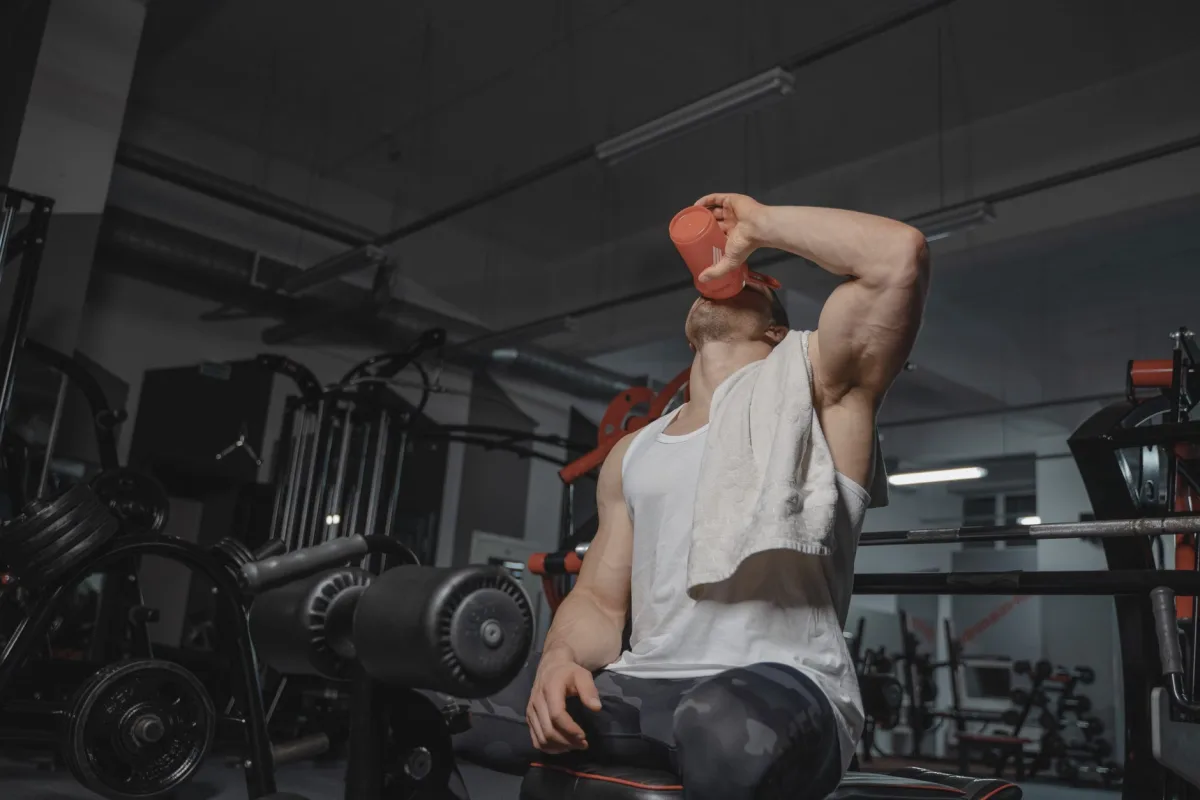
Taste compliance matters more than most buyers admit. If you dread drinking your protein shake, you'll skip it — and inconsistent protein intake undermines recovery regardless of how clean the formula is.
Momentous Whey Protein Isolate ranks among the top-rated options for both formulation and palatability in multiple expert roundups. Garage Gym Reviews gave it 4.5 out of 5 stars for taste in independent testing, with their reviewer describing the chocolate flavor as "rich... like hot chocolate" that "goes down really smoothly, really easily." The cold-press, micro-filtration process preserves the amino acid profile while producing a noticeably cleaner mouthfeel than many competitors.
For buyers who want even more flavor variety, Men's Health testers found specific stevia-sweetened whey powders that avoid the bitter chemical aftertaste that plagues the category — particularly calling out chocolate peanut butter flavors as "unexpectedly creamy even when mixed with water."
Best for: Anyone who has abandoned protein supplementation before because of taste, people who use protein shakes daily rather than occasionally, and those who want enough flavor variety to avoid getting bored.
Best for Lactose Sensitivity and Digestive Comfort
Digestive issues are one of the most common reasons people stop using protein powder — and one of the most preventable. The solution usually comes down to protein type, not abandoning supplementation.
NOW Sports Whey Protein Isolate is the standout recommendation for sensitive users. Garage Gym Reviews highlights it for clean formulation: exactly two ingredients — whey protein isolate and sunflower lecithin — earning it a 5/5 for formulation quality. No artificial flavors, no sweeteners, no fillers. The isolate filtration process removes most lactose. The trade-off is obvious: unflavored means it needs to be mixed into something that provides its own taste.
Kaged Whey Protein Isolate is a strong alternative if you want flavoring. Garage Gym Reviews' review notes 25 grams of protein at 110 calories per serving — a strong caloric efficiency ratio — with strict third-party testing and transparent labeling. The one genuine drawback: it doesn't dissolve as smoothly as most isolates, which can leave clumps in a shaker bottle.
For people who cannot tolerate dairy at all: plant-based options (pea, pumpkin, rice protein blends) are the cleanest route. See the plant-based section below.
A note on collagen as a dairy-free alternative: Some buyers consider collagen powder when dairy sensitivity pushes them away from whey. This is worth clarifying: collagen is not a complete protein — it lacks sufficient essential amino acids for muscle protein synthesis. If digestibility is your goal, a plant-based isolate is the better choice for muscle recovery; collagen serves a different purpose entirely (joints, skin, connective tissue).
Best for: Anyone experiencing bloating or discomfort with standard whey concentrate, people with diagnosed lactose intolerance, and those who want the simplest possible formula.
Best Plant-Based Protein Powders in 2026

Plant-based protein powders have a grit and chalkiness reputation that's partly outdated. Brands blending multiple plant sources have significantly improved both amino acid completeness and texture.
Swolverine Plant Protein earns the top plant-based pick from multiple expert sources specifically because it blends pea and pumpkin protein to create a complete amino acid profile — something single-source plant proteins often fail to achieve. It delivers 25 grams of protein at 140 calories per serving, competitive with many whey options. The texture is described by expert reviewers as "surprisingly smooth" for a vegan powder.
Kos Organic Superfood Plant Protein is worth considering for buyers who want organic certification and additional micronutrients. Kathryn Durston, RDN, owner of Naturally Good Nutrition, commenting via Everyday Health's expert panel, notes: "I appreciate that it's certified organic, a quality you don't see often with protein powders." The coconut milk base contributes a creamier texture, and the formula blends plant proteins with organic superfoods. Trade-off: cost per gram of protein is higher than simpler blends.
The complete amino acid issue: Single-source plant proteins (pea only, hemp only, rice only) typically miss one or more essential amino acids. The International Society of Sports Nutrition notes that plant-based athletes can compensate by consuming a greater total amount of protein or by combining complementary sources. Blended plant powders (pea + pumpkin, rice + pea) solve this more efficiently than single-source options.
Best for: Vegans, people with dairy allergies, those following whole-food-aligned diets, and anyone who wants their protein supplement to contribute a more complete nutritional profile.
Best Budget Protein Powder: Cost Per Serving Is the Right Metric
Price per serving is what matters — not the total sticker price. A 5-pound tub that looks expensive might cost less per serving than a sleek 1-pound bag with premium branding. Always divide total cost by number of servings before comparing.
Nutricost Whey Protein Concentrate delivers approximately $1 per serving for 25 grams of protein. Garage Gym Reviews tester Kate Meier, NASM-CPT, gave it 5/5 for taste and solubility (chocolate peanut butter), noting it "mixes extremely well, even in a shaker cup." Available in five flavors including unflavored. GMP-compliant facility, third-party tested (though certifying lab is not the top-tier NSF or Informed Sport). The concentrate format means more lactose than isolate options — worth knowing if you have dairy sensitivity.
Optimum Nutrition Gold Standard Whey also qualifies as strong value: the best-value designation from expert sources reflects its affordability combined with widespread availability, consistent quality control, and genuine RD endorsement.
NOW Sports Whey Protein Isolate is notable for achieving budget pricing with an isolate formula — unusual at this tier. The catch: unflavored only, limiting ready-to-drink appeal.
Best for: Students, high-volume users who go through multiple containers per month, and anyone building a consistent protein supplementation habit without a large upfront commitment.
What Protein Powder Cannot Do: Realistic Expectations
This section corrects common misconceptions before purchase, not after.
Protein powder is a convenience tool, not a magic input. It helps you reach your daily protein target when whole food sources are insufficient or inconvenient. If you're consistently hitting your protein goal through chicken, eggs, Greek yogurt, and legumes, supplementation adds nothing except cost.
More protein is not always better. The Mayo Clinic Health System and the International Society of Sports Nutrition both note that 1.4–2.0 grams of protein per kilogram of body weight per day is sufficient for most exercising individuals. For a 150-pound (68kg) person training 3–4 days per week, that's roughly 95–136 grams of total daily protein — not all of which needs to come from powder. Intakes above 2g/kg/day produce diminishing returns for most non-elite athletes.
Collagen powder is not a protein powder substitute. Collagen lacks tryptophan and is low in several essential amino acids required for muscle protein synthesis. Using it as your primary protein source will leave gaps in your amino acid intake. It has real value for joint and connective tissue support — but that's a different product for a different goal. The Best Collagen Supplements 2026 guide covers that category in full.
Vitamins, creatine, and adaptogens are a separate category. Protein powder belongs in your nutrition stack alongside whole-food protein sources. For evaluating which vitamins and supplements actually have evidence behind them, the Best Vitamins & Supplements 2026 guide applies a four-tier evidence framework to help you avoid wasting money on weak-evidence products.
Quick Reference: Match Your Goal to the Right Powder
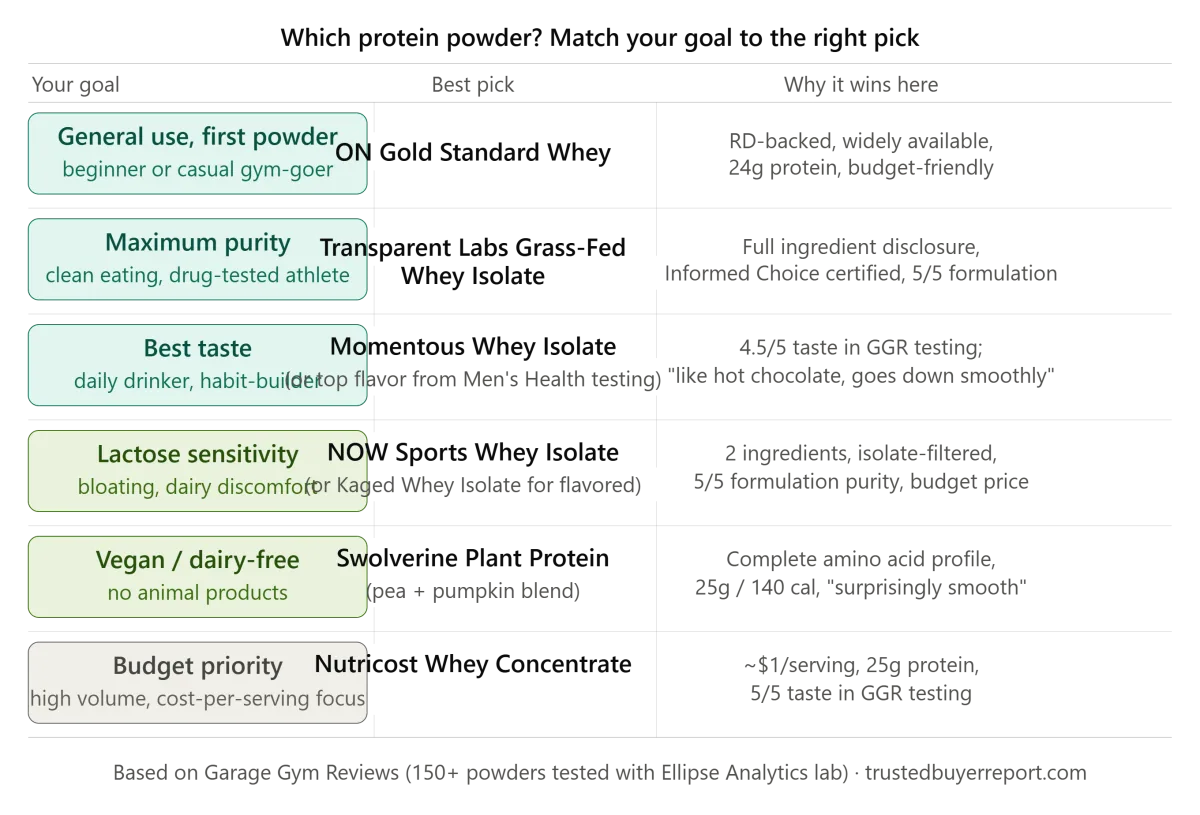
| Goal | Best pick | Why |
|---|---|---|
| General use, first powder | Optimum Nutrition Gold Standard Whey | RD-backed, widely available, affordable |
| Maximum ingredient purity | Transparent Labs Grass-Fed Whey Isolate | Full disclosure, Informed Choice certified, 5/5 formulation |
| Best taste experience | Momentous Whey Protein Isolate | 4.5/5 taste in expert testing, smooth texture |
| Lactose sensitivity | NOW Sports Whey Isolate | Two ingredients, isolate-filtered, no additives |
| Vegan / dairy-free | Swolverine Plant Protein | Complete amino acid profile, 25g/140 cal |
| Budget priority | Nutricost Whey Concentrate | ~$1/serving, 5/5 taste in testing |
| Organic certification | Kos Organic Superfood Plant Protein | USDA organic, RD-endorsed |
Frequently Asked Questions
How much protein do I actually need per day?
For most active adults, 1.4–2.0 grams of protein per kilogram of body weight per day is the evidence-based range for muscle building and recovery, per the International Society of Sports Nutrition's position stand. The Mayo Clinic places regularly exercising adults at 1.2–1.7g/kg/day. Protein powder is a tool to help reach that target — not a requirement. If you're consistently hitting your daily goal through whole foods, supplementation adds convenience, not muscle.
Is whey isolate always better than whey concentrate?
Not always — it depends on digestive tolerance and budget. Isolate has more lactose and fat filtered out, making it easier on sensitive stomachs and slightly more calorie-efficient. Concentrate is less expensive and still delivers high-quality complete protein. If you tolerate dairy well and want to minimize cost, concentrate is a sound choice. If bloating or gas is a recurring issue after using protein powder, try isolate before abandoning supplementation entirely.
What does third-party testing actually verify?
Third-party certifications like NSF Certified for Sport verify that the product contains what the label claims, in the amounts stated, and is free from substances banned in competitive sports. It does not mean the product is the best-tasting or most effective — only that it's accurately labeled and clean. Per Garage Gym Reviews, products without any third-party certification require the buyer to trust the manufacturer's word on purity — a meaningful risk in an unregulated category. For competitive athletes subject to drug testing, NSF or Informed Sport certification is essential.
Can I use protein powder as a meal replacement?
No. Protein powder is a protein supplement, not a complete meal. Most powders provide protein and minimal other macronutrients or micronutrients. They're designed to supplement — not replace — whole meals that provide fats, complex carbohydrates, fiber, and a full micronutrient spectrum. Some meal replacement powders (clearly labeled as such) include broader nutritional profiles, but standard protein powders do not.
What's the difference between whey and plant protein for building muscle?
Whey protein, particularly isolate, is a complete protein with a high leucine content and rapid digestion rate — both factors that are well-established for stimulating muscle protein synthesis post-exercise. Plant proteins can achieve similar results when consumed in adequate amounts and when complementary sources are blended to create a complete amino acid profile, per the ISSN position stand. For vegan athletes, blended plant powders (pea + pumpkin, rice + pea) are the most efficient path to a complete amino acid profile per serving.
Is collagen powder good for muscle building?
No — collagen is not a complete protein and is not appropriate as a primary protein source for muscle-building goals. It lacks sufficient tryptophan and several other essential amino acids required for muscle protein synthesis. Collagen has genuine value for joint health, connective tissue support, and skin — but those are different goals requiring a different product. The Best Collagen Supplements 2026 guide covers what collagen actually does well and how to evaluate doses and formats for those specific goals.
This article was drafted with AI assistance and fact-checked by our editorial team before publishing. It draws on expert testing data from Garage Gym Reviews, Forbes Vetted, Fortune, Everyday Health, Men's Health, ISSN, Mayo Clinic Health System, and UCLA Health — all cited inline. Trusted Buyer Report has not independently tasted or tested the products listed. We may earn a commission from purchases made through links on this page, at no additional cost to you. Rankings are finalized before affiliate links are applied. Full methodology · Affiliate disclosure · AI ethics policy