How this guide was researched: This guide is based on publicly available fare data, platform documentation, expert travel sources (National Geographic, Frommer's, Skyscanner's own booking-window research), and third-party reports including Expedia's 2026 Air Hacks Report. It does not reflect hands-on testing by Trusted Buyer Report. We synthesize these sources so you don't have to read them all.
TL;DR — Which Flight Deal Tool Should You Use?
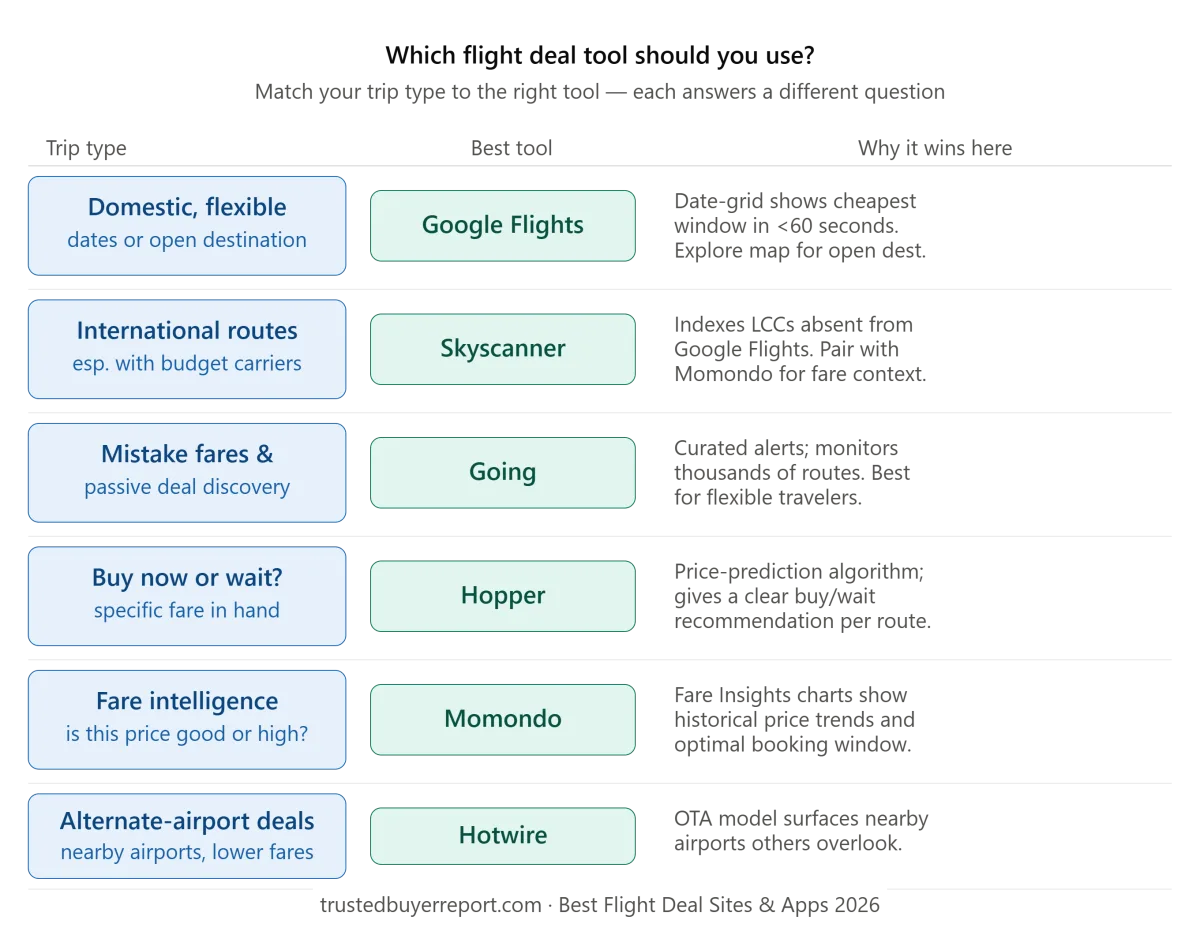
- Google Flights — best first stop for any domestic search; use the date-grid to find your cheapest window in under 60 seconds
- Skyscanner — essential for international routes; catches budget carriers Google Flights doesn't index
- Going (formerly Scott's Cheap Flights) — best for passive deal discovery and mistake fares; set it and let deals come to you
- Hopper — best when you've found a fare and need a buy-now-or-wait answer
- Momondo — best for fare intelligence; its Fare Insights charts show whether current prices are historically high or low
- Hotwire — useful for alternate-airport deals that other tools miss
The tools above aren't competing. Each answers a different question at a different stage of booking. The fastest way to find cheap flights in 2026 is a three-step sequence: Google Flights → Skyscanner → airline's direct site. Everything else is a specialist tool for a specific situation.
Quick Comparison: Which Flight Deal Site Wins for Your Trip Type?
| Trip Type | Best Tool | Why |
|---|---|---|
| Domestic, flexible dates | Google Flights | Date-grid shows cheapest window instantly |
| International routes | Skyscanner | Indexes budget carriers absent from Google |
| Mistake fares & passive alerts | Going | Curated alerts; strong on international error fares |
| Buy-now-or-wait decision | Hopper | Price-prediction algorithm; mobile-first |
| Fare trend intelligence | Momondo | Fare Insights charts show historical price context |
| Alternate-airport deals | Hotwire | Surfaces cheaper nearby airports others miss |
This article = finding cheap fares using the right tools. It is not about which airline to fly (see: Best Budget Airlines 2026: Spirit vs Frontier vs Southwest Compared), and it is not about maximizing points value (see: Best Travel Rewards Programs 2026: Which Points Are Worth Most?). If you want both — the right tool to find the fare and the full trip strategy — the Complete Travel Buyer's Guide 2026 covers the end-to-end picture.
Why No Single Tool Wins Every Search

Here's the thing most flight deal guides don't tell you: no single booking platform finds the cheapest fare on every route, every time. That's not a flaw — it's architecture. Each tool is built to answer a fundamentally different question, and using the wrong one for your situation means leaving money on the table.
There are three distinct tool types, and confusing them is the most common mistake travelers make.
Metasearch engines (Google Flights, Skyscanner, Momondo, Kayak) aggregate results from airlines and OTAs but don't sell tickets themselves. They redirect you to the booking source. Their value is speed and breadth: one search surfaces prices from dozens of sources simultaneously.
Fare alert services (Going, Thrifty Traveler, Dollar Flight Club) work differently. They monitor thousands of routes continuously and notify subscribers only when a fare is genuinely exceptional — not a 10% sale, but a pricing anomaly. Julian Kheel, CEO of Points Path, described the logic to National Geographic: these services let you "set your search on autopilot," which is the right framing. If you're not looking for a specific trip but want to be alerted when an extraordinary deal appears, this is the tool category for you.
Price-prediction apps (Hopper) answer a third question entirely: given the current fare for a specific flight, should you book today or wait? That requires historical pricing data and machine learning, not just aggregation — and it's a fundamentally different task than finding the fare in the first place.
OTA apps (Expedia, Hotwire) both aggregate and sell directly. That dual role occasionally produces consolidated pricing unavailable on pure metasearch — which is how Hotwire, in Frommer's 18-site test, found the lowest fare for a New York-to-Los Angeles flight by surfacing Burbank and Ontario airports instead of LAX. No other platform surfaced that result.
Understanding which category each tool belongs to is the prerequisite for using any of them effectively.
Google Flights: Start Every Domestic Search Here

For domestic flights, Google Flights should be your first stop — full stop.
The reason is the date-flexibility grid. Enter any route and you get a full month of prices color-coded from cheapest to most expensive. Identifying your cheapest travel window takes under 60 seconds. No other tool comes close for speed on this specific task.
Set a fare alert before you leave the page. Google sends email notifications when the price moves up or down on any route you're tracking. This has a less obvious use case that many travelers miss: set alerts on routes after you've already booked. If the price drops significantly, some airlines will issue a travel credit for the difference — and the alert costs you nothing to maintain.
The Explore map extends this further. Leave the destination blank, enter your departure city, and Google populates a map with prices to hundreds of destinations. Useful when you know you want to travel in a specific month but haven't picked a destination.
Google Flights' structural limitation: it doesn't index every budget carrier, particularly on international routes. Budget airlines that dominate certain European, Southeast Asian, and Latin American corridors sometimes won't appear in results at all. On those routes, the cheapest option is simply invisible. Use Google Flights to establish a price baseline — then cross-check on Skyscanner before you book any international route.
Skyscanner and Momondo: The International Search Pair
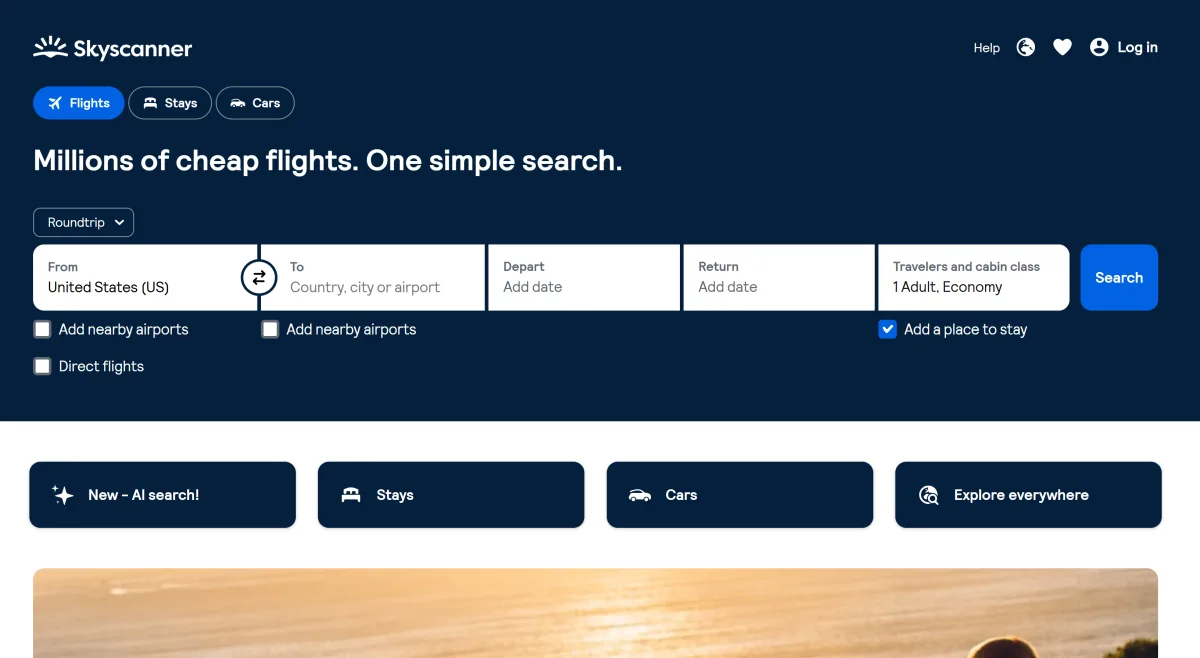
Both are metasearch engines. Both index budget carriers that Google Flights doesn't. But they serve different needs once you move past that shared strength.
Skyscanner's advantage is breadth. On a London-to-Barcelona search, Skyscanner will surface Ryanair and Vueling fares that Google Flights may not show. That's not a trivial gap — on routes where budget carriers hold the cheapest inventory, skipping Skyscanner means paying more by default.
Momondo's advantage is fare intelligence. Its Fare Insights feature shows price trends over time for any given city pair, flags whether the current price is above or below the historical median for that route, and gives a concrete booking-window recommendation. Frommer's, after testing 18 booking sites, described it as "like having an expert travel agent right there."
Here's the practical difference: Skyscanner tells you what's available now. Momondo tells you whether "now" is a good time to buy.
The recommended international search sequence:
- Google Flights — establish your price baseline
- Skyscanner — catch any budget carriers Google missed
- Momondo Fare Insights — check whether current prices are historically high or low before committing
That workflow takes under 10 minutes and covers the full picture on any international route.
Going: How Passive Deal Discovery Actually Works

Going operates on a premise worth understanding clearly before you subscribe: you're not searching for a trip. You're subscribing to be notified when an extraordinary deal appears — and then deciding whether to take it.
That model is either exactly what you want or completely wrong for your situation.
The service started in 2013 when founder Scott Keyes spotted a $130 roundtrip fare from New York to Milan and started alerting friends. By 2015 it was a business; today it serves more than 2 million members. The 2024 launch of Going's mobile app extended the service beyond email, publishing curated low-fare alerts directly to your phone.
Going surfaces two types of deals:
- Regular deals — fares meaningfully below the typical price for a route. Not a 10% sale. Substantially cheaper.
- Mistake fares — pricing errors that result in dramatically underpriced tickets. These get corrected within hours. Fast action is mandatory.
Going is best for travelers with schedule flexibility. If you can move within a two-to-four-week window and respond quickly when a deal appears, Going can deliver savings that no amount of active searching would find. If you have fixed travel dates and a specific destination, skip the subscription and use Google Flights or Skyscanner directly — Going's passive model doesn't help you here.
One clarification on deal types: Going is genuinely strong on international routes, where pricing volatility is higher and error fares appear more frequently than on domestic U.S. routes.
Hopper: The Buy-Now-or-Wait App
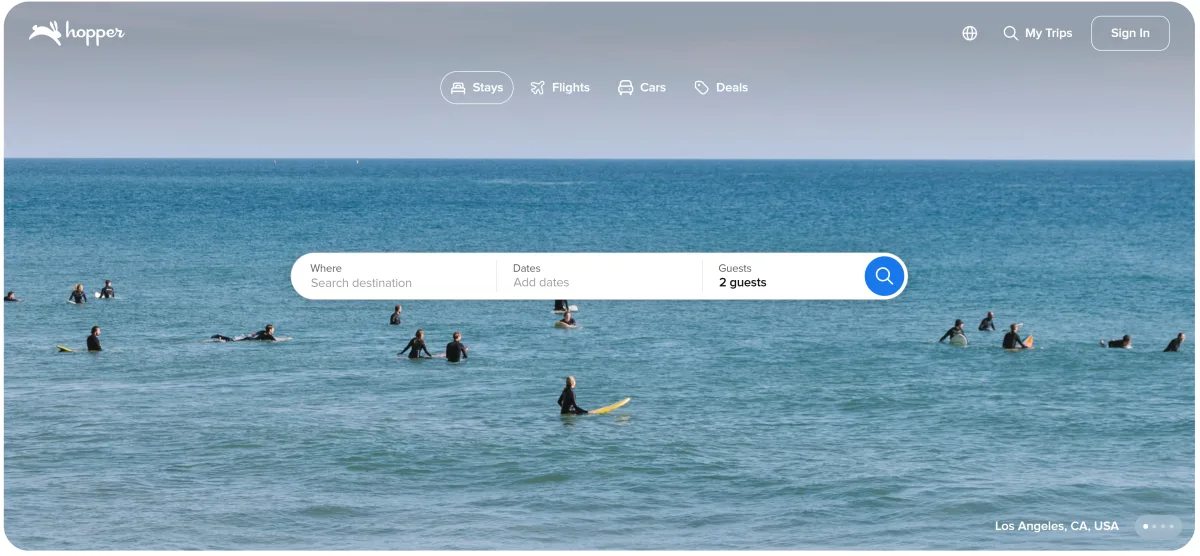
Hopper answers a question no other tool in this guide addresses: given the current fare for a specific flight, should you book today or wait for a likely lower price?
Its algorithm analyzes historical pricing data for the route and generates a probability-based recommendation. That's a fundamentally different task than finding the fare in the first place — and it requires a different tool to answer.
Where Hopper is most useful: you've already found a $650 fare to Tokyo departing in six weeks. You're not sure whether $650 is a good price or whether it will drop. Hopper gives you a specific, data-backed answer based on how that route has historically priced at this booking distance.
Where Hopper is less useful: open-destination browsing, comparing multiple routings, or surfacing deals you haven't already identified. Google Flights and Skyscanner handle those tasks better.
An honest caveat: Hopper's predictions are probabilistic, not guaranteed. External shocks — fuel price spikes, geopolitical disruptions, sudden airline capacity changes — can move fares in ways no historical model anticipates. NerdWallet's Travel Inflation Report identifies oil price volatility as the biggest current variable in airfare unpredictability. Use Hopper's recommendation as one data point, not a guarantee.
When Should You Actually Book? What the Data Shows
The booking window question is one of the most searched travel topics — and one of the most inconsistently answered. Here's what current data actually shows.
For domestic flights: booking one to three months ahead can save up to 25% compared to last-minute fares, according to Expedia's 2025 Air Hacks Report, which analyzed billions of data points from every airline in partnership with the Airlines Reporting Corporation. Skyscanner's own booking-window research aligns with this, putting the domestic sweet spot at three to eight weeks out.
For international flights: the optimal window is longer — typically two to six months, depending on route, season, and destination. Popular summer routes to Europe fill earlier than shoulder-season travel to less-trafficked destinations. If you're targeting Paris in June, January or February is when you should be booking, not March.
On day of week: Expedia's 2026 Air Hacks Report found that Friday is now the cheapest day to both depart and book, displacing the long-held belief that Tuesday or Wednesday were optimal. The reason: business travelers are returning home earlier in the week, which opens up Friday inventory for leisure travelers at lower prices.
One underused tactic: set a fare alert on a route even after you've already purchased your ticket. If the price drops substantially, some airlines will issue a travel credit for the difference. Google Flights alerts and Going's post-booking monitoring can both run passively in the background at no cost.
Loyalty Points and Flight Deal Tools: Where They Intersect
If you're planning to use points or miles, the tools covered in this guide still apply — but with one additional layer.
Going's 2026 State of Travel report notes that Air France–KLM's Flying Blue, Singapore Airlines' KrisFlyer, and British Airways' Avios all raised award prices by 5–20% in 2025 depending on route and cabin. The practical implication: points lose purchasing power faster than they used to. Going's report frames it directly — waiting for the "perfect redemption" is no longer strategic, because points bought time usually buys you less than points used now.
The tools in this guide help cash-fare travelers find the cheapest flight. Whether that cash fare or a points redemption represents better value for your specific situation depends on your program and balance — that's a separate analysis covered in depth in the Best Travel Rewards Programs 2026: Which Points Are Worth Most? guide.
The workflow is the same regardless of payment method: find the cheapest available cash fare first (using Google Flights + Skyscanner), then compare it against your best points redemption option. You can't evaluate the trade-off without knowing the cash price.
The 3-Step Booking Workflow for 2026
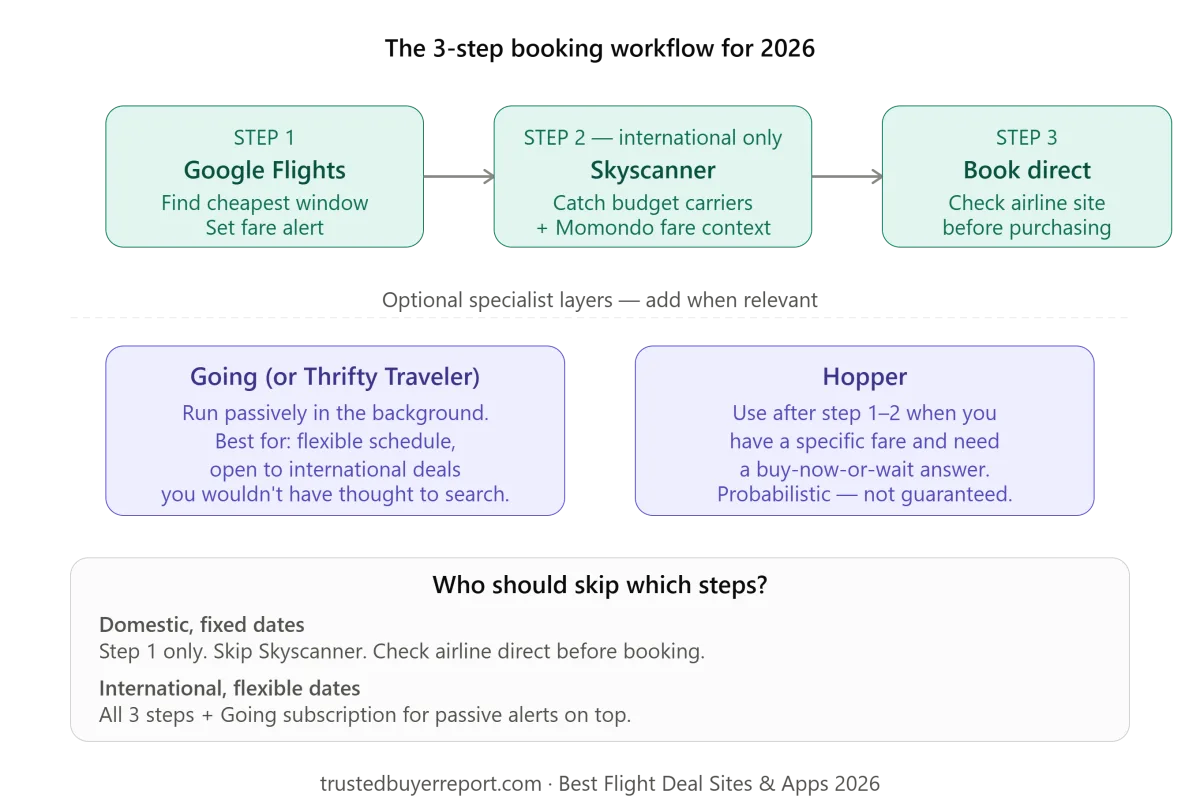
Rather than picking one tool and ignoring the rest, the most effective approach is a short, structured sequence.
Step 1 — Google Flights. Use the date-flexibility grid to identify your cheapest travel window and establish a baseline price. For domestic routes, this is often sufficient. Set a fare alert before you leave the page.
Step 2 — Skyscanner (international only). Run the same search to catch budget carriers Google Flights may not index. Check Momondo's Fare Insights if you want historical context on whether the prices you're seeing are above or below the norm for that route.
Step 3 — The airline's direct website. Before purchasing anywhere, check the airline's site. The price difference is often small, but booking direct means you deal with the airline, not a third party, if anything goes wrong — rebooking, cancellation, or compensation.
Optional layer — Going. If you have a flexible schedule and can act quickly when a deal appears, a Going subscription runs passively in the background and surfaces deals you would never have thought to search for.
Optional layer — Hopper. If you've found a specific fare and genuinely aren't sure whether to book now or wait, Hopper's price-prediction feature gives you a probability-based answer.
No single platform wins across all scenarios. The best flight deal tools in 2026 are most powerful when used in combination — each answering a different question in the booking process.
Frequently Asked Questions
Is Google Flights free to use?
Yes. Google Flights is a free metasearch tool. It does not charge booking fees and does not sell tickets directly — it redirects you to the airline or OTA to complete the purchase. Standard booking fees may apply at the destination site depending on the platform.
What is a mistake fare and how do I find one?
A mistake fare is a pricing error — typically caused by a data entry mistake or currency conversion glitch — that results in a ticket being sold dramatically below its intended price. Business-class international fares for a few hundred dollars are not unheard of. Services like Going, Thrifty Traveler, and Dollar Flight Club monitor for these and alert subscribers immediately. Speed is essential: mistake fares are typically corrected within hours, and airlines can cancel bookings made at error prices after the fact.
Does Hopper's price prediction actually work?
Under normal market conditions, reasonably well. Hopper's algorithm is based on historical pricing data and performs best on established routes with consistent demand patterns. It is less reliable during periods of external volatility — fuel price spikes, geopolitical disruptions, or sudden airline capacity changes. Treat its recommendations as a useful input, not a guarantee.
Should I book directly with the airline or through a third-party site?
Use third-party tools to find the cheapest fare, then check the airline's direct website before purchasing. Airlines sometimes price-match or offer exclusive direct-booking rates. More importantly, booking direct means you work with the airline (not an intermediary) if a flight is canceled, delayed, or rebooked — and that distinction matters significantly when something goes wrong.
Which flight search tool is best for last-minute bookings?
For genuine last-minute searches (within one to two weeks of departure), Google Flights and Skyscanner are still your starting points — but expect to pay more than you would have with a longer booking window. Domestic fares one to three months out are typically 20–25% cheaper than last-minute prices, per Expedia's 2026 Air Hacks data. Going occasionally surfaces last-minute mistake fares, but they're unpredictable by nature.
This article was researched and drafted with AI assistance, then reviewed and fact-checked by our editorial team before publishing. Sources are cited in the text. Trusted Buyer Report may earn a commission from purchases made through links on this page — this does not affect our rankings or recommendations, which are completed before any affiliate link is applied. Full methodology · Affiliate disclosure · AI ethics policy
Pre-Publish Notes (Action Required)
Placeholders that need human verification before publishing:
- Expedia's 2026 Air Hacks Report — The article cites the finding that Friday is now the cheapest day to book and depart. Verify the exact statistic and phrasing directly at expedia.com/newsroom before publishing. The original article quoted this; the rewrite paraphrases it — confirm accuracy.
- Going's 2026 State of Travel figures — The award price increase data (5–20% by Air France–KLM, Singapore Airlines, British Airways) was sourced from the original article. Verify these figures are current at going.com/guides/state-of-travel-2026.
- Internal link slugs confirmed — The four internal links used (/blog/travel-buyers-guide-2026-hotels-flights-vacations, /blog/best-budget-airlines-2026-spirit-frontier-southwest-compared, /blog/best-travel-rewards-programs-2026-points-value) were all verified as live pages during research. Confirm slugs are stable in the sitemap before publishing.
- Author byline — Add a byline with name/role before publishing (e.g., "Reviewed by [Editor Name], Travel Content Editor"). Required for E-E-A-T.
- Featured image — Current image (Pexels, credit: DΛVΞ GΛRCIΛ) is retained from original. Alt text suggestion: "Credit cards, passport, and phone on flat lay — flight deal search tools 2026". Confirm alt text is set correctly in the CMS.