
This guide is based on publicly available platform documentation, cited third-party research, and aggregated source analysis. Trusted Buyer Report has not independently tested these platforms through a live vehicle transaction. How we research → · We may earn a commission through links on this page. Full disclosure → · Drafted with AI assistance and fact-checked by our editorial team.
TL;DR — What each platform actually does
- KBB: valuation and research tool. Use it first, before contacting anyone.
- CarMax: no-negotiation retailer with in-person appraisal. Best for reliable seller offers.
- Carvana: no-negotiation retailer with fully online/home-pickup model. Best for seller convenience, strongest buyer return policy.
- CarGurus: deal-rating aggregator. Best for quickly spotting below-market listings.
- Autotrader / Cars.com / Edmunds: research and listing aggregators. Best for broadening search and reading expert/driver reviews.
- Carfax: vehicle history. Use independently for any listing that doesn't provide it automatically.
- The power move: use KBB to establish a baseline → CarGurus/iSeeCars to find underpriced listings → Carfax to vet shortlisted vehicles → CarMax + Carvana in parallel if selling.
Why Picking the Wrong Platform Costs You Real Money
Most buyers treat CarMax, Carvana, and KBB as three flavors of the same thing and pick whichever has the better app design. That's a mistake — and it's an expensive one.
These platforms don't compete. They serve fundamentally different purposes at different stages of a car transaction. KBB is a valuation and research tool. CarMax and Carvana are retailers. CarGurus is a deal-rating aggregator. Edmunds is a research platform. Treating any of them as interchangeable means you might accept the first offer you see without knowing whether it's fair — or skip the one step that would have told you it wasn't.
Here's what this guide covers that the platforms themselves won't tell you:
- What each platform actually is (not what its marketing says)
- Which platform to use for which specific job
- Where each one falls short — and what you lose if you rely on it alone
- How to combine them for the strongest possible position, whether you're buying or selling
What this guide does NOT cover: how to negotiate, inspect a vehicle, set your budget, or execute the step-by-step purchase process. For the full buying walkthrough, see our companion guide: How to Buy a Used Car Online in 2026 →
Platform Overview: What Each Tool Is Actually For
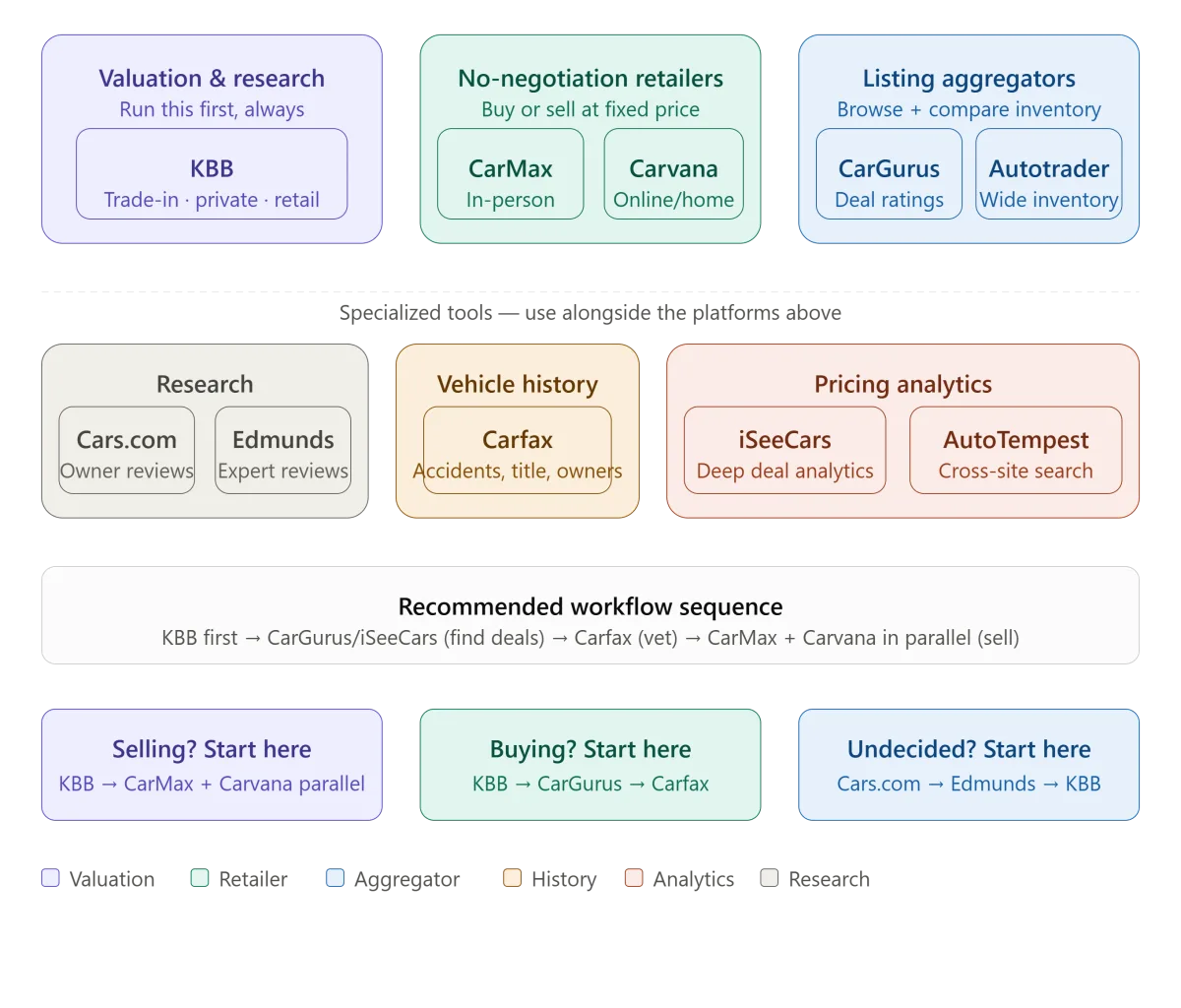
Before comparing features, get the categories right — because most "CarMax vs Carvana" comparisons bury this.
| Platform | Category | Primary job |
|---|---|---|
| KBB | Valuation & research | Establish what your car is worth before anything else |
| CarMax | Retailer (no-negotiation) | Buy or sell used vehicles; in-person appraisal |
| Carvana | Retailer (online-only) | Buy or sell used vehicles; fully remote transaction |
| CarGurus | Aggregator + deal rating | Find below-market listings fast |
| Autotrader | Aggregator | Browse the widest listing inventory |
| Cars.com | Aggregator + owner reviews | Research how a model performs in real ownership |
| Edmunds | Research + aggregator | Expert vehicle reviews + pricing tools |
| Carfax | Vehicle history | Verify any used vehicle's history before buying |
| iSeeCars | Analytics + aggregator | Deep pricing data for deal evaluation |
The practical implication: none of these platforms replaces the others. Each fills a specific gap in the car-buying or car-selling process. The question isn't which one to pick — it's which combination fits your situation.
KBB (Kelley Blue Book): The Baseline You Run Before Everything Else
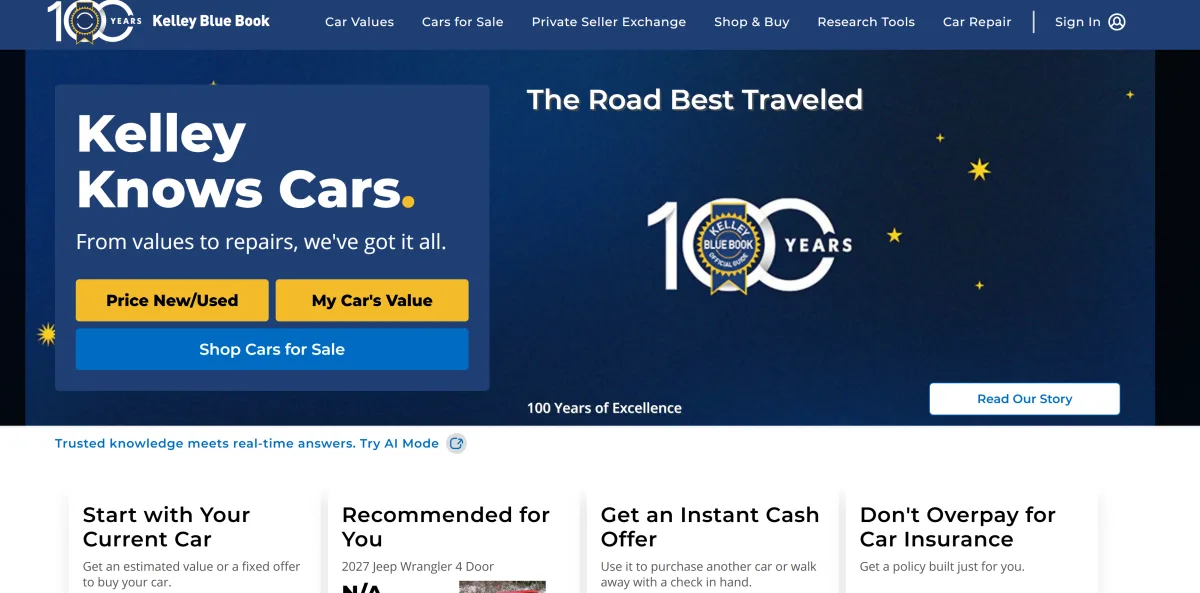
What it is: A valuation and vehicle research tool, not a transaction platform.
What it does: KBB calculates the market value of a specific vehicle — factoring in make, model, year, mileage, condition, and local market — and provides three distinct valuations: trade-in value (what a dealer would pay), private party value (what a private buyer would pay), and dealer retail value (what you'd expect to pay buying from a dealer). KBB covers both new and used vehicles and, according to LendingTree's 2026 used-car website comparison, allows users to compare up to six cars simultaneously — more than any other major platform.
Why it comes first in every workflow: KBB gives you a data-backed reference point before you engage any seller or submit your vehicle to any platform. Without it, you're evaluating offers blindly. With it, you have a specific, documented range to anchor every negotiation or acceptance decision.
Where it falls short: KBB is a research layer, not a transaction destination. It won't buy your car, it won't show you a live inventory of vehicles for sale in your area as its primary function, and a KBB value is an estimate — not a guarantee of what any specific buyer will pay on any given day. Wholesale and retail markets shift with inventory conditions and regional demand.
The specific use case: Run your vehicle through KBB before you get a CarMax appraisal or submit to Carvana. If CarMax comes in significantly below KBB's trade-in range, you have a data-backed reason to seek additional offers. If Carvana's quote aligns with KBB's private party value, you know it's within a reasonable range. KBB calibrates your expectations before you walk into any transaction.
App availability: iOS and Android. Allows sellers to list vehicles. Surfaces local inventory.
CarMax: The Reliable Seller Offer — If You Can Visit in Person

What it is: A national used-car retailer operating on a fixed, no-negotiation pricing model.
What it does: CarMax buys and sells used vehicles through a network of physical locations. As a seller, you bring your car in, CarMax inspects it, and you receive an offer. As a buyer, you browse their nationwide inventory through the app or website and purchase at the listed price — no haggling.
The key differentiator for sellers: CarMax's appraisal happens in person, at the time of your visit. According to Vantage Auto Group's 2026 platform analysis, that means the number you receive is based on a physical inspection — making it significantly more likely to be the final number, compared to platforms that quote online based on information you provide. CarMax offers are valid for seven days.
That seven-day window matters strategically. It's long enough to also submit your vehicle to Carvana and receive their online quote. Running both in parallel — CarMax in person, Carvana online — costs nothing and often surfaces a meaningful price difference. CarMax confirms this directly: offers are valid for seven days so you have time to compare your options.
Pricing position: In Vantage Auto Group's 2026 platform analysis, CarMax tends to offer slightly higher prices than Carvana on popular used models, though the gap varies significantly by vehicle type and regional demand. Neither consistently beats the other — which is why parallel offers are the correct approach.
Where it falls short:
- CarMax has now rolled out at-home pickup nationwide as of late 2025, so the "must visit in person" constraint no longer applies in most markets. However, the in-store appraisal — where a CarMax associate physically examines your vehicle — remains more likely to produce a firm, final number than a remote estimate.
- Used vehicles only. Buyers seeking new cars need a different platform.
- Not the highest ceiling: a broker running competitive bids among multiple buyers will typically produce a higher seller price than either CarMax or Carvana, per Vantage Auto Group's research.
App availability: iOS and Android. Nationwide used-vehicle inventory, no listing fee for sellers.
Carvana: Maximum Convenience — With a Critical Caveat for Sellers

What it is: A national used-car retailer operating entirely online, with home pickup and delivery.
What it does: Carvana's entire model is built around eliminating the need to go anywhere. As a seller, you submit your vehicle details online, receive an offer, schedule a home pickup, and receive payment without leaving your house. As a buyer, you browse, finance, and purchase entirely online, with the vehicle delivered to your home.
The strongest buyer protection in the no-negotiation space: Carvana's seven-day return policy is the most generous feature in the fixed-price used-car market. You have a week with the vehicle before the sale is final — long enough to identify issues that photos didn't reveal. LendingTree's 2026 used-car website comparison rates Carvana best for this return policy specifically. Carvana also provides 360-degree photos for every listing, which partially compensates for the inability to physically inspect before buying.
The critical caveat for sellers: Carvana's initial online quote is conditional. It's based on the information you provide, not on a physical inspection of your vehicle. The final number is subject to adjustment after Carvana's pickup inspection. If there are undisclosed issues — any damage, wear, or mechanical problems not captured in what you submitted — the offer can change. This is a meaningful distinction from CarMax's in-person model.
What Carvana doesn't do: It's a closed marketplace. Carvana doesn't surface local inventory from other dealers, and it doesn't allow private listings. According to Yahoo Autos' 2026 app review, if you want to browse cars from local dealers or list your own vehicle privately, Carvana is not the right tool.
The vending machine angle: In select cities, Carvana operates car vending machines — physical pickup locations that create a unique in-person experience for buyers who want something between full home delivery and a traditional dealership. Sherpa Auto Transport's used-car site guide notes these as a genuine differentiator for buyers in those markets.
App availability: iOS and Android. No local inventory search, no private listings.
CarGurus: The Fastest Way to Spot Below-Market Listings
What it is: A listing aggregator that rates every vehicle as a good deal, fair deal, or overpriced — based on market pricing data.
What it does: CarGurus doesn't just show you listings; it tells you whether each listing is priced well. Every vehicle on the platform receives a deal rating based on market comparison data, removing much of the manual work of evaluating whether a price is competitive. According to CarGurus' own platform description, CarGurus gives each car a deal rating from great to overpriced and its Best Match sort order helps consumers find their best deal. The platform also ranks listings by dealer reputation — another signal that reduces buyer research time.
The Autolist acquisition: CarGurus acquired Autolist, which CarFromJapan notes claims more than five million dealer listings aggregated from major platforms including CarMax and Carvana. That breadth makes CarGurus one of the most comprehensive starting points for buyers who want deal ratings across the widest possible inventory.
Where it falls short: CarGurus is a research and discovery tool, not a transaction platform. You still execute the purchase directly with the seller or dealer. The deal ratings are market-relative — they tell you whether a listing is priced competitively compared to similar vehicles in your area, not whether the specific vehicle is mechanically sound or worth buying.
Fee model for sellers: Listing is free; a fee applies only when the vehicle sells. Per Vehicle Transport Hub's used-car website analysis.
Autotrader, Cars.com, and Edmunds: Research and Aggregation
These three platforms occupy similar territory — broad listing inventory plus research tools — with meaningful differences in what they emphasize.
Autotrader
LendingTree's 2026 comparison rates Autotrader best for comparing options across a wide inventory. It integrates KBB pricing tools, which makes it a strong hybrid of listing browsing and valuation in one interface. Both new and used vehicles are listed. According to LendingTree, it allows side-by-side comparison of up to five cars simultaneously.
Best for: Buyers who want the broadest possible inventory view with pricing context built in.
Cars.com
LendingTree rates Cars.com best for real-world driver insights. Model reviews are embedded directly alongside listing inventory — meaning you can read how actual owners experience a specific vehicle in daily use, not just see spec sheets and expert assessments. This is a meaningful advantage for buyers evaluating a model they haven't owned before.
Best for: Buyers who want to understand how a model performs in real ownership before narrowing their search.
Edmunds
Edmunds is primarily a research platform with trusted expert reviews, competitive pricing tools, and vehicle history integration. According to CarFromJapan's 2026 app comparison, the Edmunds app surfaces both local dealerships and major online retailers including CarMax — making it useful for buyers comparing traditional and digital-first options side by side.
Best for: Research-first buyers who want expert assessments alongside pricing data.
A note on cannibalization: If you're using this article and your site also has an Autotrader review, a Cars.com review, and an Edmunds review as standalone pages, link those from here. The treatment above is summary-level — enough for a buyer to understand which platform to reach for, not a full evaluation.
Carfax: Non-Negotiable for Any Private or Third-Party Listing
What it is: A vehicle history reporting platform.
What it does: Carfax provides a report on any used vehicle's documented history — accidents, title issues, odometer readings, service records, and number of previous owners. LendingTree identifies Carfax as the top platform for full vehicle history in their 2026 comparison.
When it's automatic: Carvana and Cars.com include vehicle history reports as part of their listing experience. CarMax provides history reports on its inventory. If you're buying through any of these platforms, the report comes with the listing.
When you need to run it independently: Any vehicle from a private seller, any listing that doesn't explicitly state a history report is provided, or any situation where you want to verify the report the seller provides. Running an independent Carfax check on a vehicle you didn't source through a major platform is standard due diligence, not optional.
The limitation: Carfax only reports events that were documented — accidents that were never reported, maintenance done outside of tracked shops, and some kinds of damage don't appear. A clean Carfax is a positive signal, not a guarantee.
iSeeCars and AutoTempest: For Data-Driven Buyers
iSeeCars
iSeeCars provides deep pricing analytics and market data — including how long specific vehicles have been sitting on the market, which models are depreciating fastest, and which trim levels represent the best value at a given price point. It's more granular than CarGurus' good/fair/overpriced labels, and better suited for buyers who want to understand the data behind a deal rather than just a rating.
Best for: Buyers who want quantitative deal evaluation, not just a rating label.
AutoTempest
AutoTempest aggregates listings from multiple platforms simultaneously in a single search interface — Craigslist, eBay, Cars.com, and dealer sites included. Both platforms are free to use, per Vehicle Transport Hub.
Best for: Buyers who want a single search interface across the broadest possible set of sources, including private sellers.
Platform Comparison: Direct Feature Grid
| Feature | CarMax | Carvana | KBB | CarGurus | Autotrader | Cars.com | Edmunds | Carfax |
|---|---|---|---|---|---|---|---|---|
| Primary role | Retailer | Retailer | Valuation | Aggregator | Aggregator | Aggregator | Research | History |
| Buys your car | Yes | Yes | No | No | No | No | No | No |
| Seller offer type | In-person (final) | Online (conditional) | N/A | N/A | N/A | N/A | N/A | N/A |
| Offer validity | 7 days | Varies | N/A | N/A | N/A | N/A | N/A | N/A |
| Home pickup (sellers) | No | Yes | N/A | N/A | N/A | N/A | N/A | N/A |
| Buyer return policy | Limited | 7-day | N/A | N/A | N/A | N/A | N/A | N/A |
| New vehicles | No | No | Yes | Yes | Yes | Yes | Yes | N/A |
| Private listings | No | No | Yes | Yes | Yes | Yes | No | N/A |
| Deal rating | No | No | No | Yes | No | No | No | N/A |
| Vehicle history | Provided | Provided | Integrated | Available | Available | Included | Integrated | Core product |
| Listing fee (sellers) | None | None | Available | None (sell fee) | Varies | Varies | N/A | N/A |
| App platform | iOS + Android | iOS + Android | iOS + Android | iOS + Android | iOS + Android | iOS + Android | iOS + Android | iOS + Android |
Platform Combinations: Matched to Your Situation
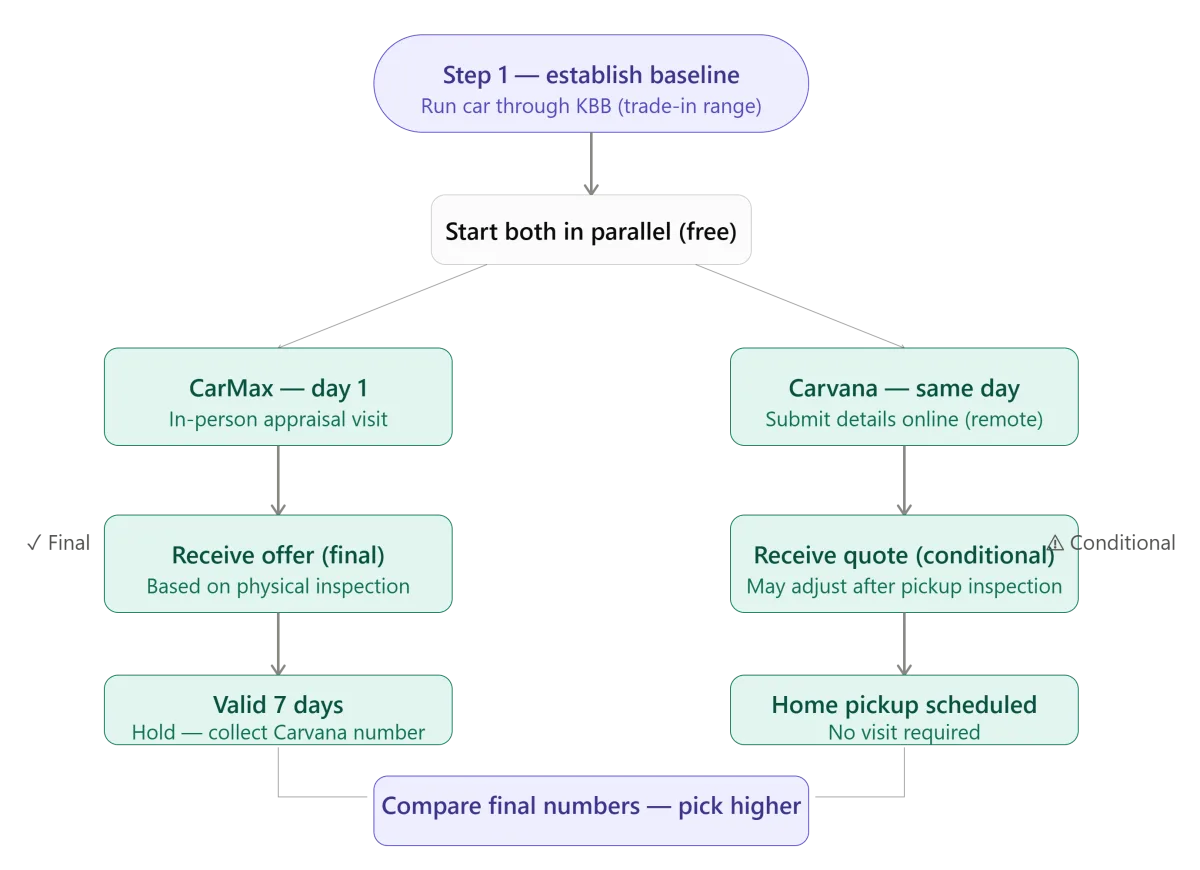
"I want to sell my car and get the highest reliable offer." Get a CarMax in-person appraisal first. Their number is based on a physical inspection and is typically the final offer. Use the seven-day validity window to also submit to Carvana online. Compare both final numbers — not initial estimates — before deciding. Neither consistently pays more; the winning platform depends on your specific vehicle, condition, and regional demand.
"I want to sell but I'm not near a CarMax location." Carvana's home-pickup model is your best no-hassle option. Get the online quote, schedule pickup, and factor in that the final number may be adjusted after their inspection. If maximizing price matters more than convenience, consider a broker who runs competitive bids — Vantage Auto Group's analysis consistently shows brokered sales producing higher seller prices than either platform.
"I'm buying and I want to make sure I'm not overpaying." Run the specific model and year through KBB to establish fair market value. Then use CarGurus or iSeeCars to find listings priced below that range. Shortlist two or three vehicles before you contact any seller.
"I'm buying online and want the strongest protection." Carvana's seven-day return policy is the most buyer-protective feature in the no-negotiation used-car space. Pair it with an independent Carfax check and a KBB valuation before committing. The 360-degree photos and included history report reduce — but don't eliminate — the information gap of buying without a physical inspection.
"I haven't decided on a specific model yet." Cars.com is underused for this stage. The embedded real-owner reviews let you evaluate how a model performs in daily life, not just on paper. Edmunds covers expert assessments if you want professional evaluation alongside owner perspectives. Neither platform requires you to be close to a purchase decision.
"I want to understand the market before I do anything else." Spend 30 minutes on KBB and iSeeCars before you look at a single listing. KBB gives you the pricing range for specific vehicles in your market. iSeeCars shows you which models are depreciating, which are holding value, and which trim levels represent the best deal at your target price point. That foundation changes how you evaluate every listing you see afterward.
What These Platforms Don't Tell You

Every platform on this list is a tool for a specific job — but none of them replaces independent due diligence on a specific vehicle.
A CarGurus "great deal" badge means the price is below market average for similar listings in your area. It doesn't mean the transmission is in good shape.
A Carvana 360-degree photo tour is the most thorough visual inspection available in the online-only model. It doesn't replace a pre-purchase mechanical inspection by an independent mechanic on a vehicle you're seriously considering.
A clean Carfax report means documented history is clear. Undocumented events — accidents not reported to insurance, flood damage in regions where it goes unreported, and maintenance done at non-tracked shops — don't appear.
CarMax's in-person appraisal produces a reliable, final offer based on the condition they see at the time of inspection. If something emerges later that wasn't apparent during the appraisal, the offer reflects what they saw — not what exists.
These aren't criticisms of the platforms. They're structural limitations of any information tool applied to a physical product. For the full set of due-diligence steps — how to verify a listing, what to look for in a history report, and when to require an independent inspection — see our complete buying guide: How to Buy a Used Car Online in 2026 →
Frequently Asked Questions
Is CarMax or Carvana better for selling a car?
Neither is consistently better. CarMax's in-person appraisal produces a more reliable final offer because it's based on a physical inspection. Carvana's online model is more convenient, but the initial quote is conditional and may be adjusted after pickup inspection. The correct approach is to run both in parallel — CarMax offers are valid for seven days, which gives you enough time to also collect a Carvana quote for comparison.
Is KBB accurate for used-car pricing?
KBB provides a data-driven estimate based on regional market conditions, vehicle specifications, and reported transaction data. It's the most widely used reference for used-car valuation in the US market. That said, it's an estimate — actual offers from buyers will vary based on current inventory, regional demand, and the specific condition of your vehicle. Use it as a calibration baseline, not as a guaranteed number.
Does CarGurus charge a fee to list a car for sale?
Listing on CarGurus is free. According to Vehicle Transport Hub's platform analysis, CarGurus charges a fee only when the vehicle sells — not for the listing itself.
What is Carvana's return policy for buyers?
Carvana offers a seven-day return window after delivery. This is the most generous buyer-protection policy among the major no-negotiation used-car platforms. LendingTree's 2026 used-car website comparison specifically rates Carvana as the top platform for its return policy.
Do I need Carfax if I'm buying through Carvana or CarMax?
Both Carvana and CarMax provide vehicle history reports as part of their listing and selling process. If you're buying through either platform, an independent Carfax report is redundant. For vehicles sourced through private sellers, local dealers, or platforms that don't automatically include history reports, running an independent Carfax check is standard due diligence.
What's the best car buying app for finding below-market deals?
CarGurus is the most direct tool for this: it rates every listing as a great deal, good deal, fair deal, or overpriced relative to current market data. iSeeCars provides more granular pricing analytics for buyers who want the data behind the rating rather than just the label. Both are free to use.
Can I buy a new car on CarMax or Carvana?
No. Both CarMax and Carvana sell used vehicles only. For new vehicles, use Autotrader, Cars.com, Edmunds, or KBB — all of which cover both new and used inventory.
For the step-by-step process of executing a used-car purchase online — including budget-setting, vehicle selection, inspection checklist, and how to close a deal — see: How to Buy a Used Car Online in 2026: Complete Guide →