How this guide was researched: This guide synthesizes publicly available market research, manufacturer specifications, and consumer feedback aggregated from verified buyer sources. Trusted Buyer Report has not personally tested the products mentioned. Data is cited and current as of June 2026.

We may earn a commission when you click links on this page. This doesn't affect our recommendations — our editorial assessment is completed before any affiliate link is applied. Full disclosure →
The Short Answer (Read This Before Anything Else)
Before you spend a dollar on art or craft supplies in 2026, answer four questions: What am I making? Who is it for? How often will I do this? What is my honest skill level?
Those four answers will eliminate 90% of your choices and save you from the most common mistake in this category — buying supplies calibrated for a different skill level or use case than yours.
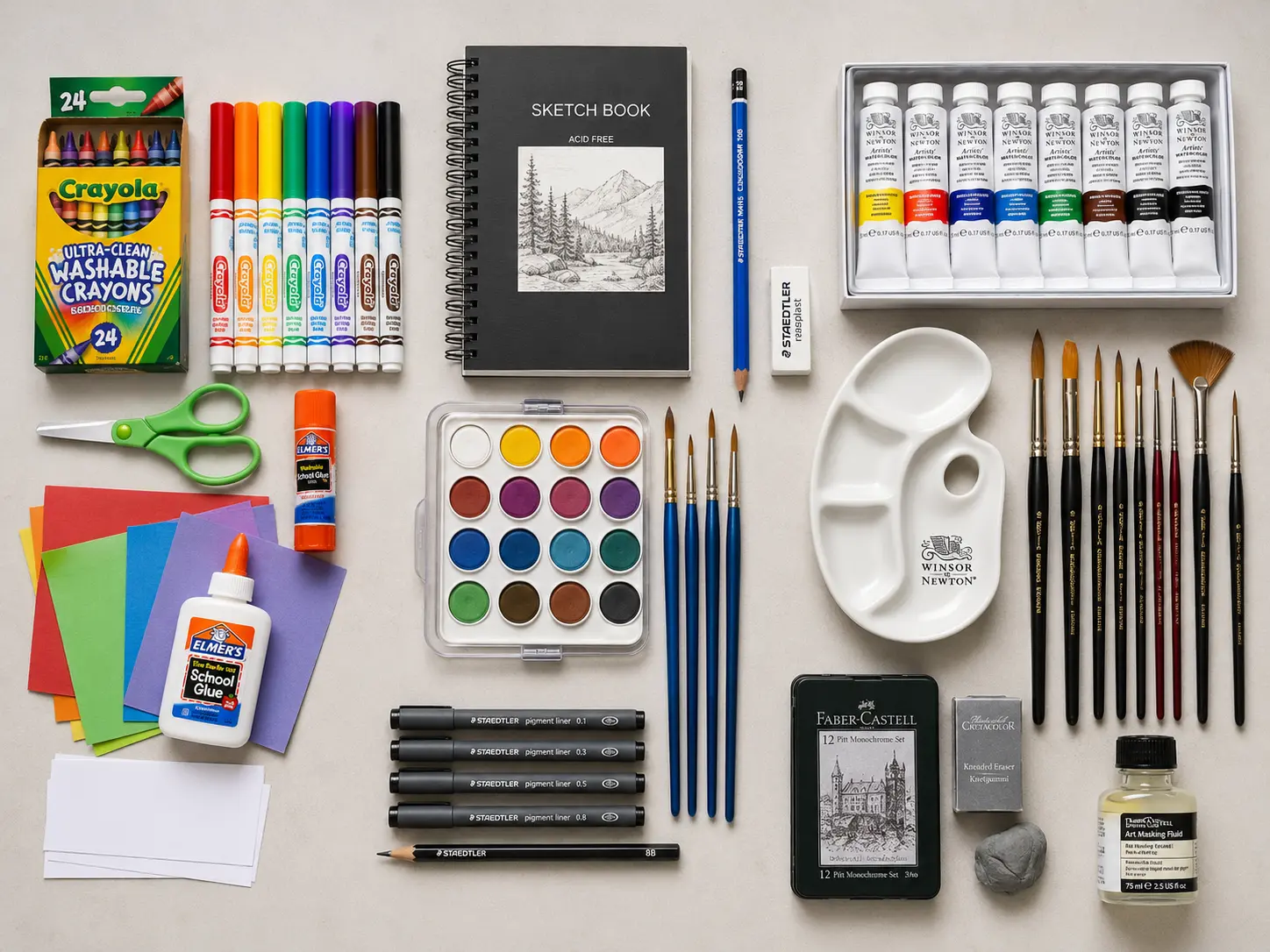
Bottom line by buyer type:
Parent buying for a child (under 12): Prioritize AP-certified non-toxic products; skip artist-grade anything.
Adult beginner: Student-grade materials from established brands (Arteza, Pentel, Faber-Castell Goldfaber line) are correctly calibrated for your stage — and significantly cheaper per session than professional grade.
Serious hobbyist (1+ year in): Ready to invest in professional-grade pigments and tools where it matters (brushes, paints) and save on surfaces/paper.
Selling finished work: Lightfastness and archival stability matter; don't cut corners on pigments or paper grade.
Quick Comparison: Where to Buy Art and Craft Supplies in 2026
Channel | Best For | Price Level | Key Risk |
|---|---|---|---|
Amazon / major e-commerce | Standard supplies, fast delivery, wide assortment | Lowest | Counterfeit risk on premium brands; vet seller carefully |
Michaels / Hobby Lobby / Jo-Ann | Tactile assessment, beginner-friendly staff, easy returns | Mid | Higher prices on identical products vs. online |
Independent art supply stores | Professional-grade materials, expert advice, curated selection | Highest | Limited selection for non-fine-art crafts |
Etsy / handmade marketplaces | Artisan and small-batch materials unavailable elsewhere (natural dyes, handmade tools) | Variable | Quality varies by seller; vet reviews carefully |
Thrift / estate sales | High-quality vintage supplies at fraction of retail | Lowest | Inconsistent availability; some materials may be degraded |
Why the Art and Craft Supply Market Is Harder to Shop in 2026 Than Ever Before
The global arts and crafts market is estimated at $10.26 billion in 2026, projected to reach $16.95 billion by 2035 (Business Research Insights). In the US alone, online hobby and craft supply sales hit $4.3 billion in 2026, up 1.4% year-over-year (IBISWorld).
More market means more SKUs. The average beginner searching "acrylic paint set" on a major online marketplace encounters more than 400 distinct product listings before scrolling past the first page.
There's also a structural feedback loop IBISWorld calls out: social media inspiration drives purchases before buyers have the knowledge to evaluate what they're buying. You see a satisfying resin pour on TikTok, buy a $30 resin kit, then discover resin requires ventilation, UV lamps, and significant practice. The kit sits unused. This isn't a personal failure — it's a predictable outcome in a market designed to convert inspiration into purchase as quickly as possible.
Retailers have also shifted toward higher-margin all-in-one kits. Kits aren't inherently bad, but they obscure whether the contents match your skill level or intended use. This guide gives you the framework to evaluate before you buy — not after.
Step 1: Identify Your Creative Category (This Eliminates Most Bad Purchases)
The arts and crafts market breaks into distinct segments: Painting and Drawing, Sewing and Fabric, Paper Crafts, Kids Crafts, Specialty Tools, and broader hobby areas. Knowing your segment eliminates the majority of irrelevant listings immediately.
The household segment dominates at 52.43% of market share in 2026, driven by two very different buyer groups (Fortune Business Insights):
Parents buying for children's learning and development
Individual adults buying for personal creative projects
Both groups might search "beginner supplies," but their product requirements are completely different.
Before buying anything, get clear on:
What am I making? A specific output (a knitted scarf, watercolor portraits, greeting cards) is more useful than "I want to be creative."
Who is it for? Personal use, gifts, sale, or educational use each carry different quality and durability requirements.
How often will I do this? A weekly practice requires different volume and storage thinking than a single seasonal project.
What is my actual skill level? Student-grade materials are not inferior — they're correctly calibrated for the learning phase and cost significantly less per session.
Personal use vs. commercial use matters: Materials sold for hobbyist use often differ from professional or commercial-grade supplies in pigment load, archival stability, and consistency across batches. If you intend to sell finished work or display it long-term, those differences matter. If you're practicing technique, they often don't.
Step 2: Know Who Makes What You're Buying
The arts and crafts supply market contains legacy fine art brands, mass-market craft manufacturers, direct-to-consumer startups, and artisan producers — each with different quality standards, price strategies, and target audiences.
Key manufacturers active in this space include Faber-Castell AG, Crayola LLC, Pentel, Arteza LLC, and Fiskars Group (Research and Markets, 2026).
What each brand actually means for buyers:
Faber-Castell AG is a German manufacturer with over 260 years of history, widely regarded as a benchmark for drawing and colored pencils. Their Polychromos line uses oil-based pigments with high lightfastness (professional grade). Their Goldfaber line uses the same hexagonal barrel design with lower pigment concentration — a useful starting point for developing artists who aren't yet ready to invest in the Polychromos price tier.
Crayola LLC is correctly positioned as a children's craft brand. Products are non-toxic and designed for educational use. Pigment quality and lightfastness are not suitable for work intended to last — which is fine, because that's not who these products are for.
Arteza LLC entered the market as a direct-to-consumer brand filling the gap between student-grade and professional-grade. Generally acceptable for serious hobbyists who aren't ready for artist-grade pricing. Assortment is broad; quality is consistent for the price tier.
Fiskars Group dominates the cutting tools segment. Their scissors use hardened stainless steel blades with a precision-ground edge that maintains sharpness significantly longer than generic alternatives — the difference becomes obvious after roughly 20 hours of use. Most Fiskars scissor lines carry a lifetime warranty, which is itself a quality signal worth noting.
On retail channels: Hypermarkets and supermarkets hold a 35.56% distribution share in 2026 primarily through price accessibility. The arts and crafts retail professional market is valued separately at $2.98 billion in 2026 (Business Research Insights), reflecting the meaningful scale of dedicated craft retail operating outside mass-market channels.
Step 3: Read the Label, Not the Marketing Copy
Marketing language in this category is aggressively unregulated. "Professional quality," "artist grade," and "premium" can appear on any product regardless of actual composition. The following objective quality signals are what actually matter.
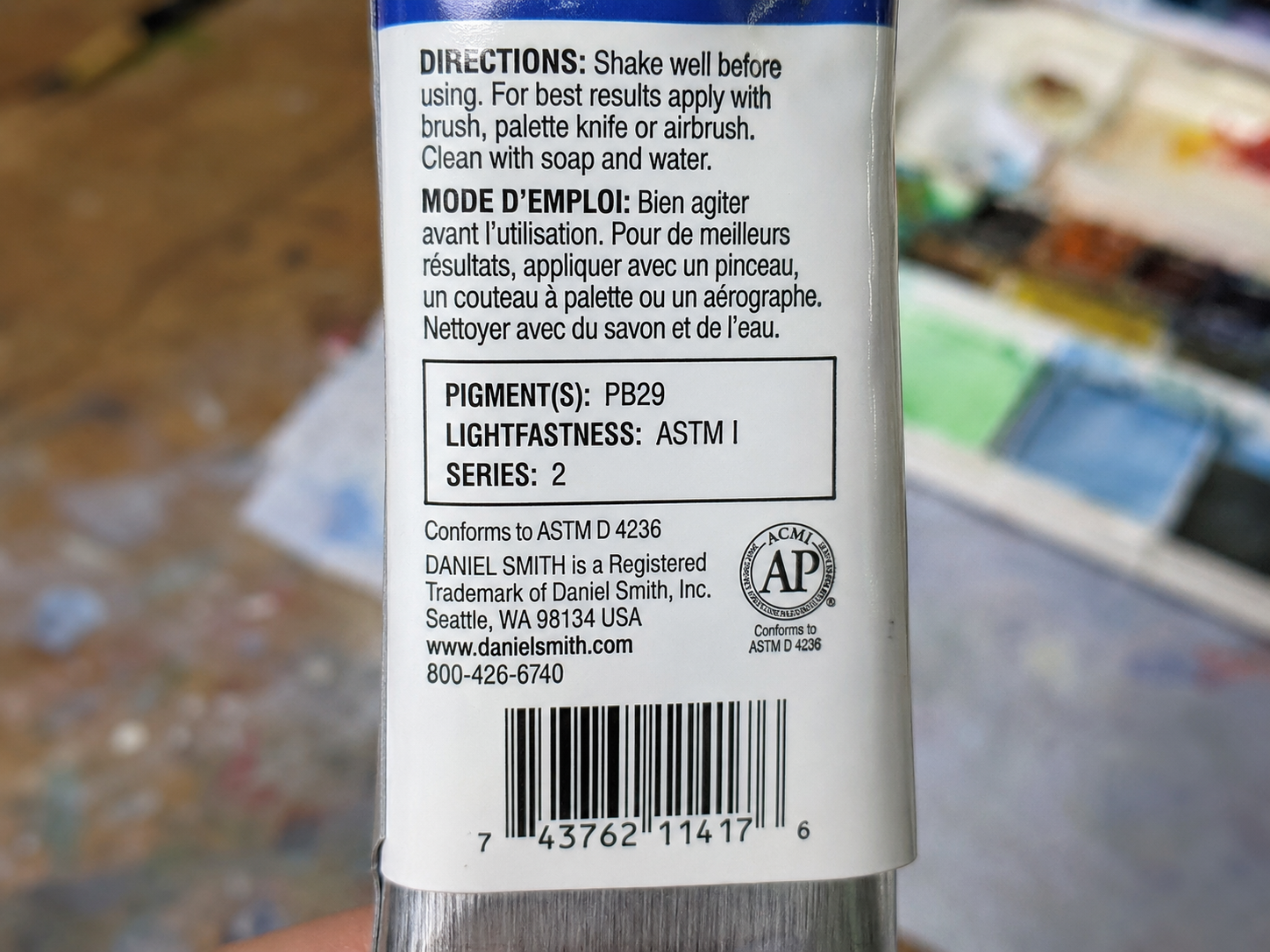
Safety Certifications (Non-Negotiable for Children's Products)
ASTM D4236: The US standard for evaluating art materials for chronic health hazards.
AP (Approved Product) seal from ACMI: Reviewed by a toxicologist, certified non-toxic. For enclosed spaces or children's use, this is required.
EN 71: The European equivalent of ASTM D4236.
Pigment Quality (For Paints, Inks, and Dyes)
The useful information is on the back of the tube, not the front:
Pigment codes (e.g., PB29 for ultramarine blue, PY150 for nickel azo yellow): Single-pigment formulations mix more cleanly and predictably than multi-pigment blends.
Lightfastness rating: ASTM I (excellent) or ASTM II (very good) means the pigment resists fading under light exposure. Student-grade paints often carry ASTM III or no rating at all.
Series number: Higher series numbers indicate more expensive pigments — not inherently better paints, but they explain price differences within a single brand's line.
Paper Specifications
GSM (grams per square meter) is the objective weight measurement. Watercolor paper below 300 GSM will buckle when wet unless stretched or taped. Sketch paper at 90 GSM is suitable for pencil work but will bleed with markers. These aren't preferences — they're physical constraints.
Tools and Hardware
For cutting tools, blade steel quality and pivot tension are the variables that matter. The difference between quality and generic scissors becomes obvious only after sustained use — budget accordingly if you'll be cutting regularly.
Step 4: Evaluate Sustainability Claims Without Getting Greenwashed
Sustainability is a genuine market driver in 2026 — the arts and crafts market's projected 7.4% CAGR through 2030 is partly attributed to demand for sustainable handmade products (Research and Markets, 2026).

The problem: "natural," "eco-friendly," and "green" are unregulated terms on product packaging.
Certifications that carry genuine weight:
FSC (Forest Stewardship Council): For wood and paper products, confirms responsibly managed forest sourcing. Look for this on sketchbooks, wooden tool handles, and mounting boards.
OEKO-TEX Standard 100: For textiles, certifies every component has been tested for harmful substances. Relevant for fabric, yarn, and felt.
USDA Certified Biobased: For adhesives and finishes, confirms the product derives from renewable biological sources rather than petroleum.
Performance trade-offs (real, not marketing):
Natural dyes have lower lightfastness than synthetic alternatives. Indigo fades significantly faster than a synthetic blue dye under UV exposure. For decorative work not exposed to direct sunlight, natural dyes perform well. For functional items that will be washed repeatedly, synthetic dyes maintain an advantage.
Water-based, low-VOC acrylic paints have largely closed the performance gap with solvent-based alternatives for most hobbyist applications. The practical benefit — no solvent smell, no hazardous waste disposal — is significant for anyone working in a home studio or shared space.
The most sustainable purchase option: Secondhand. Estate sales, thrift stores, and online secondhand markets regularly surface high-quality vintage art supplies at a fraction of retail cost. Vintage professional-grade brushes found at an estate sale may outperform new mid-range alternatives simply because older manufacturing standards used higher-grade materials. This isn't nostalgia — it's arbitrage.
Step 5: Choose Your Buying Channel Based on What You're Buying
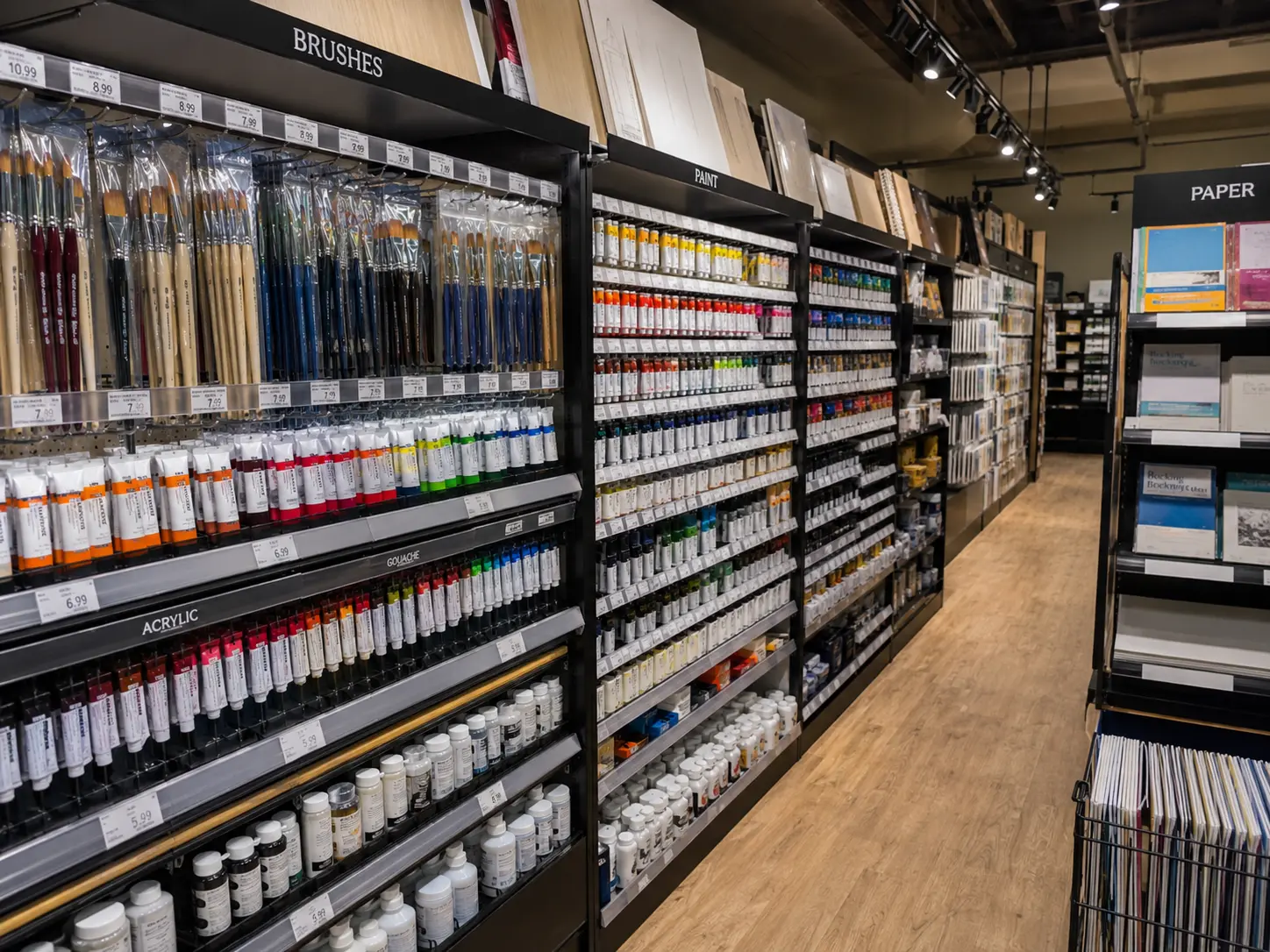
Channel choice affects price, authenticity risk, return options, and the quality of advice you receive. No channel is universally best — the right source depends on what you're buying and how much you already know about it.
Amazon and Major Online Marketplaces
Best for: Standard, widely-reviewed products where you can verify seller reputation.
Risk: Counterfeit Winsor & Newton and Faber-Castell products exist on major marketplaces, sold by third-party sellers at prices that seem reasonable but reflect inferior materials.
Mitigation: Buy from the brand's own storefront on the marketplace, or from sellers with verified purchase reviews specifically mentioning material quality. Read one-star reviews carefully — they often surface authenticity issues that five-star reviews bury.
Specialty Craft Retailers (Michaels, Hobby Lobby, Jo-Ann Stores)
Best for: Beginners who benefit from tactile assessment and staff advice; buyers who want straightforward return policies.
You can feel paper texture, assess brush spring, and compare yarn weights in person. Return policies at these chains are generally customer-friendly, which reduces the risk of a mismatched purchase. Prices are typically higher than online for identical products, but the in-person experience has genuine value for new buyers.
Independent Local Art Supply Stores
Best for: Serious hobbyists making significant investments in a new medium.
These stores typically carry professional-grade materials that big-box chains don't stock. Staff are often practicing artists with direct product experience. You'll pay more, but you're also getting curated selection — the store has already filtered out mediocre products — and advice calibrated to your actual project.
Etsy and Handmade Marketplaces
Best for: Materials that don't exist in mass retail (hand-dyed silk ribbon, small-batch linocut ink, natural plant-dyed yarn, handmade ceramic pottery tools).
For these categories, Etsy is often the only viable source outside of specialty trade suppliers. Evaluate sellers by reviewing their full shop history and reading reviews that mention material quality specifically. A seller with 500 sales and 4.9 stars across reviews mentioning dye lot consistency is meaningfully more reliable than a newer shop with fewer reviews.
Thrift and Estate Sales
Best for: Buyers with some category knowledge who can evaluate quality on sight.
You won't find this in most buyer's guides, but it's worth including: estate sales and thrift stores regularly surface high-quality vintage art supplies in excellent condition. This requires more effort and patience than buying new, but the savings on professional-grade materials can be substantial — and some vintage products are genuinely superior to current equivalents.
Your Pre-Purchase Checklist
Use this before buying any art or craft supplies:
[ ] I know what specific thing I'm making (not just a general creative interest)
[ ] I know who it's for and what quality/durability level that requires
[ ] I've identified my skill level honestly and matched it to the appropriate grade level
[ ] I've checked the back of the label for pigment codes, lightfastness rating, and safety certifications — not just the front
[ ] I've decided on a buying channel based on what I'm buying, not just convenience
[ ] For tools, I've checked for a warranty as a quality signal
[ ] For sustainable products, I've looked for a real certification (FSC, OEKO-TEX, USDA Biobased) rather than unverified claims
[ ] If buying on a marketplace, I've checked the seller's storefront and one-star reviews
Frequently Asked Questions
Is student-grade paint good enough for a serious hobbyist? For most purposes, yes — particularly while you're developing technique. Student-grade paints use lower pigment concentrations and may include fillers, which means colors can shift slightly when mixed and may fade faster over time. For practice work and pieces you won't display long-term, student-grade is the correct choice. When you're consistently producing work you want to keep or sell, that's the signal to move to artist-grade for your most-used colors.
How do I avoid counterfeit art supplies on Amazon? Buy from the brand's own Amazon storefront rather than third-party sellers. Check that the product listing matches the brand's official product photos and descriptions. Read reviews specifically mentioning authenticity or quality, and treat unusually low prices on premium brands as a warning sign rather than a deal.
What's the most common beginner mistake when buying art supplies? Buying to a skill level you're aspiring to rather than where you actually are. Professional-grade supplies don't compensate for technique — they reward technique that's already there. Starting with student-grade materials from a reliable brand, learning the medium, and upgrading specific tools as your needs become clear is almost always the better approach.
Are all-in-one craft kits worth buying? For genuine beginners who aren't sure whether they'll continue a craft, kits reduce the research burden and typically cost less upfront than buying components separately. The trade-off is that kits often include materials calibrated for a specific project — so if you want to go beyond the kit's instructions, you'll quickly find yourself needing individual components anyway. For anyone who already knows they want to pursue a craft seriously, buying components individually usually provides better value and more flexibility.
Where can I find sustainable art supplies that actually perform? Start with brands that carry verified certifications rather than unverified "eco-friendly" claims. For paper: FSC-certified sketchbooks and watercolor paper are widely available from Strathmore and Canson. For textiles: OEKO-TEX certified fabric is available through independent fabric retailers and some Etsy sellers. For paints: Golden and Liquitex both offer water-based, low-VOC formulations that perform comparably to conventional acrylics for most hobbyist applications.